Franciscus
2x President
Supporter
Aventura Resident
Commerce Department
Multiman155
Compliance Officer
- Joined
- Apr 25, 2025
- Messages
- 2,350
- Thread Author
- #1
Case Filing
IN THE DISTRICT COURT OF THE COMMONWEALTH OF REDMONT
CIVIL ACTION
Multiman155
Plaintiff
v.
Federal Reserve Bank,
Defendant;
&
DonTrillions,
Defendant
CIVIL ACTION
Multiman155
Plaintiff
v.
Federal Reserve Bank,
Defendant;
&
DonTrillions,
Defendant
Complaint
On 25 February 2026, the Federal Reserve Bank publicly announced what it described as a “board decision” to move financial institutions onto the Compliant reporting system and require daily API-based reporting. That same day, Plaintiff submitted a Freedom of Information request through the FRB’s official ticket system seeking the records and communications behind that decision. The FRB Governor was present in that ticket.
The law required a response within seven days. The FRB and its Governor did not approve the request, deny it as unreasonable, propose narrowing it, provide a partial release, or offer redactions or a summary. It simply did nothing. Silence is not compliance. Silence is a failure to perform a basic statutory duty.
This case is about enforcing a simple rule of public administration: when a government entity is asked for records about a major public decision, it must answer. The FRB, and its Governor, did not.
I. Parties
- Multiman155 (Plaintiff)
- Federal Reserve Bank (Defendant)
- DonTrillions (Defendant)
II. Facts
- On 25 February 2026, the Federal Reserve Bank (FRB) publicly announced that it would move financial institutions to "Compliant" as the required system for reporting total client deposits, tracking central reserve positions, and monitoring institutional balances (Exhibit P-001).
- The announcement stated that the change was a "board decision," that the transition was mandatory for all financial institutions, and that daily reporting through the Compliant API would be required (Exhibit P-001).
- The announcement further represented that all financial institutions would be expected to provide real-time deposit information through automated API reporting (Exhibit P-001).
- The same afternoon, Plaintiff publicly petitioned against the announced change (Exhibit P-002).
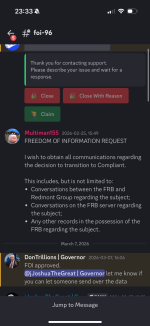
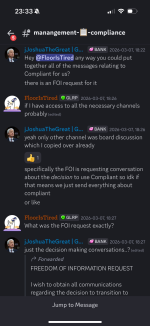
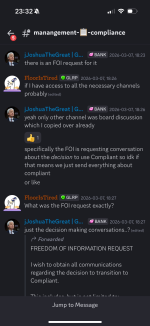
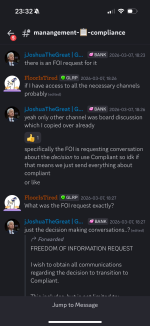
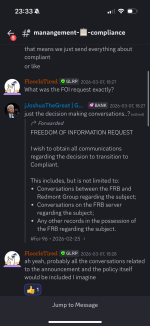
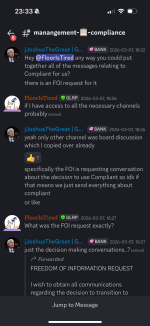
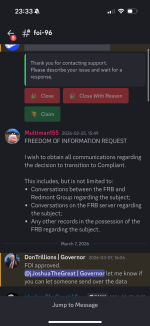
- Also on 25 February 2026, Plaintiff opened ticket #ticket-96 in the FRB’s official ticket system and submitted a Freedom of Information request ("the Request"; see Exhibit P-003).
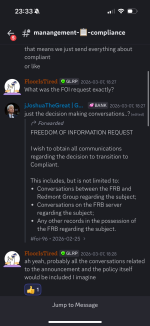
- The Request sought all communications regarding the decision to transition to Compliant, including but not limited to:
- conversations between the FRB and Redmont Group regarding the subject;
- conversations on the FRB server regarding the subject; and
- other records in the possession of the FRB regarding the subject.
- The Request was directed to the FRB and concerned a discrete FRB decision and the records underlying it.
- The Request targeted records held by, maintained by, or accessible to the FRB in its official capacity, including official server communications and other records in FRB possession.
- If Defendants believed any part of the Request was too broad, the law still required a response and the fullest possible compliance by way of narrowing, partial production, redaction, or summary.
- Seven days passed without any response from the FRB nor its Governor as to the Request.
- Plaintiff received no approval, denial, request for clarification, partial release, summary, or explanation of any kind from the FRB nor its Governor with regards to the Request.
- While DonTrillions has publicly stated his intent to depart as FRB governor and train his successor (Exhibit P-009), he still retained the office of the FRB Governor at all times relevant to this case (Exhibits P-007, P-008, P-011).
- On 5 March 2026 Plaintiff provided the Department of Justice with notice of intent to file suit (Exhibit P-006).
- The Department of Justice acknowledged the notice and stated that it would attempt to resolve the matter before suit (Exhibit P-006), but no FRB response followed (Exhibit P-003).
- As of the filing of this complaint, the FRB still has not responded to Plaintiff’s FOI request.
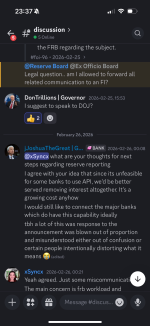
- The public importance of the requested records is heightened by the fact that the FRB announcement described the Compliant transition as a "board decision" (Exhibit P-003), while at least one person publicly identified as a Board Member stated, "talking to board, there was no vote on this" (Exhibit P-004; Exhibit P-005).
- Plaintiff operates the bLAWg, a news organization (Exhibit P-010).
- The mission of the bLAWg is cover to updates in the business community, legal community, and beyond (Exhibit P-010).
- Plaintiff has been de facto prohibited timely access to records sought to evaluate the lawfulness, process, and factual basis of a major FRB policy announcement affecting all financial institutions.
- The de facto prohibition on timely access has harmed the ability of the bLAWg to engage in investigative reporting regarding the subject of the Request.
- On 7 March, ElysiaCrynn and FloorIsTired (among others) conversed in #economics about this lawsuit (Exhibits P-015, P-016, and P-017).
- In the conversation described within Fact 21, Ex-Officio FRB Board Member ElysiaCrynn publicly expressed that she was "pretty sure [she] saw some stuff for it get deleted" (Exhibit P-016).
- In the conversation described within Fact 21, FRB Employee FloorIsTired publicly expressed that "they deleted the template" and "they deleted the announcement without consulting me" (Exhibit P-016).
- After receiving the freedom of information request in Ticket-96, and before responding to it, the FRB or its agents deleted messages potentially responsive to that FOI request (Exhibits P-015, P-016, and P-017).
III. Claims for Relief
III.I Failure to Respond to Freedom of Information
Plaintiff alleges that the Defendants violated the Redmont Civil Code Act (RCCA) by failing to respond to Plaintiff’s valid FOI request within the time required by law.Failure to Respond to Freedom of Information is a tort under RCCA, Part XI, Section II:
2. Failure to Respond to Freedom of Information
Violation Type: Strict Liability
Penalty: Up to 50 Civil Penalty Units; Writ of Mandamus
A person commits a violation if the person:
(a) unreasonably delays or fails to respond to a valid Freedom of Information request within the time limits prescribed by law.
Relevant Law: Act of Congress - Classified Materials Act
The Classified Material Act (CMA), which sets the "time limits prescribed by law" referred to in the RCCA, requires that FOI requests to government entities receive a response within seven days (CMA, Section 8(2)). For requests submitted to the FRB, the responsible officer is the FRB Governor (CMA, Section 8(5)(d)). The government must comply with reasonable FOI requests to the fullest extent possible, including through partial release, redaction, or summary where full disclosure would be unlawful or harmful (CMA, Section 8(6)).
Plaintiff submitted an FOI request to the FRB on 25 February 2026 through the FRB’s official ticket system. The request sought records and communications regarding the announced transition to Compliant. Defendants gave no response at all within the statutory period.
The materials sought were facially within the FRB’s possession, jurisdiction, or knowledge. Defendants were still required to respond within seven days by approving the request, denying it as unreasonable, or complying to the fullest lawful extent through narrowing, partial release, redaction, or summary. Defendants did none of those things.
Plaintiff does not claim any special press-only entitlement to government records beyond the law. Rather, Plaintiff relies on the Classified Materials Act, which grants FOI rights to any individual or entity and requires a response within seven days. But the Court should construe that statutory right in light of the Constitution’s protection of Freedom of the Press and Media. Where a news organization seeks records concerning a major public financial decision, silence by the government does more than violate a statute; it frustrates timely public scrutiny and impairs the ability of the press to inform the public on a matter of immediate importance.
As such, defendants committed Failure to Respond to Freedom of Information, and Plaintiff is entitled to a writ of mandamus and the statutory civil penalty.
III.II Failure to Perform Statutory Duty
We now examine whether the Defendants, as a government body and responsible officer, failed to perform a duty required by law.Failure to Perform Statutory Duty is a tort under Redmont Civil Code Act Part XI, Section 7:
7. Failure to Perform Statutory Duty
Violation Type: Negligent
Remedy: Writ of Mandamus
A person commits a violation if the person:
(a) being a government officer or body, fails to perform a duty required by law; and
(b) the failure causes harm to the plaintiff.
This violation shall not occur where:
(c) The failure was due to circumstances beyond the defendant’s control.
As discussed supra in Claim for Relief III.I of this complaint, a legal duty to timely respond to Plaintiff’s FOI request is imposed by the RCCA and CMA. In addition, the Federal Reserve Act (FRA) requires that the FRB "be transparent about its operations, only limited by the reasonable adverse effects of this transparency" (FRA, Section 4(2)(c)).
Plaintiff alleges that the following duties were breached:
- The duty to respond to Freedom of Information requests imposed by RCCA, Part XI, Section II; and
- The duties of the FRB Governor under CMA, Sections 8(2), 8(5)(d), and 8(6);
- The duty of the FRB itself to be transparent under FRA, Section 4(2)(c).
Defendants, therefore, committed Failure to Perform Statutory Duty, and Plaintiff is entitled to mandamus compelling a lawful response and production process.
III.III On Original Jurisdiction and Parties joined to this case
III.III.I The Constitution grants the District Court original jurisdiction over this case
"The Constitution is the highest law of the Commonwealth. It binds all institutions, people, and overrides any law or authority that conflicts with it" (Const., Preamble). This Constitution lays out the original jurisdiction of the District Court, granting it original jurisdiction over both "public official misconduct" (Const. 16(1)(c)) and "minor civil cases whose value does not exceed more than $120,000 dollars" (Const. 16(1)(e)).This case is a minor civil case whose value does not exceed more than $120,000. Even if we were to read either tort as public official misconduct, the District Court would retain constitutional jurisdiction over this case.
I note this only because the text of the Classified Materials Act purports to grant the Federal Court jurisdiction over challenges to ignored and denied FOI requests "made to the Executive or Congress" (CMA, Section 8(7)(a)), stating that upon denial or failure to respond "that the appeal shall be lodged in the Federal Court in the first instance. The Judiciary shall order the full or partial release of the material if it determines that the request was reasonable. The Court may impose redactions or conditions on any such disclosure" (ibid.).
Statute cannot override the Constitution, and attempts to modify the Constitution "with statute must fail because the Constitution is the supreme law of the land" (In re [2023] SCR 5 | [2026] SCR 4, Decision, Par. 15). As such, the District Court retains jurisdiction here, regardless of statute that would purport to strip jurisdiction therefrom.
III.III.II The FRB, and its governor, are both direct parties to this case.
III.III.II.I The FRB Governor may bear some personal liability for Failure to Respond to Freedom of InformationRCCA, Part XI, Section II notes that a person commits the violation of Failure to Respond to Freedom of Information, when that person "unreasonably delays or fails to respond to a valid Freedom of Information request within the time limits prescribed by law".
Plaintiff recognizes that, within Redmont, "it is well established that when a government department causes harm through its officers, liability attaches to the department itself" (YeetGlazer v. Commonwealth of Redmont [2025] FCR 76, Verdict, "Opinion and Analysis of the Court", "On Colour of Law and Institutional Liability", Par. 3). This liability need not solely arise "on a theory of respondeat superior, but on the independent ground that the Department's own policies, customs, and failures of supervision were the proximate cause of the Plaintiff's injuries. Where the policy of an institution is indifference to the rights of those subject to its authority, the institution bears responsibility for the foreseeable consequences of that indifference" (id., Par. 7). When an individual acts using the power of the underlying government institution, thus, that institution may be held liable.
This case may be different; the duty to handle Freedom of Information requests is imposed directly upon the "The FRB Governor" (CMA, Section 8(3)(d)). The liability for this violation, therefore, may lie (in whole, or in part) with the Governor himself.
As his personal rights may be implicated by the relief sought here, the FRB Governor must be listed as a direct party (see generally: MasterCaelen v. Hon. Magistrate Dr_Eksplosive [2026] FCR 14); he is thus included as a Defendant.
III.III.II.II The Federal Reserve Bank is nevertheless a Direct Party for its to adhere to FRA 4(2)(c)
The Federal Reserve Bank is a governmental entity (and thus a distinct legal entity) under the law (Legal Entity Act, Part II, Section 5(d)). As "Legal entities shall be a legal person with separate rights and liabilities, strictly distinct from their directors, managers, members, shareholders, employees and other agents" (Legal Entity Act, Part I, Section 2(b)), the legal liability from the FRB's duty to be transparent under FRA Section 4(2)(c) thus attaches directly to the FRB. The FRB itself is, thus, a direct party to this case, regardless of how liability attaches for the claim discussed in Claim for Relief III.I.
III.IV Abuse of Power and Misfeasance in Public Office
Plaintiff alleges that Defendant (or Defendant's agents) caused the Plaintiff harm and violated:- The Criminal Code Act's prohibition on abuse of power. Plaintiff alleges that the Defendant unlawfully deleted messages sought in the Plaintiff's FOI, with knowledge of or reckless disregard as to whether those deletions were lawful.
- The Redmont Civil Code Act's prohibition of misfeasance in public office. Plaintiff alleges that Defendant, or a director thereof, unlawfully and intentionally deleted messages, that this deletion caused harm to the Plaintiff inasmuch as it frustrated recovery of the information through FOI, and that one knew or ought to have known that deleting such messages after an FOI request was filed would be illegal.
(CCA, Part II, Section 2).(a) exercises any power, function, or duty vested in them by virtue of their position as members of the Executive, Legislative, or Judicial branches, or employee of a government agency, in contravention of the law; and
(b) either:
(i) knows that the exercise of power is unlawful; or
(ii) acts with reckless disregard as to whether the exercise of power is lawful.
Under the Redmont Civil Code Act, a person commits misfeasance in public office when that person:
(RCCA, Part XI, Section 3).(a) being a public official, intentionally misuses their power; and
(b) the misuse causes harm to the plaintiff; and
(c) the official knew or ought to have known that the conduct was unlawful.
When an action that harms a Plaintiff would constitute crime under the Criminal Code and a violation of the RCCA, a Plaintiff may "pursue both, provided that there is no double recovery for the same loss" (RCCA, Part II, Section 4(3)(c). The Plaintiff sees that these two laws prohibit very similar things, and chooses to pursue both as it pertains to the deletion of messages.
III.IV.I The FRB has a lawful duty to transparency under the Federal Reserve Act
The Federal Reserve Bank has a statutory duty to "be transparent about its operations, only limited by the reasonable adverse effects of this transparency" (FRA, Section 4(2)(c)). The powers and duties of the FRB as a whole vest in its Board; "[a]ny authority or power given to the FRB as a whole shall be regarded as given to the Federal Reserve Board" (FRA, Section 5(1)(d)). The composition of the FRB's Board is "4 seats for Sitting Board Members and additionally 1 ex officio seat for the Secretary of the Department of Commerce" (FRA, Section 5(1)(c)).III.IV.II The FRB is obligated to comply with FOI requests to the fullest extent possible
The Classified Materials Act establishes that "[t]he Government is obligated to comply with all reasonable FOI requests to the fullest extent possible, including through partial releases, redactions, or summaries where full disclosure would be unlawful or harmful" (Classified Materials Act, Section 8(6)). The FRB is included in this obligation of the "Government"; it a governmental entity (LEA, Part II, Section 1(5)(d)) created directly by a statute (Federal Reserve Act).III.IV.III Deletion of messages sent by another is an exercise of power granted by one's role
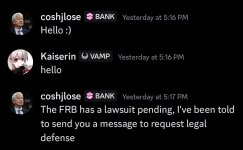
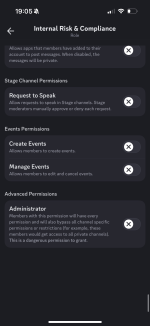
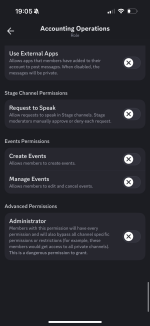
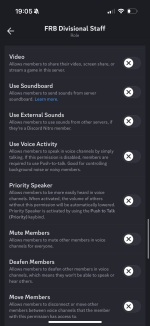
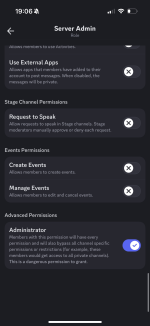
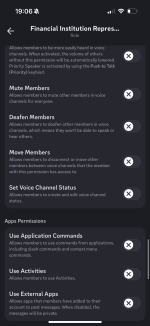
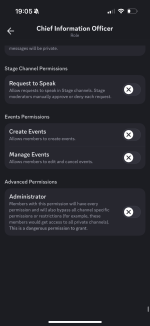
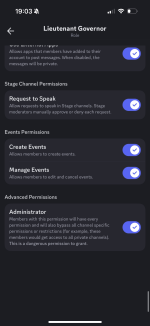
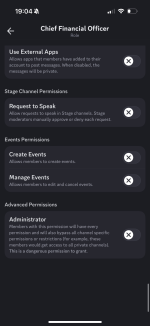
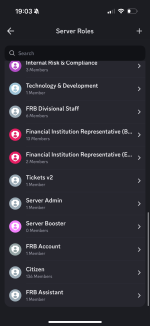
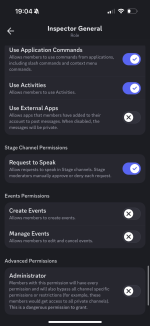
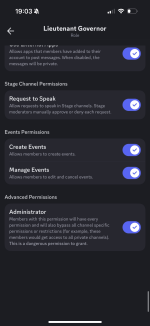
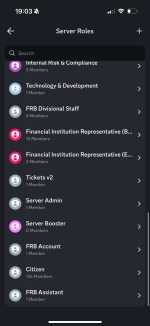
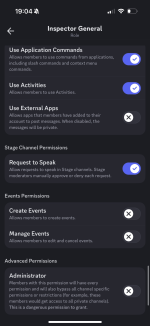
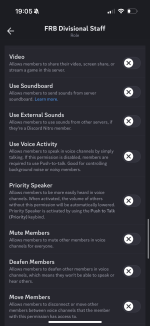
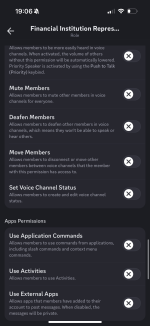
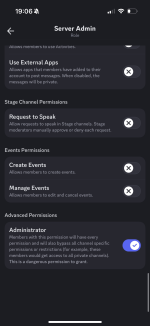
Deletion of another's message is a privileged administrative function (see: Exhibits P-021 and P-024). Permissions required to delete another's message in the FRB are not available to everyone (see: Exhibit P-025). Roles in the server are set up in a way that aligns with one's relationship with the FRB (see: Exhibit P-026); Reserve Members, the Reserve Governor, FRB employees, and FI reps are given different roles from ordinary people. The Plaintiff understands that certain people have the ability to delete messages sent by others (see: Exhibit P-016, FloorIsTired saying "they deleted the announcement"; Exhibit P-001, for FloorIsTired's announcement).III.IV.IV The FRB unlawfully deleted records plausibly related to the Plaintiff's FOI request after the request was filed
ElysiaCrynn, at all times relevant, held a position a member of the Reserve Board as an ex-officio member in her capacity as Secretary of Commerce (Exhibits P-018 P-019; FRA, Sections 3(6)(b), 5(1)(b), 5(1)(h)). FloorIsTired, meanwhile, has served as an employee of the FRB at all times relevant (Exhibit P-001 through P-003, P-020).In discovery, the Plaintiff submitted additional information relating to the deletion of information that was potentially responsive to the Plaintiff's FOI request. Among these were candid admissions by ElysiaCrynn and FloorIsTired that relevant information was deleted (Exhibits P-015, P-016, and P-017). Indeed, the public statements "stand[] unrebutted, uncontradicted, and unimpeached. It is a confession from within the walls of the Department itself" (YeetGlazer v. Commonwealth of Redmont [2025] FCR 76, Order of the Court, Section V.B, Par. 4). While the Plaintiff has shown one specific instance of deletion in the Emergency Injunction request within Post No. 2, admissions in a public forum thus show that more was deleted.
On balance of probabilities, a privileged actor in the FRB deleted messages that were sent by others. After all, FloorIsTired publicly stated that "they deleted the template" and "they deleted the announcement without consulting me" (Exhibit P-016). From the context of the conversation, "they" refers plainly to the Board of the FRB itself.
As shown Sections III.I, III.II, III.IV.I and III.IV.II, the FRB has obligations under the law to be transparent and fulfil FOI requests to the fullest extent possible. Deletion of material violates both of these lawful obligations.
As deletion here was "committed by government agents wielding powers available to them solely by virtue of their offices" (YeetGlazer v. Commonwealth of Redmont [2025] FCR 76, Verdict, Opionion and Analysis of the Court, On Colour of Law and Institutional Liability, Par. 1) and as "it is well established that when a government department causes harm through its officers, liability attaches to the department itself" (id., Par. 2), the FRB is ultimately responsible for these deletions.
III.IV.V The Plaintiff was harmed by deletions
The FOI returns provided by the FRB did not appear to contain the information that the FRB's employees had said was deleted (see: Exhibits P-022 and P-023). The returns did not appear to contain any sort of "draft" that ElysiaCrynn and FloorIsTired publicly discussed as having been deleted (see: Exhibit P-016), nor the "template" publicly mentioned as deleted by FloorIsTired (id.). The deletion of these documents caused harm to the Plaintiff inasmuch as they frustrated the Plaintiff's ability to obtain them via FOI.III.IV.VI The FRB knew, or ought to have known, that deleting material sought in a reasonable FOI request would be illegal; the deletion occurred with (at minimum) reckless disregard for the law
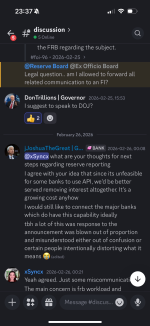
In Ticket No. 96, in which the FOI request was filed, present were then-FRB Board members DonTrillions, jJoshuaTheGreat, and xSyncx (see: Exhibit P-002). Each of them were pinged by role when the ticket was opened (Exhibit P-027). As "[a]ny authority or power given to the FRB as a whole shall be regarded as given to the Federal Reserve Board" (FRA, Section 5(1)(d)), the FRB knew (or should have known) that an FOI was pending - the FOI was requested a mere two minutes after the ticket was opened (Exhibit P-003). It should be plainly obvious that deleting information sought in that FOI request would be illegal for the FRB to do, given its mandate of transparency and its obligations to fulfil FOIs.At minimum, deleting relevant information after having been informed of a pending FOI constitutes reckless disregard for the law. The FRB, in deleting related content (as described in Exhibits P-015, P-016, and P-017) did this.
III.IV.VII FRB Board Members hold public office
Public office is "Any position to which a person may be elected or nominated to" (Const. 54).There are two types of board members on the FRB: "Sitting Board Member is a Member of the Board who was confirmed into the position. ... Ex Officio Board Member is a member who holds the seat by virtue of being Department of Commerce Secretary" (FRA, Section 3(6)(a)-(b)). Sitting board members are nominated to the role: "Sitting Board Members shall be nominated by the House of Representatives with a majority, and confirmed by the Senate with a supermajority" (FRA, section 5(1)(i)). The ex officio member is a Cabinet Secretary, who must be nominated and confirmed by the Senate before sitting in office (Const. 4(4)). As such, all FRB Board members, including the ex officio member, hold the position as a result of being in public office.
III.IV.VIII No exceptions under the law saves the FRB
The Abuse of Power definition provides possible defenses: (1) that a good-faith mistake was made as to legality; and (2) that the action was performed on advice of counsel (CCA, Part II, Section 1(c)-(d)). The former is not plausible here - one cannot make a good faith mistake as to legality by deleting information plausibly resonsive to an FOI request after seeing the FOI request come in. The latter is also unlikely: the Defense has not demonstrated that these deletions were on advice of counsel, and the Department of Justice seems to have heard crickets from the FRB at the relevant times (Exhibit P-006).IV. Prayer for Relief
Plaintiff prays that the Court enter judgment providing the following relief:- Declaratory Judgement.Plaintiff prays that the Court declare:
- That Plaintiff’s FOI request was valid;
- That Defendants committed Failure to Respond to Freedom of Information in violation of RCCA, Part XI, Section 2;
- That FRB Governor Dontrillions committed Failure to Perform Statutory Duty in violation of RCCA, Part XI, Section 7, by failing to perform duties of the FRB Governor under CMA, Sections 8(2) and 8(5)(d);
- That the governmental entity known as the Federal Reserve Bank committed Failure to Perform Statutory Duty in violation of RCCA, Part XI, Section 7, by failing to perform duties of the government under CMA Section 8(6) and by failing to "be transparent about its operations" as required by FRA Section 4(2)(c).
- That the FRB, through its agents, caused harm to the Plaintiff arising from Abuse of Power, in violation of CCA, Part II, Section 1.
- That the FRB, through its agents, caused harm to the Platintiff arising from Misfeasance in Public Office, in violation of RCCA, Part XI, Section 3.
- Injunctive Relief.Plaintiff prays that the Court issue the following injunctive relief:
- A Writ of Mandamus ordering Defendants to formally respond to Plaintiff’s 25 February 2026 FOI request within 72 hours of judgment.
- A Writ of Mandamus requiring Defendants to produce all responsive non-exempt records held by or accessible to the FRB in official channels, files, tickets, motions, votes, orders, and maintained correspondence, within a deadline set by the Court.
- A Writ of Mandamus requiring that, for any responsive material withheld in whole or in part, Defendants must identify the category of material withheld and state the specific legal grounds for withholding it.
- A Writ of Mandamus requiring partial release, redactions, summaries, or other tailored disclosure to the fullest extent possible if the Court concludes that any portion of the request cannot lawfully be released in full.
- A preservation order preventing the deletion, destruction, or alteration of responsive records, including official FRB server messages, tickets, board motions, votes, gubernatorial orders, and external communications held by the FRB relating to the Compliant transition.
- Monetary Relief. The Plaintiff prays that this Court order the following Monetary Relief and/or damages:
- Civil Penalties. For Failure to Respond to Freedom of Information (Claim III.I): A civil penalty of up to 50 Civil Penalty Units, as authorized under RCCA, Part XI, Section II.
- Punitive damages. Deleting information sought in an FOI request after such a request has been filed is plainly outrageous. For violations of the Criminal Code Act's prohibition on Abuse of Power and the Redmont Civil Code Act's prohibition of Misfeasance in Public Office, punitive damages in the amount of $25,000 are sought, in line with RCCA, Part III, Section 3.
- Nominal Damages. For Failure to Perform Statutory Duty (Claim III.II): Nominal Damages in the amount of $7,500 from each defendant, as authorized under RCCA, Part III, Section 4.
- Legal Fees. As a pro-se litigant, Plaintiff seeks legal fees equal to 30% of the total case value, pursuant to RCCA, Part III, Sections 7(2)(a) and 7(2)(h).
- Other Relief. Such other and further monetary or equitable relief as the Court deems just and proper.
V. Evidence
VI. Witness List
- Multiman155
- DonTrillions
- jJoshuaTheGreat
- FloorIsTired
- xSyncx
- Kaiserin_
VII. Attestation
By making this submission, I agree I understand the penalties of lying in court and the fact that I am subject to perjury should I knowingly make a false statement in court.
DATED: This 7 day of March 2026
Last edited: