Lawsuit: Pending Multiman155 v. Federal Reserve Bank & DonTrillions [2026] DCR 29

Franciscus

26th President
State Department
Congressional Staff
Supporter
Oakridge Resident
Homeland Security Department
Health Department
President
Multiman155
Multiman155
Electoral Manager
Joined
Apr 25, 2025
Messages
1,564

Case Filing


IN THE DISTRICT COURT OF THE COMMONWEALTH OF REDMONT
CIVIL ACTION

Multiman155
Plaintiff

v.

Federal Reserve Bank,
Defendant;
&
DonTrillions,
Defendant


Complaint​

On 25 February 2026, the Federal Reserve Bank publicly announced what it described as a “board decision” to move financial institutions onto the Compliant reporting system and require daily API-based reporting. That same day, Plaintiff submitted a Freedom of Information request through the FRB’s official ticket system seeking the records and communications behind that decision. The FRB Governor was present in that ticket.

The law required a response within seven days. The FRB and its Governor did not approve the request, deny it as unreasonable, propose narrowing it, provide a partial release, or offer redactions or a summary. It simply did nothing. Silence is not compliance. Silence is a failure to perform a basic statutory duty.

This case is about enforcing a simple rule of public administration: when a government entity is asked for records about a major public decision, it must answer. The FRB, and its Governor, did not.


I. Parties​

  1. Multiman155 (Plaintiff)
  2. Federal Reserve Bank (Defendant)
  3. DonTrillions (Defendant)


II. Facts​

  1. On 25 February 2026, the Federal Reserve Bank (FRB) publicly announced that it would move financial institutions to "Compliant" as the required system for reporting total client deposits, tracking central reserve positions, and monitoring institutional balances (Exhibit P-001).
  2. The announcement stated that the change was a "board decision," that the transition was mandatory for all financial institutions, and that daily reporting through the Compliant API would be required (Exhibit P-001).
  3. The announcement further represented that all financial institutions would be expected to provide real-time deposit information through automated API reporting (Exhibit P-001).
  4. The same afternoon, Plaintiff publicly petitioned against the announced change (Exhibit P-002).
  5. Also on 25 February 2026, Plaintiff opened ticket #ticket-96 in the FRB’s official ticket system and submitted a Freedom of Information request ("the Request"; see Exhibit P-003).
  6. The Request sought all communications regarding the decision to transition to Compliant, including but not limited to:
    1. conversations between the FRB and Redmont Group regarding the subject;
    2. conversations on the FRB server regarding the subject; and
    3. other records in the possession of the FRB regarding the subject.
  7. The Request was directed to the FRB and concerned a discrete FRB decision and the records underlying it.
  8. The Request targeted records held by, maintained by, or accessible to the FRB in its official capacity, including official server communications and other records in FRB possession.
  9. If Defendants believed any part of the Request was too broad, the law still required a response and the fullest possible compliance by way of narrowing, partial production, redaction, or summary.
  10. Seven days passed without any response from the FRB nor its Governor as to the Request.
  11. Plaintiff received no approval, denial, request for clarification, partial release, summary, or explanation of any kind from the FRB nor its Governor with regards to the Request.
  12. While DonTrillions has publicly stated his intent to depart as FRB governor and train his successor (Exhibit P-009), he still retained the office of the FRB Governor at all times relevant to this case (Exhibits P-007, P-008, P-011).
  13. On 5 March 2026 Plaintiff provided the Department of Justice with notice of intent to file suit (Exhibit P-006).
  14. The Department of Justice acknowledged the notice and stated that it would attempt to resolve the matter before suit (Exhibit P-006), but no FRB response followed (Exhibit P-003).
  15. As of the filing of this complaint, the FRB still has not responded to Plaintiff’s FOI request.
  16. The public importance of the requested records is heightened by the fact that the FRB announcement described the Compliant transition as a "board decision" (Exhibit P-003), while at least one person publicly identified as a Board Member stated, "talking to board, there was no vote on this" (Exhibit P-004; Exhibit P-005).
  17. Plaintiff operates the bLAWg, a news organization (Exhibit P-010).
  18. The mission of the bLAWg is cover to updates in the business community, legal community, and beyond (Exhibit P-010).
  19. Plaintiff has been de facto prohibited timely access to records sought to evaluate the lawfulness, process, and factual basis of a major FRB policy announcement affecting all financial institutions.
  20. The de facto prohibition on timely access has harmed the ability of the bLAWg to engage in investigative reporting regarding the subject of the Request.


III. Claims for Relief​

III.I Failure to Respond to Freedom of Information​

Plaintiff alleges that the Defendants violated the Redmont Civil Code Act (RCCA) by failing to respond to Plaintiff’s valid FOI request within the time required by law.

Failure to Respond to Freedom of Information is a tort under RCCA, Part XI, Section II:

2. Failure to Respond to Freedom of Information
Violation Type: Strict Liability
Penalty: Up to 50 Civil Penalty Units; Writ of Mandamus
A person commits a violation if the person:
(a) unreasonably delays or fails to respond to a valid Freedom of Information request within the time limits prescribed by law.
Relevant Law: Act of Congress - Classified Materials Act

The Classified Material Act (CMA), which sets the "time limits prescribed by law" referred to in the RCCA, requires that FOI requests to government entities receive a response within seven days (CMA, Section 8(2)). For requests submitted to the FRB, the responsible officer is the FRB Governor (CMA, Section 8(5)(d)). The government must comply with reasonable FOI requests to the fullest extent possible, including through partial release, redaction, or summary where full disclosure would be unlawful or harmful (CMA, Section 8(6)).

Plaintiff submitted an FOI request to the FRB on 25 February 2026 through the FRB’s official ticket system. The request sought records and communications regarding the announced transition to Compliant. Defendants gave no response at all within the statutory period.

The materials sought were facially within the FRB’s possession, jurisdiction, or knowledge. Defendants were still required to respond within seven days by approving the request, denying it as unreasonable, or complying to the fullest lawful extent through narrowing, partial release, redaction, or summary. Defendants did none of those things.

Plaintiff does not claim any special press-only entitlement to government records beyond the law. Rather, Plaintiff relies on the Classified Materials Act, which grants FOI rights to any individual or entity and requires a response within seven days. But the Court should construe that statutory right in light of the Constitution’s protection of Freedom of the Press and Media. Where a news organization seeks records concerning a major public financial decision, silence by the government does more than violate a statute; it frustrates timely public scrutiny and impairs the ability of the press to inform the public on a matter of immediate importance.

As such, defendants committed Failure to Respond to Freedom of Information, and Plaintiff is entitled to a writ of mandamus and the statutory civil penalty.

III.II Failure to Perform Statutory Duty​

We now examine whether the Defendants, as a government body and responsible officer, failed to perform a duty required by law.

Failure to Perform Statutory Duty is a tort under Redmont Civil Code Act Part XI, Section 7:

7. Failure to Perform Statutory Duty
Violation Type: Negligent
Remedy: Writ of Mandamus
A person commits a violation if the person:
(a) being a government officer or body, fails to perform a duty required by law; and
(b) the failure causes harm to the plaintiff.
This violation shall not occur where:
(c) The failure was due to circumstances beyond the defendant’s control.

As discussed supra in Claim for Relief III.I of this complaint, a legal duty to timely respond to Plaintiff’s FOI request is imposed by the RCCA and CMA. In addition, the Federal Reserve Act (FRA) requires that the FRB "be transparent about its operations, only limited by the reasonable adverse effects of this transparency" (FRA, Section 4(2)(c)).

Plaintiff alleges that the following duties were breached:
  1. The duty to respond to Freedom of Information requests imposed by RCCA, Part XI, Section II; and
  2. The duties of the FRB Governor under CMA, Sections 8(2), 8(5)(d), and 8(6);
  3. The duty of the FRB itself to be transparent under FRA, Section 4(2)(c).
The FRB had a statutory duty to answer Plaintiff’s FOI request. The Governor had the statutory role for handling FRB FOI matters and the broader legal responsibility to ensure compliance with law. Plaintiff was harmed by that failure because the nonresponse deprived him of timely access to records concerning a major public FRB action, impaired his ability to assess whether the announced “board decision” was lawfully made, and frustrated journalistic scrutiny of a matter affecting all financial institutions.

Defendants, therefore, committed Failure to Perform Statutory Duty, and Plaintiff is entitled to mandamus compelling a lawful response and production process.

III.III On Original Jurisdiction and Parties joined to this case​

III.III.I The Constitution grants the District Court original jurisdiction over this case​

"The Constitution is the highest law of the Commonwealth. It binds all institutions, people, and overrides any law or authority that conflicts with it" (Const., Preamble). This Constitution lays out the original jurisdiction of the District Court, granting it original jurisdiction over both "public official misconduct" (Const. 16(1)(c)) and "minor‌ ‌civil‌ ‌cases‌ ‌whose‌ ‌value‌ ‌does‌ ‌not‌ ‌exceed‌ more than $120,000 dollars" (Const. 16(1)(e)).

This case is a minor civil case whose value does not exceed more than $120,000. Even if we were to read either tort as public official misconduct, the District Court would retain constitutional jurisdiction over this case.

I note this only because the text of the Classified Materials Act purports to grant the Federal Court jurisdiction over challenges to ignored and denied FOI requests "made to the Executive or Congress" (CMA, Section 8(7)(a)), stating that upon denial or failure to respond "that the appeal shall be lodged in the Federal Court in the first instance. The Judiciary shall order the full or partial release of the material if it determines that the request was reasonable. The Court may impose redactions or conditions on any such disclosure" (ibid.).

Statute cannot override the Constitution, and attempts to modify the Constitution "with statute must fail because the Constitution is the supreme law of the land" (In re [2023] SCR 5 | [2026] SCR 4, Decision, Par. 15). As such, the District Court retains jurisdiction here, regardless of statute that would purport to strip jurisdiction therefrom.

III.III.II The FRB, and its governor, are both direct parties to this case.​

III.III.II.I The FRB Governor may bear some personal liability for Failure to Respond to Freedom of Information
RCCA, Part XI, Section II notes that a person commits the violation of Failure to Respond to Freedom of Information, when that person "unreasonably delays or fails to respond to a valid Freedom of Information request within the time limits prescribed by law".

Plaintiff recognizes that, within Redmont, "it is well established that when a government department causes harm through its officers, liability attaches to the department itself" (YeetGlazer v. Commonwealth of Redmont [2025] FCR 76, Verdict, "Opinion and Analysis of the Court", "On Colour of Law and Institutional Liability", Par. 3). This liability need not solely arise "on a theory of respondeat superior, but on the independent ground that the Department's own policies, customs, and failures of supervision were the proximate cause of the Plaintiff's injuries. Where the policy of an institution is indifference to the rights of those subject to its authority, the institution bears responsibility for the foreseeable consequences of that indifference" (id., Par. 7). When an individual acts using the power of the underlying government institution, thus, that institution may be held liable.

This case may be different; the duty to handle Freedom of Information requests is imposed directly upon the "The FRB Governor" (CMA, Section 8(3)(d)). The liability for this violation, therefore, may lie (in whole, or in part) with the Governor himself.

As his personal rights may be implicated by the relief sought here, the FRB Governor must be listed as a direct party (see generally: MasterCaelen v. Hon. Magistrate Dr_Eksplosive [2026] FCR 14); he is thus included as a Defendant.

III.III.II.II The Federal Reserve Bank is nevertheless a Direct Party for its to adhere to FRA 4(2)(c)
The Federal Reserve Bank is a governmental entity (and thus a distinct legal entity) under the law (Legal Entity Act, Part II, Section 5(d)). As "Legal entities shall be a legal person with separate rights and liabilities, strictly distinct from their directors, managers, members, shareholders, employees and other agents" (Legal Entity Act, Part I, Section 2(b)), the legal liability from the FRB's duty to be transparent under FRA Section 4(2)(c) thus attaches directly to the FRB. The FRB itself is, thus, a direct party to this case, regardless of how liability attaches for the claim discussed in Claim for Relief III.I.


IV. Prayer for Relief​

Plaintiff prays that the Court enter judgment providing the following relief:
  1. Declaratory Judgement. Plaintiff prays that the Court declare:
    1. That Plaintiff’s FOI request was valid;
    2. That Defendants committed Failure to Respond to Freedom of Information in violation of RCCA, Part XI, Section 2;
    3. That FRB Governor Dontrillions committed Failure to Perform Statutory Duty in violation of RCCA, Part XI, Section 7, by failing to perform duties of the FRB Governor under CMA, Sections 8(2) and 8(5)(d);
    4. That the governmental entity known as the Federal Reserve Bank committed Failure to Perform Statutory Duty in violation of RCCA, Part XI, Section 7, by failing to perform duties of the government under CMA Section 8(6) and by failing to "be transparent about its operations" as required by FRA Section 4(2)(c).
  2. Injunctive Relief. Plaintiff prays that the Court issue the following injunctive relief:
    1. A Writ of Mandamus ordering Defendants to formally respond to Plaintiff’s 25 February 2026 FOI request within 72 hours of judgment.
    2. A Writ of Mandamus requiring Defendants to produce all responsive non-exempt records held by or accessible to the FRB in official channels, files, tickets, motions, votes, orders, and maintained correspondence, within a deadline set by the Court.
    3. A Writ of Mandamus requiring that, for any responsive material withheld in whole or in part, Defendants must identify the category of material withheld and state the specific legal grounds for withholding it.
    4. A Writ of Mandamus requiring partial release, redactions, summaries, or other tailored disclosure to the fullest extent possible if the Court concludes that any portion of the request cannot lawfully be released in full.
    5. A preservation order preventing the deletion, destruction, or alteration of responsive records, including official FRB server messages, tickets, board motions, votes, gubernatorial orders, and external communications held by the FRB relating to the Compliant transition.
  3. Monetary Relief. The Plaintiff prays that this Court order the following Monetary Relief and/or damages:
    1. Civil Penalties. For Failure to Respond to Freedom of Information (Claim III.I): A civil penalty of up to 50 Civil Penalty Units, as authorized under RCCA, Part XI, Section II.
    2. Nominal Damages. For Failure to Perform Statutory Duty (Claim III.II): Nominal Damages in the amount of $7,500 from each defendant, as authorized under RCCA, Part III, Section 4.
    3. Legal Fees. As a pro-se litigant, Plaintiff seeks legal fees equal to 30% of the total case value, pursuant to RCCA, Part III, Sections 7(2)(a) and 7(2)(h).
  4. Other Relief. Such other and further monetary or equitable relief as the Court deems just and proper.


V. Evidence​

1772903136044.png

1772903144219.png

1772903154219.png
1772903187916.png
1772903227759.png
1772903295613.png
1772903327815.png
1772903373191.png
1772903404843.png
1772903426509.png
1772903469059.png
1772906603805.png
1772913201065.png
1772914718679.png


VI. Witness List​

  1. Multiman155
  2. DonTrillions
  3. jJoshuaTheGreat
  4. FloorIsTired
  5. xSyncx
  6. Kaiserin_


VII. Attestation​


By making this submission, I agree I understand the penalties of lying in court and the fact that I am subject to perjury should I knowingly make a false statement in court.

DATED: This 7 day of March 2026


Motion


IN THE DISTRICT COURT OF THE COMMONWEALTH OF REDMONT
MOTION FOR EMERGENCY INJUNCTION

Your Honor:

In order for a final judgement to be meaningful, records sought must be preserved. Preservation of records does not cause harm to the FRB, but deletion of records after the filing of the FOI would irreparably harm the Plaintiff.

At present, the Federal Reserve Bank has already deleted at least one message plausibly related to the FOI request. This includes the message shown in Exhibit P-001, which has since been deleted from the #fi-announcements channel on the FRB discord (See: Exhibit P-013). This deletion occurred after the FOI was filed (compare timestamps in Exhibit P-003 with that of Exhibit P-014).

On an emergency basis, the Plaintiff thus prays that this Court issue:

  • A writ of Mandamus preventing the deletion, destruction, or alteration of records possibly responsive to the FOI scope, including but not limited to official FRB server messages, tickets, board motions, votes, gubernatorial orders, and external communications held by the FRB relating to the Compliant transition. This should last until final judgement is issued.

1772916944331.png
1772917467652.png


Writ of Summons

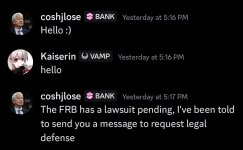
@DonTrillions @xSyncx @coshjlose @Soundi83 , is required to appear before the District Court in the case of Multiman155 v. Federal Reserve Bank & DonTrillions [2026] DCR 29

Failure to appear within 72 hours of this summons will result in a default judgement based on the known facts of the case.

Both parties should make themselves aware of the Court Rules and Procedures, including the option of an in-game trial should both parties request one.


Motion


IN THE DISTRICT COURT OF THE COMMONWEALTH OF REDMONT
MOTION FOR EMERGENCY INJUNCTION

Your Honor:

In order for a final judgement to be meaningful, records sought must be preserved. Preservation of records does not cause harm to the FRB, but deletion of records after the filing of the FOI would irreparably harm the Plaintiff.

At present, the Federal Reserve Bank has already deleted at least one message plausibly related to the FOI request. This includes the message shown in Exhibit P-001, which has since been deleted from the #fi-announcements channel on the FRB discord (See: Exhibit P-013). This deletion occurred after the FOI was filed (compare timestamps in Exhibit P-003 with that of Exhibit P-014).

On an emergency basis, the Plaintiff thus prays that this Court issue:

  • A writ of Mandamus preventing the deletion, destruction, or alteration of records possibly responsive to the FOI scope, including but not limited to official FRB server messages, tickets, board motions, votes, gubernatorial orders, and external communications held by the FRB relating to the Compliant transition. This should last until final judgement is issued.

Granted.
 
Last edited:
Your Honour,

The Department of Justice is present on behalf of the Federal Reserve Bank. We have been unable to make contact with DonTrillions, and we are not statutorily authorised to represent a private individual.
 

Attachments

  • Screenshot_20260308_140153_Discord.jpg
    Screenshot_20260308_140153_Discord.jpg
    67.7 KB · Views: 32
please present answer to complaint within 48 hours.
apologies for the delay, I have been busy with irl stuff
 
Hereby requesting a 24 hour extension. I've got a paper due today.
 

Motion


IN THE DISTRICT COURT OF THE COMMONWEALTH OF REDMONT
MOTION FOR DEFAULT JUDGEMENT - Defendant DonTrillions

Your Honor,

I file this motion solely with respect to co-defendant DonTrillions in his personal capacity. He is not being represented by Kaiserin_ on this matter and thus had an independent obligation to answer the complaint within 48 hours, as he did not requests an extension.

48 hours have come and gone since your instruction in Post No. 7. No answer from DonTrillions has been received.

Therefore, for failure to respond, I request default judgement against that defendant or, in the alternative, that a public defender be swiftly assigned.


Motion


IN THE DISTRICT COURT OF THE COMMONWEALTH OF REDMONT
MOTION FOR DEFAULT JUDGEMENT - Defendant DonTrillions

Your Honor,

I file this motion solely with respect to co-defendant DonTrillions in his personal capacity. He is not being represented by Kaiserin_ on this matter and thus had an independent obligation to answer the complaint within 48 hours, as he did not requests an extension.

48 hours have come and gone since your instruction in Post No. 7. No answer from DonTrillions has been received.

Therefore, for failure to respond, I request default judgement against that defendant or, in the alternative, that a public defender be swiftly assigned.

PD to be assigned.
 

Answer to Complaint


IN THE DISTRICT COURT OF THE COMMONWEALTH OF REDMONT
ANSWER TO COMPLAINT


Multiman155
Plaintiff

v.

Federal Reserve Bank
Defendant

I. ANSWER TO COMPLAINT

1–3. AFFIRM the facts regarding the FRB’s announcement.
4. AFFIRM that Plaintiff initiated a public petition against the decision.
5–8. AFFIRM the material facts of the FOI request.
9. AFFIRM that the law requires a response.
10–11. AFFIRM that Plaintiff received no response from the FRB within 7 days of the FOI request.
12. AFFIRM that DonTrillions has publicly stated his intent to resign as Governor, and that he retained the office during this period.
13–14. AFFIRM the facts regarding Plaintiff’s communication with the DOJ.
15. AFFIRM that Plaintiff had not received a response to the FOI request prior to the filing of this suit, NOTING that the request has since been accepted and fulfilled.
16. NEITHER AFFIRM NOR DENY that the public importance of the request was especially high, NOTING that there were likely other avenues through which the alleged confusion could be cleared.
17–18. AFFIRM the facts regarding the nature of Plaintiff’s “bLAWg” news organisation.
19–20. NEITHER AFFIRM NOR DENY that Plaintiff has suffered harm with regard to the operation of bLAWg, NOTING that there are avenues for reporting that do not rely on FOI requests, and that this purported harm is unsubstantiated and minimal.

II. DEFENCES
1. The inability of the FRB to fulfill the FOI request was due primarily to the de facto absence of the FRB Governor, who the Plaintiff correctly notes is intent on resigning imminently.
2. The excessive workload of the FRB, especially in light of the de facto absence of the Governor, makes the fulfillment of incredibly substantial FOI requests, such as that filed by the Plaintiff, very difficult to maintain. Witness testimony will confirm this. Though Plaintiff was legally entitled to a response, the unique situation of the FRB at the time of the request warrants special consideration, including diminishing of damages.
3. Little harm was suffered by Plaintiff due to the bureaucratic stalling experienced by the FRB during this time. Other avenues, such as interviews with the board member mentioned in fact 16, could have expounded on the facts of the situation which Plaintiff sought to report on. Additionally, no monetary or material harm was suffered by Plaintiff as a result of the missed FOI request.

By making this submission, I agree I understand the penalties of lying in court and the fact that I am subject to perjury should I knowingly make a false statement in court.

DATED: This 14th day of March, 2026.


Answer to Complaint


IN THE DISTRICT COURT OF THE COMMONWEALTH OF REDMONT
ANSWER TO COMPLAINT


Multiman155
Plaintiff

v.

Federal Reserve Bank
Defendant

I. ANSWER TO COMPLAINT

1–3. AFFIRM the facts regarding the FRB’s announcement.
4. AFFIRM that Plaintiff initiated a public petition against the decision.
5–8. AFFIRM the material facts of the FOI request.
9. AFFIRM that the law requires a response.
10–11. AFFIRM that Plaintiff received no response from the FRB within 7 days of the FOI request.
12. AFFIRM that DonTrillions has publicly stated his intent to resign as Governor, and that he retained the office during this period.
13–14. AFFIRM the facts regarding Plaintiff’s communication with the DOJ.
15. AFFIRM that Plaintiff had not received a response to the FOI request prior to the filing of this suit, NOTING that the request has since been accepted and fulfilled.
16. NEITHER AFFIRM NOR DENY that the public importance of the request was especially high, NOTING that there were likely other avenues through which the alleged confusion could be cleared.
17–18. AFFIRM the facts regarding the nature of Plaintiff’s “bLAWg” news organisation.
19–20. NEITHER AFFIRM NOR DENY that Plaintiff has suffered harm with regard to the operation of bLAWg, NOTING that there are avenues for reporting that do not rely on FOI requests, and that this purported harm is unsubstantiated and minimal.

II. DEFENCES
1. The inability of the FRB to fulfill the FOI request was due primarily to the de facto absence of the FRB Governor, who the Plaintiff correctly notes is intent on resigning imminently.
2. The excessive workload of the FRB, especially in light of the de facto absence of the Governor, makes the fulfillment of incredibly substantial FOI requests, such as that filed by the Plaintiff, very difficult to maintain. Witness testimony will confirm this. Though Plaintiff was legally entitled to a response, the unique situation of the FRB at the time of the request warrants special consideration, including diminishing of damages.
3. Little harm was suffered by Plaintiff due to the bureaucratic stalling experienced by the FRB during this time. Other avenues, such as interviews with the board member mentioned in fact 16, could have expounded on the facts of the situation which Plaintiff sought to report on. Additionally, no monetary or material harm was suffered by Plaintiff as a result of the missed FOI request.

By making this submission, I agree I understand the penalties of lying in court and the fact that I am subject to perjury should I knowingly make a false statement in court.

DATED: This 14th day of March, 2026.

thank you. we shall continue once a PD has been assigned.
 
Your Honour,

Pursuant to the precedent set in Dragonfly0001, Brustklefurry, YourLocalDiabeto V. CopTop_YT, lawanoespr, Alexthelillion [2024] FCR 85, we request that this case be severed and that the Plaintiff file these cases individually as the counsel in this matter are different.
Your Honor,

May I respond to this request?

Response


IN THE DISTRICT COURT OF THE COMMONWEALTH OF REDMONT
RESPONSE OPPOSING REQUEST TO SEVER

In this case, Co-Defendant DonTrillions has asked that this "case be severed and that the Plaintiff file these cases individually as the counsel in this matter are different". The Plaintiff opposes the request to sever on the basis that the Co-Defendant's cited precedent has been superceded by subsequent changes in statute; the RCCA's new handling of joinder of parties (including the ability of parties to file cross-claims, and the ability to join third parties via a third-party complaint) permits joinder of co-defendants represented by separate counsels.

1. The RCCA is controlling and expressly permits joinder​

1.1 On Joinder and RCCA controls​

The current law regarding joinder of defendants in cases is found in the Redmont Civil Code Act, which was signed into law in February 2026. In that law, the Congress and explicitly permitted joinder of additional parties to a case under the following circumstances:
(1) The court may order the joinder of additional parties where:
(a) Complete relief cannot be granted without the additional party; or
(b) The additional party claims an interest in the subject matter such that disposing of the case without them may impair their ability to protect that interest.

(2) The court may consolidate multiple proceedings involving common questions of law or facts in the interest of judicial efficiency.
(RCCA, Part IV, Section 6).

As applied to this case, complete relief to the Plaintiff cannot be granted without both defendants present. What's more, separating out these two cases would create multiple proceedings "involving common questions of law or facts", which would hamper judicial efficiency.

Regarding the prior ruling cited by the Plaintiff: Plaintiff's cited case is from 2024, and all other cases I could find that granted this sort of severance pre-date the passage of the RCCA. RCCA post-dates it, and is controlling at this moment. Joinder of defendants, therefore, is justified and permitted under the law as it currently stands; mere difference in counsel is no longer a reason that grants severance.

1.2 On how the RCCA deals with ancillary claims​

Rather than swift severance whenever two defendants may have had opposing interests, the RCCA reformed civil procedure through the creation of a robust set of ancillary claims (see: RCCA, Part IV). The joinder provision, combined with the presence of these sorts of claims, permits one single case to handle rather complex chains of claims. This newly includes the handling of related claims by one co-defendant against another and claims by a (co-)defendant against a third party. The RCCA also formalized guidance around counterclaims, which had previously largely been had at Common Law.

Prior to the RCCA, severance was common and was granted fairly swiftly. But, as shown both above and below, this practice is no longer the law. Rather, the RCCA seeks to keep cases joined whenever practicable and provides parties with complex tools to protect their interests in this new joinder-focused system. One such tool, cross-claims, is discussed in the section immediately below. Another such tool, third-party claims, is discussed in Section 3. Reading all of these together, the structural relationship helps to reinforce the reading of joinder as laid out in Section 1.1.

2. The RCCA's creation of Cross-Claims reinforces the authority to join co-defendants with separate counsels​

Next, we turn to an example scenario contemplated by the RCCA in which two co-defendants would be joined to a case and more or less required to have separate counsels: the RCCA's creation of cross-claims.

The RCCA created a new civil procedure regarding cross-claims. Cross-claims are similar conceptually to counter-claims, inasmuch as existing parties to the case file paperwork in order to sue another party to the case. The main difference is that cross-claims are filed by one co-Plaintiff/co-Defendant against their fellow co-Plaintiff or co-Defendant, whereas counterclaims are filed by a Defendant against a Plaintiff.

As such, the Congress provided a means by which allow co-defendants to file claims against fellow co-defendants:
1. Definitions
...

(2) Cross-claim means a claim brought by a party against a co-party (e.g. one plaintiff against another plaintiff, or one defendant against another defendant) within the same proceeding.

...

(4) Compulsory claim means a counterclaim or cross-claim arising from the same transaction, occurrence, or subject matter as the original claim, which must be brought in the current proceeding.

(5) Permissive claim means a counterclaim or cross-claim arising from a different transaction or occurrence than the original claim, which may be brought in the current proceeding.

...
3. Cross-Claims
(1) A party may file a compulsory or permissive cross-claim against a co-party.

(2) Compulsory cross-claims must be filed before the close of discovery, or they are waived.

(3) Permissive cross-claims may be filed before the close of discovery, provided they fall within the jurisdiction of the court.

(4) A cross-claim may seek:
(a) A share of any damages owed to the plaintiff, proportionate to the co-party’s responsibility;
(b) Full reimbursement from the co-party where the cross-claimant’s liability is solely the result of the co-party’s conduct; or
(c) Separate damages for harm the co-party caused directly to the cross-claimant.
(RCCA, Part IV, Sections 1(2), 1(4)-(5), 3(1)-(4)).

When someone files a cross-claim, they would become a cross-plaintiff with respect to that claim; likewise when someone is on the receiving end of a cross-claim, they would become a cross-defendant. The existence of cross-claims more or less requires that co-defendants have separate counsels for their own best interests — a lawyer cannot in good faith represent a Plaintiff and Defendant in the same action (c.f. Criminal Code Act, Part III, Section 14).

The filing of cross-claims may more or less require separate counsels for civil co-defendants. But the RCCA does not say that severance is the answer; rather the RCCA's joinder provisions must be read as permitting co-defendants with separate counsels to be joined to a case.

3. The RCCA's creation of Third-party claims reinforces the authority to join co-defendants with separate counsels​

Next we turn to examining another provision which creates separate co-defendants with separate counsels: third-party claims. A third-party claim is "a claim brought by a defendant against a person not currently a party to the proceeding, alleging that the third party is or may be liable for all or part of the plaintiff’s claim against the defendant" (RCCA, Part IV, Section 1(3)). The RCCA lays out third-party claims as follows:

4. Third-Party Claims
(1) A defendant may file a third-party claim against a person not currently a party to the proceeding where:
(a) The third party is or may be liable to the defendant for all or part of the plaintiff’s claim; or
(b) The third party is or may be liable to the defendant for contribution or indemnification.

(2) A third-party claim must be filed within the defendant’s initial response or with leave of the court.

(3) Upon filing of a third-party claim, the third party becomes a party to the proceeding with all associated rights and obligations.

(4) The plaintiff may assert claims directly against the third party arising from the same transaction or occurrence.
(RCCA, Part IV, Section 4).

Third-party claims, like cross-claims, are new creations of the RCCA. Their filing requires the Court to join, as a defendant, someone who was not originally party to the case. They have even been used for this purpose in the FCR (see: Brick and Browse Inc. v. MasterCaelen, Third-Party Defendant Pepecuu [2026] FCR 18).

In a third-party complaint, the original cases's defendant becomes a Third-Party Plaintiff, and the defendant of a third-party complaint becomes a Third-Party Defendant. The Third-Party Defendant also becomes a defendant to the original case in their own right, as the original case's Plaintiff "plaintiff may assert claims directly against the third party arising from the same transaction or occurrence".

As with cross-claims, the third-party defendant is going to need different legal counsel than the individual who filed the third-party complaint. But, under the RCCA, the legal pathway the Courts follow is to join the parties to the same case, not to require that the case be severed and re-filed individually.

4. Conclusion​

As shown above, the RCCA creates a statutory scheme that focuses on joining related claims to the same case and providing for robust measures to handle disputes between co-parties. While this law is a departure from a previous rule-of-thumb practiced by the courts, it is the law; "Congress's will must be deferred to" (Galactic Empire of Redmont v. Commonwealth of Redmont [2025] FCR 78 - appeal, page 6, par. 5), and "Congress is free to make whatever changes to rules, regulations, or statues they wish, so long as those changes are constitutional" (id., page 7, par. 4).

Joinder, being expressly permitted, ought thus be enforced here.

 
Back
Top