Lawsuit: Pending Crown of Alexandria and Dominion of Queendom v. Commonwealth of Redmont

Kaiserin_

Ex-Lesbian Vampire
Supporter
Oakridge Resident
Foreign Dignitary
Kaiserin_
Kaiserin_
Alexandrian Dignitary
Joined
Jan 1, 2025
Messages
341

Motion


IN THE FEDERAL COURT OF THE COMMONWEALTH OF REDMONT
MOTION FOR EMERGENCY INJUNCTION

Plaintiffs move for an emergency injunction preventing the Commonwealth from withdrawing recognition of the Dominion of Queendom. Its intent to do so may constitute unlawful interference in the affairs of Queendom and Alexandria according to the Wilderness and Alexandria Act and the Treaty of Mutual Recognition and Sovereignty.


Case Filing


IN THE FEDERAL COURT OF THE COMMONWEALTH OF REDMONT
CIVIL ACTION


Crown of Alexandria
Dominion of Queendom
Co-Plaintiffs

v.

Commonwealth of Redmont
Defendant

COMPLAINT

The Plaintiff complains against the Defendant as follows:

Earlier this month, the Kingdom of Alexandria and the Dominion of Queendom lawfully entered into a binding treaty which recognised Queendom as an independent polity under the Alexandrian Crown. The Commonwealth of Redmont has attempted, through force and threats, to violate the autonomy of both of these entities by preventing them from conducting their own peaceful relations.

Alexandria and Queendom did no wrong in the eyes of international law - the former has not attempted to claim governmental jurisdiction over the latter. Queendom passes and enforces its own laws, maintains its own borders, and conducts its own economy. The Queendom-Alexandria Treaty of Recognition and Special Autonomy presents a unity of culture and a shared loyalty to the ceremonial monarchy of Alexandria.

Yet, the Commonwealth cannot say the same of its respect for the law and for the autonomy of those outside its borders. Its actions fall squarely outside of the realm of legal foreign policy as determined by Redmont's own laws and treaties. Today, Alexandria and Queendom assert their rights to autonomy and fair treatment under the law.

I. PARTIES
1. Crown of Alexandria (represented by ConsequencesInc)
2. Dominion of Queendom (represented by Tacoman1619)
3. Commonwealth of Redmont

II. FACTS
1. The Crown of Alexandria is the enduring legal embodiment of the Kingdom of Alexandria, and its chief representative is the Prime Minister.
2. The Kingdom of Alexandria is a Recognised Nation under the Wilderness and Alexandria Act (WAA), and the Commonwealth of Redmont holds legal relations with and obligations to it, thereby affording it the right to sue in this Court.
3. Executive Order 63/26: Wild Town Recognition recognised the Dominion of Queendom as a Foreign Entity under the WAA, granting it certain rights and privileges under Redmontian law, thereby affording it the right to sue in this Court.
4. The Queendom-Alexandria Treaty of Recognition and Special Autonomy, signed on October 10th by both parties and ratified by Alexandria on the 17th, establishes a formal relationship between the Dominion of Queendom and the Kingdom of Alexandria, recognising the former as a part of the latter while maintaining the independence of both.
5. The Treaty of Mutual Recognition and Sovereignty, ratified by Redmont on June 18th, 2025, and by Alexandria on the 23rd, establishes an obligation of noninterference between Redmont and Alexandria.
6. Part IV, § 1 of the WAA declares that treaties have the force of law and are subject to the same rules and limitations as statutes.
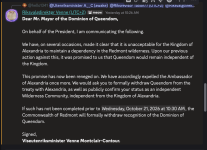
7. On October 17th, DOS representative Vennefly communicated to the Dominion of Queendom, on behalf of the President, that the Alexandrian ambassador had been expelled, and that Queendom had until the 21st to withdraw from the Treaty of Recognition and Special Autonomy, or else face derecognition.
8. On October 18th, Redmontian President Anton Frontier communicated the same to the Prime Minister of Alexandria, and made the matter public.
9. On October 18th, the Dominion of Queendom began a democratic referendum on whether to nullify or uphold the Treaty of Recognition and Special Autonomy.
10. The DOS allowed an extra 48 hours of recognition for this referendum to proceed.
11. On the 21st, the Dominion of Queendom voted to uphold the Treaty of Recognition and Special Autonomy, affirming its status as a fully autonomous Alexandrian polity.

III. CLAIMS FOR RELIEF
1. Violation of the Wilderness and Alexandria Act:
Part II, § 1(G) of the Wilderness and Alexandria Act provides that diplomatic actions between Redmont and any Foreign Entity shall not result in “Attempting to interfere with or bring about a change in leadership of another Foreign Entity.” Because all matters of foreign affairs, excepting treaties, are codified in law, this statute represents a valid restriction on the conduct of the Redmontian government. By expelling the Alexandrian ambassador and threatening to withdraw recognition of Queendom in response to a treaty that did not involve them, the Commonwealth unlawfully interfered with Alexandria, Queendom, and their leadership.

2. Violation of the Treaty of Mutual Recognition and Sovereignty:
Article 2, § 2 of the Treaty of Mutual Recognition and Sovereignty states that “Neither State shall interfere, directly or indirectly, in the internal affairs, governance, legal processes, or political institutions of the other.” By preventing Alexandria from maintaining its own independent relations with the Dominion of Queendom, Redmont violated the Treaty’s stipulations against interference in the governance, legal processes, and political institutions of Alexandria, and violated the autonomy of the Kingdom.

IV. PRAYER FOR RELIEF
The Plaintiff seeks the following from the Defendant:
1. $100,000 in punitive damages to each plaintiff for the violation of the Wilderness and Alexandria Act, totalling $200,000.
2. $100,000 in punitive damages to the Crown of Alexandria for the violation of the Treaty of Mutual Recognition and Sovereignty.
3. Legal fees equal to 30% of the value of the judgment.

V. EVIDENCE
queendomtreaty1.png
queendomtreaty2.png
alexandriatreaty1.png
alexandriatreaty2.png
dosqueendom1.png
dosqueendom2.png
alexandriados1.png
alexandriados2.png
alexandriados3.png
redmontannouncement.png
dosqueendom3.png
dosqueendom4.png
queendomaffirmation.png
1792732663550.png
1792732699514.png

WITNESS LIST
1. ConsequencesInc - Prime Minister of Alexandria
2. Tacoman1619 - Mayor of Queendom

1792733236013.png

By making this submission, I agree I understand the penalties of lying in court and the fact that I am subject to perjury should I knowingly make a false statement in court.

DATED: This 23rd day of October, 2026.


Attachments
  • dosqueendom1.png
    dosqueendom1.png
    288.7 KB · Views: 30
Last edited:

Court Order


IN THE FEDERAL COURT OF THE COMMONWEALTH OF REDMONT
ORDER TO SHOW CAUSE

After a review of the initial Complaint, the Court is concerned about certain deficiencies within it that hamper the Plaintiff’s case. The Court orders Plaintiff to answer the following:
1. Plaintiff claims that the Wilderness and Alexandria Act and Executive Order 63/26: Wild Town Recognition provide for the ability for foreign entities to sue within Redmontian Courts. The Court cannot identify any such provision within either. Why does the Plaintiff believe that foreign entities not recognized as a Legal Entity within existing statute (see Redmont Corporate Entities Act) have the ability to be a party within Redmontian Courts?
2. Plaintiff cites a date of ramification for the Treaty of Mutual Recognition and Sovereignty, but fails to cite with a hyperlink that ratification, which the Court finds violates Rule 1.10. This must be remedied.

These are only the first deficiencies that the Court has identified, and there’s no guarantee that more orders similar to this one will not be issued. Plaintiff has 48 hours to follow this order.

So Ordered.

Brief


IN THE FEDERAL COURT OF THE COMMONWEALTH OF REDMONT
ORDER TO SHOW CAUSE: RESPONSE

Your Honour,

1. The WAA and EO 63/26 do not directly or explicitly provide that Foreign Entities may sue before Redmont's courts. What they do do, however, is recognise the existence of Foreign Entities as a type of entity under the law, and recognise Alexandria and Queendom as members of that class of entities. The WAA further endows Foreign Entities and Recognised Nations with explicit rights, such as those enumerated in Part II, § 3 and § 4. The Constitution further grants the Executive the ability to sign treaties, and the Senate's the ability to ratify them (§ 24, § 4). The WAA asserts that these treaties carry the force of law (Part IV, § 1(C)). The Treaty of Mutual Sovereignty Recognition and Sovereignty explicitly affirms the existence of the Kingdom of Alexandria, and recognises its political institutions, including the Monarch and Prime Minister. Redmont therefore, by its own Constitution and laws, recognises and grants rights to Foreign Entities, and submits itself to binding obligations to them. Without the ability to sue in Redmontian courts, Foreign Entities would lack the ability to assert these rights and hold Redmont accountable to these legal obligations, therefore rendering this entire body of law essentially meaningless. An interpretation that does such would not only fail to give effect to Congress's intent and the plain meaning of law, but would go against the principles of fundamental justice espoused by the Constitution.

If, however, the Court is not satisfied with this argument, an interpretation of § 5 of the RCEA that renders it as exhaustive may still allow for the ability of Foreign Entities to sue. Under the presumption that the only legal entities that may exist or have rights under Redmontian law are those listed in the RCEA (a fact with Plaintiffs would contest, given the above argument), both Redmont and Queendom fit the definition of a governmental entity. § 5(3)(j) of the Act enumerates governmental entities as legal persons, and Part XVI governs their form. § 62(1) states that "A governmental entity is formed by executive order, law, town bylaw or town constitution, and exists from the enactment of that instrument until its dissolution." § 62(4) lists a number of governmental entities "for the avoidance of doubt", before providing that "any other entity created by an avenue listed in subsection (1)" is also a valid legal entity. It is clear through common law that an organisation need not explicitly be labeled as a legal entity in its originating law in order to gain legal personhood. Before the existence of the RCEA or the Legal Entity Act, for example, the Constitution and the Executive Standards Act simply declared the existence of the Executive Departments, and they were accepted as having legal personhood. The Kingdom of Alexandria is recognised by law, and the Dominion of Queendom is recognised by Executive Order pursuant to law. This clearly meets the formation requirement found in § 62(1) of the RCEA. Further, these entities are not without in-game representation. The Kingdom of Alexandria has a shell player (the same as the Executive Departments) called SCGovernment, and the Dominion of Queendom has a DB through the economy plugin, simply named Queendom (albeit not tax-exempt, though this may be a deficiency of circumstance if the Court accepts that Queendom qualifies as a governmental entity). Evidence attached. The Treaty of Mutual Sovereignty recognises the authority of the Prime Minister and Monarch as the representatives of Alexandria (Article 4, § 1 & 3), and the Department of State, through its acts of diplomacy, recognises the Mayor of Queendom as its leader (P-005, P-006)

Plaintiffs continue to hold that the meaning and intent of the Constitution, the WAA, and EO 62/26 provide for the ability of Foreign Entities to assert their legal rights in Redmont's courts with or without the provisions of the RCEA, but it is clear that a direct interpretation of the Act yields the same results.

As a final point, this case was filed prior to the derecognition of Queendom by the DOS (P-018), which Plaintiffs contend constitutes an illegal interference with Queendom's autonomy, as held in the Complaint. Should the Court grant the Emergency Injunction filed with this case, the derecognition should therefore be rendered null until a verdict has been reached, and this case should be allowed to continue.

2. Pursuant to Rule 1.10, the text of the Treaty of Mutual Recognition and Sovereignty is already hyperlinked at its first mention in Fact 5 of the Complaint. Redmont's Department of State has not updates the "Treaties" page on the DemocracyCraft forums, so Alexandria's forums page is used. Evidence for the date of ratification is included in the screenshot marked P-014. However, in the interest of complying with the Court's order, Plaintiffs will amend Fact 5 of the Complaint to include a link to the message in the Congress Discord declaring the passage of the ratification vote.


1792882702322.png
1792882782371.png
1792884321162.png
 
Back
Top