Lawsuit: In Session MMiqa v. Bar Association of Redmont [2026] DCR 142

Objection


IN THE DISTRICT COURT OF THE COMMONWEALTH OF REDMONT
OBJECTION - BREACH OF PROCEDURE

The Plaintiff has spoken out of turn, therefore the Defense requests this response to be struck.

Overruled, Plaintiff is allowed to respond to objections without permission from the PO.
 

Objection


IN THE DISTRICT COURT OF THE COMMONWEALTH OF REDMONT
OBJECTION - BREACH OF PROCEDURE

The Plaintiff has spoken out of turn, therefore the Defense requests this response to be struck.

Overruled, Plaintiff is allowed to respond to objections without permission from the PO.
 

Objection


IN THE DISTRICT COURT OF THE COMMONWEALTH OF REDMONT
OBJECTION - PERJURY

Your Honour,

The Defense's argument does not support its position.

First, the Defense stated that 'The assertion that one cannot vote abstain on a motion because abstain isn't mentioned in the law is absurd' but the Plaintiff never said an abstain vote is invalid or cannot be cast; the Plaintiff's argument has always been that the Act does not define abstention's effect on the calculation of a majority, not that abstention itself is invalid.

Second, the Defense characterized the Plaintiff's argument as an attempt to 'misinterpret the text to serve their own purposes,' but every proposition the Plaintiff has advanced rests directly on the text of Part IV, Section 2(2) itself, quotation rather than interpretation.

Third, the Defense presented the Constitution's Dynamic Majority provision, Part I, Section 10(2), as though it were a general rule, when the provision appears under the heading 'THE CONGRESS,' immediately following Section 10(1), which expressly limits it to 'all voting conducted in Congress,' meaning the text itself confines this rule to Congress.

The Plaintiff respectfully requests that the Court charge the Defense with perjury for these three statements, each made in a filing before this Court.

DATED: This 12th day of August, 2026

MMiqa
Plaintiff, Self-Represented

Plaintiff, please review the Information - Court Rules and Procedures before throwing perjury objections around. You need proof that the statement is false, and proof that it was made in knowledge of its falsity.
This objection does not prove that any statements were false. In fact, many items are under contention and will be resolved upon the conclusion of this trial.
Objection overruled.
 

Objection


IN THE DISTRICT COURT OF THE COMMONWEALTH OF REDMONT

OBJECTION - BREACH OF PROCEDURE

Your Honor,

The Defendant's own response, currently on the record, contains argumentative language starting from the first sentece of their response, including the following statements:


These are not neutral statements of fact. They are characterizations offered to persuade the Court, made by the Defendant, in this case.

Plaintiff, this is your last warning. Do not bloat this Court with meritless objections.
The language used is fully permissible. Objection overruled.
 
IN THE DISTRICT COURT OF THE COMMONWEALTH OF REDMONT
SUBMISSION OF INTERROGATORIES

Your Honour,
The Plaintiff submits the following interrogatories to the Defendant:

1. On August 11, 2026, two days after this lawsuit was filed, did you co-author, with Representative _GreyMC, a bill titled the "BAR Rendition Act," which proposes to strike the current text of Part IV, Section 2(2), "All decisions of the Council shall be passed by a simple majority of all sitting Councillors," in its entirety, and replace it with new text reading, "All decisions of the Council shall pass with a simple majority, unless otherwise provided by law, of ayes out of all non-abstention votes cast, and will be rejected with a simple majority, unless otherwise provided by law, of nays out of all non-abstention votes cast"? Please answer Yes or No.


2. You, CreeperTD Executive Advisor and the BAR Chairperson, stated that:

As defined by the BAR act, the motion had received a simple majority of votes, as a councillor voting abstain means that their vote will count towards the quorum, but not count as either an Aye or a Nay.

Can you please quote the specific section and text of the Bar Association of Redmont Act, as it was valid on August 5 2026, the date this Motion to Censure occurred, that supports your statement?

3. CreeperTD, you have co-authored BAR Rendition Act with _GreyMC. Did you fully comprehend and research the current Bar Association of Redmont Act before co-authoring the BAR Rendition Act?

4. The president vetoed the Bar Rendition Act, stating that changing the "a majority of the all sitting Councillors" to "a majority of ayes among non-abstention votes cast." was "a lower threshold than the Act has ever set and I do not believe it is what was intended." The current Bar Association of Redmont Act does not include the role of abstaining and how it should be counted towards the majority. This change was requested on August 11 and it was vetoed.

What made you sure that a section from an Act that was in draft on August 11, and it was vetoed by the President on August 14 was valid to be shown as a legal ground here?


The Plaintiff reserves the right to ask any further interrogatories up to the 5 interrogatory limit.
 
IN THE DISTRICT COURT OF THE COMMONWEALTH OF REDMONT
SUBMISSION OF INTERROGATORIES

Your Honour,
The Plaintiff submits the following interrogatories to the Defendant:

1. On August 11, 2026, two days after this lawsuit was filed, did you co-author, with Representative _GreyMC, a bill titled the "BAR Rendition Act," which proposes to strike the current text of Part IV, Section 2(2), "All decisions of the Council shall be passed by a simple majority of all sitting Councillors," in its entirety, and replace it with new text reading, "All decisions of the Council shall pass with a simple majority, unless otherwise provided by law, of ayes out of all non-abstention votes cast, and will be rejected with a simple majority, unless otherwise provided by law, of nays out of all non-abstention votes cast"? Please answer Yes or No.


2. You, CreeperTD Executive Advisor and the BAR Chairperson, stated that:


Can you please quote the specific section and text of the Bar Association of Redmont Act, as it was valid on August 5 2026, the date this Motion to Censure occurred, that supports your statement?

3. CreeperTD, you have co-authored BAR Rendition Act with _GreyMC. Did you fully comprehend and research the current Bar Association of Redmont Act before co-authoring the BAR Rendition Act?

4. The president vetoed the Bar Rendition Act, stating that changing the "a majority of the all sitting Councillors" to "a majority of ayes among non-abstention votes cast." was "a lower threshold than the Act has ever set and I do not believe it is what was intended." The current Bar Association of Redmont Act does not include the role of abstaining and how it should be counted towards the majority. This change was requested on August 11 and it was vetoed.

What made you sure that a section from an Act that was in draft on August 11, and it was vetoed by the President on August 14 was valid to be shown as a legal ground here?


The Plaintiff reserves the right to ask any further interrogatories up to the 5 interrogatory limit.

Objection


IN THE DISTRICT COURT OF THE COMMONWEALTH OF REDMONT
OBJECTION - ASSUMES FACT NOT IN EVIDENCE; BREACH OF PROCEDURE

Your honor,
The Plaintiff has referenced a bill written by a specific member of the BAR Council in interogatory questions directed to the entirety of the Bar Association of Redmont. Although the BAR is being represented by myself, Chairperson CreeperTD, I am not the entirety of the BAR Council. Therefore, presenting these interrogatories to the Plaintiff as a whole is improper for this stage of the case, and should be witness questioning made to myself as an individual. The defense humbly requests that the questions should be struck in their entirety based off of this breach of procedure alone.

In addition, these questions reference a bill and the vetoing of said bill. The Plaintiff has not submitted to the court anything to do with that bill. The bills contents, and the veto mentioned by the plaintiff, are not law, therefore the Plaintiff should be required to submit the specific passages mentioned as evidence to the court, as they aren't part of an act of congress, before they are brought up as facts for the purposes of questioning. Unless this evidence is submitted, the Defense humbly requests that the court strike these questions for assuming facts not in evidence.


Evidence


IN THE DISTRICT COURT OF THE COMMONWEALTH OF REDMONT
SUBMISSION OF DISCOVERY EVIDENCE

Your Honour,

The Plaintiff submits the following evidence into the record:

P-001 — BAR Rendition Act, co-authored by BAR Chairperson CreeperTD and Representative _GreyMC, introduced in Congress on August 11, 2026.


P-002 — Presidential Veto of the BAR Rendition Act, issued by President Theory Fontaine on August 14, 2026.


These are submitted to establish the contents of the BAR Rendition Act and the President's veto message referenced in the Plaintiff's interrogatories to the Defense.


Objection


IN THE DISTRICT COURT OF THE COMMONWEALTH OF REDMONT
OBJECTION - ASSUMES FACT NOT IN EVIDENCE; BREACH OF PROCEDURE

Your honor,
The Plaintiff has referenced a bill written by a specific member of the BAR Council in interogatory questions directed to the entirety of the Bar Association of Redmont. Although the BAR is being represented by myself, Chairperson CreeperTD, I am not the entirety of the BAR Council. Therefore, presenting these interrogatories to the Plaintiff as a whole is improper for this stage of the case, and should be witness questioning made to myself as an individual. The defense humbly requests that the questions should be struck in their entirety based off of this breach of procedure alone.

In addition, these questions reference a bill and the vetoing of said bill. The Plaintiff has not submitted to the court anything to do with that bill. The bills contents, and the veto mentioned by the plaintiff, are not law, therefore the Plaintiff should be required to submit the specific passages mentioned as evidence to the court, as they aren't part of an act of congress, before they are brought up as facts for the purposes of questioning. Unless this evidence is submitted, the Defense humbly requests that the court strike these questions for assuming facts not in evidence.

RESPONSE TO OBJECTION

The Plaintiff wishes to clear the confusion. The Defendant is here to represent the BAR and is the Chairperson of the BAR. For question 2, the Defendant and also the Chairperson of the BAR co-authored an Act, an Act they quoted here when it was not passed. Other members of the BAR but CreeperTD cannot give full information based on the act CreeperTD had done alone with greymc.

Rule 4.8 states that "The Plaintiff and Defendant may ask up to 5 relevant questions while within discovery to each other that they must answer truthfully and to the best of their ability."

Therefore, what the Defendant has said here is also false.
Therefore, presenting these interrogatories to the Plaintiff as a whole is improper for this stage of the case, and should be witness questioning made to myself as an individual.

In the Rule 4.8, there are no exemptions. CreeperTD is the Defendant, and we are in Discovery. This is not the first time the Defendant asked for exemptions that has no basis in the rules.

The Plaintiff was also asked questions when representing themselves in the past as Interrogatories.

CreeperTD quoted a section, which they have said that it was in the Bar Association of Redmont Act, but it actually exist in the Bar Rendition Act, which was vetoed. Other Council members would not be able to answer questions about an Act that CreeperTD alone co-authored with greymc.

The Defendant is representing the BAR here, and they are being questioned about a mistake they have made in this Court. They have misquoted a section claiming it was in the Bar Association of Redmont Act, but actually it existed in a vetoed act they co-authored.

Every question the Plaintiff has asked emerged from the responses of the Defendant made in this court while they were representing the BAR, and now they can't fall back on the:
I am not the entirety of the BAR Council

When they are questioned by their actions that was done in this Court while representing the BAR Council.

On the veto by the president. The president actively defends the Plaintiff's position in their veto, stating "The amendment at Part II §1(5) replaces a majority of all sitting Councillors with a majority of ayes among non-abstention votes cast."

The Plaintiff wishes to show a double standard issued by the Defendant:

As defined by the BAR act, the motion had received a simple majority of votes, as a councillor voting abstain means that their vote will count towards the quorum, but not count as either an Aye or a Nay

Here, the Defendant did not give the link to the Bar Association of Redmont Act, and did not disclose which section in the Act supports their claim, yet they make the claim that what Plaintiff said should be struck since they did not gave a link to a public information that can be easily found in this website since the Plaintiff gave which section they were referring to. As said, this is not the first time the Defendant is asking for exemptions. However, in order to show transparency, the Plaintiff uploaded the evidences in the correct format.

In summary, the Defendant has said that "As defined by the BAR act, the motion had received a simple majority of votes, as a councillor voting abstain means that their vote will count towards the quorum, but not count as either an Aye or a Nay", which does not exist in the Bar Association of Redmont Act, and it exists in the Bar Rendition Act.

This is the justification of the bringing up the Bar Rendition Act, an Act they co-authored with greymc days after this lawsuit was filed, completely amending the Part IV 2(2) of the Bar Association of Redmont Act, where the Plaintiff's claim based on, which was vetoed by the president, and in the veto the president openly supports the view the Plaintiff has.

President's veto is also important since it defends the Plaintiff's position and they have claimed that "That is a lower threshold than the Act has ever set and I do not believe it is what was intended." when they were talking about the amendment request on Part IV 2(2), openly defending that the intention was "a majority of all sitting Councillors".

All material above is relevant Your Honor, the Plaintiff kindly request this objection to be overruled.
 
Last edited:
IN THE DISTRICT COURT OF THE COMMONWEALTH OF REDMONT

SUBMISSION OF WITNESS LIST

Your Honor,

Pursuant to Rule 4.9, the Plaintiff submits the following witness list:

1. CreeperTD
2. OwnedBlock
3. xVoltrix
4. asexualdinosaur

These people were the Councillors that have voted on the Motion to Censure MMiqa.
 
RESPONSE TO OBJECTION

The Plaintiff wishes to clear the confusion. The Defendant is here to represent the BAR and is the Chairperson of the BAR. For question 2, the Defendant and also the Chairperson of the BAR co-authored an Act, an Act they quoted here when it was not passed. Other members of the BAR but CreeperTD cannot give full information based on the act CreeperTD had done alone with greymc.

Rule 4.8 states that "The Plaintiff and Defendant may ask up to 5 relevant questions while within discovery to each other that they must answer truthfully and to the best of their ability."

Therefore, what the Defendant has said here is also false.


In the Rule 4.8, there are no exemptions. CreeperTD is the Defendant, and we are in Discovery. This is not the first time the Defendant asked for exemptions that has no basis in the rules.

The Plaintiff was also asked questions when representing themselves in the past as Interrogatories.

CreeperTD quoted a section, which they have said that it was in the Bar Association of Redmont Act, but it actually exist in the Bar Rendition Act, which was vetoed. Other Council members would not be able to answer questions about an Act that CreeperTD alone co-authored with greymc.

The Defendant is representing the BAR here, and they are being questioned about a mistake they have made in this Court. They have misquoted a section claiming it was in the Bar Association of Redmont Act, but actually it existed in a vetoed act they co-authored.

Every question the Plaintiff has asked emerged from the responses of the Defendant made in this court while they were representing the BAR, and now they can't fall back on the:


When they are questioned by their actions that was done in this Court while representing the BAR Council.

On the veto by the president. The president actively defends the Plaintiff's position in their veto, stating "The amendment at Part II §1(5) replaces a majority of all sitting Councillors with a majority of ayes among non-abstention votes cast."

The Plaintiff wishes to show a double standard issued by the Defendant:


Here, the Defendant did not give the link to the Bar Association of Redmont Act, and did not disclose which section in the Act supports their claim, yet they make the claim that what Plaintiff said should be struck since they did not gave a link to a public information that can be easily found in this website since the Plaintiff gave which section they were referring to. As said, this is not the first time the Defendant is asking for exemptions. However, in order to show transparency, the Plaintiff uploaded the evidences in the correct format.

In summary, the Defendant has said that "As defined by the BAR act, the motion had received a simple majority of votes, as a councillor voting abstain means that their vote will count towards the quorum, but not count as either an Aye or a Nay", which does not exist in the Bar Association of Redmont Act, and it exists in the Bar Rendition Act.

This is the justification of the bringing up the Bar Rendition Act, an Act they co-authored with greymc days after this lawsuit was filed, completely amending the Part IV 2(2) of the Bar Association of Redmont Act, where the Plaintiff's claim based on, which was vetoed by the president, and in the veto the president openly supports the view the Plaintiff has.

President's veto is also important since it defends the Plaintiff's position and they have claimed that "That is a lower threshold than the Act has ever set and I do not believe it is what was intended." when they were talking about the amendment request on Part IV 2(2), openly defending that the intention was "a majority of all sitting Councillors".

All material above is relevant Your Honor, the Plaintiff kindly request this objection to be overruled.

Objection


IN THE DISTRICT COURT OF THE COMMONWEALTH OF REDMONT
OBJECTION - BREACH OF PROCEDURE

Your Honor,

The Plaintiff appears to have forgotten what a response to objection actually is. Rather than responding to the content of the objection, a majority of their objection consists of using their inquest questions to make further legal arguments. Not only does this show that the Plaintiff created leading questions, in which they attempted to testify as counsel, but it also simply isn’t a response to objection, rather they are attempting to use the response to the objection to make legal arguments that belong in an opening statement or the initial complaint. The Defense requests that the court strikes this response for breach of procedure.


Objection


IN THE DISTRICT COURT OF THE COMMONWEALTH OF REDMONT
OBJECTION - BREACH OF PROCEDURE

Your Honor,

The Plaintiff appears to have forgotten what a response to objection actually is. Rather than responding to the content of the objection, a majority of their objection consists of using their inquest questions to make further legal arguments. Not only does this show that the Plaintiff created leading questions, in which they attempted to testify as counsel, but it also simply isn’t a response to objection, rather they are attempting to use the response to the objection to make legal arguments that belong in an opening statement or the initial complaint. The Defense requests that the court strikes this response for breach of procedure.

RESPONSE TO OBJECTION

Your Honor,

The Defendant has stated:
1-)
The Plaintiff has not submitted to the court anything to do with that bill
The Plaintiff has submitted the bill's link and gave reasons why that bill is relevant in their first response to objection.

2-)
Although the BAR is being represented by myself, Chairperson CreeperTD, I am not the entirety of the BAR Council.

For this, the Plaintiff has given the answer, that is here:

Rule 4.8 states that "The Plaintiff and Defendant may ask up to 5 relevant questions while within discovery to each other that they must answer truthfully and to the best of their ability."

3-)
Therefore, presenting these interrogatories to the Plaintiff as a whole is improper for this stage of the case, and should be witness questioning made to myself as an individual.
The answer is the same, rule 4.8 states that "the Plaintiff and Defendant may ask up to 5 relevant questions while within discovery".

The Plaintiff wishes to also draw attention to the fact that there is not a "specific guideline" when it comes to response to objection. The objection done by the Defendant itself was vague and did not target any singular question at all, they took the approach that they cannot answer since they represent the BAR and can't talk for all, but forgot the fact that they are the Defendant in this case and thats all that matters according to the Rule 4.8 and there are no exceptions stated in the rule.

The Plaintiff has shown that they have a right to ask up to 5 relevant questions, quoted the rule with link, and he has shown how these questions were relevant.

He has given grounds for every question, why they are valid, and according to the rule 4.8 the Plaintiff and the Defendant can ask themselves up to 5 relevant questions.

Since the Defendant did not give specifics on which question was invalid, since some were directly given as a representative of the BAR in this lawsuit, and some were in the Bar Rendition Act (where they have represented himself only), and they have given no legal ground for the claim that they may not answer the questions, the Plaintiff wished not to take risks and explained in detail how all the questions are relevant.

The Plaintiff wishes to draw attention that the response included solely the justification of the submissions of interrogatories, and did not talk in any argumentative tone, whatever they have talked about was linked throughout and was facts with proof, the Plaintiff legitimized and explained in detail how all the questions asked were relevant since the Defendant did not claim which question was breaching the procedure specifically and again, the Plaintiff wished not to take risks on this matter.

For example, the Defendant talked about a claim the Plaintiff has never done before, but when objected, the Judge overruled.
The assertion that one cannot vote abstain on a motion because abstain isn't mentioned in the law is absurd

Again, for summary, the Plaintiff simply asked questions, and explained how these questions were relevant when objections to questions occured. If the Defendant gives specific objections rather than vague ones, the Plaintiff is open to answer the specific objections if given by the Defendant as well.

I am respectfully requesting from the honorable Judge to overrule this objection since the Plaintiff only talked about how relevant the questions were to this case when questioned and they have simply talked about which rule gives them right to ask Defendant up to 5 relevant questions.
 
RESPONSE TO OBJECTION

The Plaintiff wishes to clear the confusion. The Defendant is here to represent the BAR and is the Chairperson of the BAR. For question 2, the Defendant and also the Chairperson of the BAR co-authored an Act, an Act they quoted here when it was not passed. Other members of the BAR but CreeperTD cannot give full information based on the act CreeperTD had done alone with greymc.

Rule 4.8 states that "The Plaintiff and Defendant may ask up to 5 relevant questions while within discovery to each other that they must answer truthfully and to the best of their ability."

Therefore, what the Defendant has said here is also false.


In the Rule 4.8, there are no exemptions. CreeperTD is the Defendant, and we are in Discovery. This is not the first time the Defendant asked for exemptions that has no basis in the rules.

The Plaintiff was also asked questions when representing themselves in the past as Interrogatories.

CreeperTD quoted a section, which they have said that it was in the Bar Association of Redmont Act, but it actually exist in the Bar Rendition Act, which was vetoed. Other Council members would not be able to answer questions about an Act that CreeperTD alone co-authored with greymc.

The Defendant is representing the BAR here, and they are being questioned about a mistake they have made in this Court. They have misquoted a section claiming it was in the Bar Association of Redmont Act, but actually it existed in a vetoed act they co-authored.

Every question the Plaintiff has asked emerged from the responses of the Defendant made in this court while they were representing the BAR, and now they can't fall back on the:


When they are questioned by their actions that was done in this Court while representing the BAR Council.

On the veto by the president. The president actively defends the Plaintiff's position in their veto, stating "The amendment at Part II §1(5) replaces a majority of all sitting Councillors with a majority of ayes among non-abstention votes cast."

The Plaintiff wishes to show a double standard issued by the Defendant:


Here, the Defendant did not give the link to the Bar Association of Redmont Act, and did not disclose which section in the Act supports their claim, yet they make the claim that what Plaintiff said should be struck since they did not gave a link to a public information that can be easily found in this website since the Plaintiff gave which section they were referring to. As said, this is not the first time the Defendant is asking for exemptions. However, in order to show transparency, the Plaintiff uploaded the evidences in the correct format.

In summary, the Defendant has said that "As defined by the BAR act, the motion had received a simple majority of votes, as a councillor voting abstain means that their vote will count towards the quorum, but not count as either an Aye or a Nay", which does not exist in the Bar Association of Redmont Act, and it exists in the Bar Rendition Act.

This is the justification of the bringing up the Bar Rendition Act, an Act they co-authored with greymc days after this lawsuit was filed, completely amending the Part IV 2(2) of the Bar Association of Redmont Act, where the Plaintiff's claim based on, which was vetoed by the president, and in the veto the president openly supports the view the Plaintiff has.

President's veto is also important since it defends the Plaintiff's position and they have claimed that "That is a lower threshold than the Act has ever set and I do not believe it is what was intended." when they were talking about the amendment request on Part IV 2(2), openly defending that the intention was "a majority of all sitting Councillors".

All material above is relevant Your Honor, the Plaintiff kindly request this objection to be overruled.
The answer is the same, rule 4.8 states that "the Plaintiff and Defendant may ask up to 5 relevant questions while within discovery".

The Plaintiff wishes to draw attention that the response included solely the justification of the submissions of interrogatories, and did not talk in any argumentative tone, whatever they have talked about was linked throughout and was facts with proof, the Plaintiff legitimized and explained in detail how all the questions asked were relevant since the Defendant did not claim which question was breaching the procedure specifically and again, the Plaintiff wished not to take risks on this matter.

Objection


IN THE DISTRICT COURT OF THE COMMONWEALTH OF REDMONT
OBJECTION - PERJURY

Your honor,

The plaintiff has repeatedly misrepresented facts about this case despite having been told that they are wrong, proving that they are, in fact, doing so intentionally. The Plaintiff has, on two occasions, claimed that the Defendant is CreeperTD, the BAR Chairperson. See:

RESPONSE TO OBJECTION

The Plaintiff wishes to clear the confusion. The Defendant is here to represent the BAR and is the Chairperson of the BAR. For question 2, the Defendant and also the Chairperson of the BAR co-authored an Act, an Act they quoted here when it was not passed. Other members of the BAR but CreeperTD cannot give full information based on the act CreeperTD had done alone with greymc.

Rule 4.8 states that "The Plaintiff and Defendant may ask up to 5 relevant questions while within discovery to each other that they must answer truthfully and to the best of their ability."

Therefore, what the Defendant has said here is also false.

In the Rule 4.8, there are no exemptions. CreeperTD is the Defendant, and we are in Discovery. This is not the first time the Defendant asked for exemptions that has no basis in the rules.

The Plaintiff was also asked questions when representing themselves in the past as Interrogatories.

CreeperTD quoted a section, which they have said that it was in the Bar Association of Redmont Act, but it actually exist in the Bar Rendition Act, which was vetoed. Other Council members would not be able to answer questions about an Act that CreeperTD alone co-authored with greymc.

The Defendant is representing the BAR here, and they are being questioned about a mistake they have made in this Court. They have misquoted a section claiming it was in the Bar Association of Redmont Act, but actually it existed in a vetoed act they co-authored.

Every question the Plaintiff has asked emerged from the responses of the Defendant made in this court while they were representing the BAR, and now they can't fall back on the:

Here, the Defendant did not give the link to the Bar Association of Redmont Act, and did not disclose which section in the Act supports their claim, yet they make the claim that what Plaintiff said should be struck since they did not gave a link to a public information that can be easily found in this website since the Plaintiff gave which section they were referring to. As said, this is not the first time the Defendant is asking for exemptions. However, in order to show transparency, the Plaintiff uploaded the evidences in the correct format.

In summary, the Defendant has said that "As defined by the BAR act, the motion had received a simple majority of votes, as a councillor voting abstain means that their vote will count towards the quorum, but not count as either an Aye or a Nay", which does not exist in the Bar Association of Redmont Act, and it exists in the Bar Rendition Act.

There are many more instances of this, but the Plaintiff has repeatedly and deliberately referred to myself, CreeperTD, the person representing the BAR in this civil action, as the Defendant, and in each quote I have highlighted each time the Plaintiff has referred to CreeperTD as such. Not only is this absurd to do, but it is an intentional misrepresentation of the facts being made by the Plaintiff to justify their actions. Part II §1 of the Legal Entity Act provides for the existence of government entities. Subsection (1) states,
(1) A governmental entity shall be formed by:

(a) executive order;

(b) law;

(c) town bylaw; or,

(d) town constitution.
The government entity involved in this lawsuit, the Bar Association of Redmont, was formed by the Bar Association of Redmont Act, meaning that it was legally formed according to the LEA. Part I §2(3) states that "Legal entities shall be a legal person with separate rights and liabilities, strictly distinct from their shareholders, members, and agents." Given that the individual CreeperTD is considered the director of the BAR with regards to LEA Part II §4, which states:
(4) If not defined, the director or directors of a governmental entity shall be either:

(a) each person in a body of equal persons, notwithstanding the possibility of a chair and/or vice chair or equivalent position being elected or appointed out of that body; or if not present,

(b) the most senior person leading the entity.
What is important to take away from these laws is that CreeperTD is not and cannot be considered the Defendant in any way, shape, or form, unlike what the Plaintiff has intentionally misrepresented to the court. CreeperTD may be the Defendant's director and legal representative, but he cannot have interrogatories directed towards him. The Plaintiff's statements, which include Posts numbered 106, 109, and 112, should be struck as perjurious and the Plaintiff themselves should be charges with Perjury, as it is clear that they are making these statements despite having been informed that they are wrong, and the law clearly proving that their statements are false.

 
INTERROGATORIES
The Defense submits the following question to the Plaintiff:
After being asked in #legal “so.. you didn't do research before filing..?”, you stated that “I did, but the question of what he had voted was a mystery since I had not have the bars discord and the voting was not revealed, I made an educated guess since there was no way he would have abstained (he did).” Is this statement true? Did you, in fact, make the assertion that then Councillor CreeperTD voted aye on the motion to censure based off an educated guess, without any evidence to support the assertion?
 
Response to Objection

Your Honor,

Although the BAR is being represented by myself, Chairperson CreeperTD, I am not the entirety of the BAR Council.

The Defense’s own filing states: “the BAR is being represented by myself, Chairperson CreeperTD.” Having admitted he represents the Defendant, CreeperTD cannot claim it is perjury to be addressed as the Defendant.

Every question the Plaintiff asked concerns statements CreeperTD himself made in this case as that representative, including his claim that a rule existed “as defined by the BAR act,” when it in fact existed only in the BAR Rendition Act he co-authored, a mistake he made himself, in his own words, while representing the Defendant.

CreeperTD has answered to complaint, has filed motions and objections, since they are representing the BAR in this Court.

What is important to take away from these laws is that CreeperTD is not and cannot be considered the Defendant in any way

When CreeperTD makes a motion, answer or objection in this court, they do it as a representative of the BAR. They are the Chairperson of the BAR, they voted on the Motion to Censure MMiqa, he is not the sole Defendant, but he is part of the Defense.

When he makes a mistake, such as stating a fact that does not exist in the BAR act but it does exist in another Act that he co-authored, the question arose from their actions when he was representing the BAR in this lawsuit.

The Plaintiff did not ask specific questions to CreeperTD because they think he is the BAR, the questions arose from the statements CreeperTD had done in this lawsuit while representing the BAR.

CreeperTD is a part of the Defense, not only because they are representing the BAR in this lawsuit, because he was and still is in the BAR, along with other current members of the BAR. CreeperTD is not the only person in the Defense, but they are a part of it and his individual actions are also questionable.

These questions could have include OwnedBlock, since they also are a part of Defense, same reason with CreeperTD.

There is no perjury here. The Plaintiff respectfully requests this objection be overruled.
 
In conjunction with the above filing, the Defense wishes to submit the following as evidence.

1787526736582.png
 
Did you, in fact, make the assertion that then Councillor CreeperTD voted aye on the motion to censure based off an educated guess, without any evidence to support the assertion?

Yes, in part. In my mind I thought CreeperTD voted Aye, but at the time of filing I had no proof, so I left it ambiguous on purpose. I made an educated guess but never explicitly stated what CreeperTD’s vote was while filing this lawsuit.

When I filed the Complaint, BAR had not disclosed how each Councillor voted on this specific motion, and I could not locate the BAR Discord. Working from limited information, I deliberately left CreeperTD’s vote ambiguous in the Complaint, and framed the argument as an “even if” scenario: even if CreeperTD’s vote were counted as Aye, the total was only 2 votes in favor out of 4 active members, which does not constitute a majority, and with his vote removed entirely, the motion fails even more decisively with only 1 vote in favor. The point of that framing was that the outcome does not depend on how CreeperTD voted, since his vote should be disregarded regardless due to the conflict of interest, and the majority was not reached under either scenario. The Complaint’s wording that “CreeperTD voted to censure the attorney” reflected an assumption I could not confirm, not a claim of certainty. This was not a knowing false statement. Perjury requires an intentional lie, and I did not intentionally misrepresent a fact I knew to be false; I made an inference from incomplete information and built the argument around both possible outcomes precisely because I could not confirm which one was true.

Once I learned CreeperTD had in fact voted Abstain, I sought to correct this through an amendment. Under Rule 3.5, information already submitted cannot be altered or removed, only added to, so the original wording remains on the record. For clarity: CreeperTD voted Abstain, not Aye.

The claim was that CreeperTD’s vote, due to the COI, should be disregarded, whether it was Aye, Against, or Abstain. I made my claim ambiguous on purpose, since I had no access to full information.

The phrase ‘voted to censure’ described my general understanding of the outcome I knew had occurred, since that motion passed, not a formal assertion of which specific option, Aye, Nay, or Abstain, CreeperTD selected. I did not state ‘CreeperTD voted Aye.’ The Complaint’s own argument immediately proceeds on an ‘even if’ basis precisely because I could not confirm the specific vote cast. The phrase reflects an assumption about the result, not a claim of certainty about the specific mechanics of how that result was reached.

Neither correction affects the outcome of Claim I. A simple majority of 4 sitting Councillors is 3, and a simple majority of 5 sitting Councillors is also 3. The Motion to Censure received only 2 votes in favor under either figure.
 
Objection overruled. There is not enough evidence to affirm that the statements were made knowingly, nor that some of these statements are unequivocally false (they are under contention and will be resolved within the trial).

Motion


IN THE DISTRICT COURT OF THE COMMONWEALTH OF REDMONT
MOTION TO RECONSIDER


Your honor,


The Defense requests that the court reconsider their ruling on this objection. The Defense would specifically ask the court to reexamine part 2 of the objection made, which stated:


2) In Claim II, the Plaintiff states that, “CreeperTD voted to censure the attorney actively litigating that case against CreeperTD's own department.” Then Councillor CreeperTD did not vote to censure the Plaintiff, rather they voted abstain. (D-001) This information is publicly available to anyone who has joined the BAR discord server, which the Plaintiff was entirely able to do, but instead, they made the assertion that the councillor voted in favor of censuring them without any evidence of them having done so. In addition, the Plaintiff asserts that “With CreeperTD's vote removed, the motion fails even more decisively with only 1 vote in favor.” This is also entirely false. The two members who voted Aye on the Motion to Censure were Councillors OwnedBlock and xVoltrix. Quorum would have been reached for the motion with or without then Councillor CreeperTD’s vote to abstain, which once again shows that the Plaintiff’s assertion was factually incorrect.


The statement submitted by the Plaintiff that “CreeperTD voted to censure the attorney actively litigating that case against CreeperTD's own department" is unequivocally false, and should not be considered by the court. The Plaintiff has stated that “In my mind I thought CreeperTD voted Aye… I made an educated guess.” The Plaintiff is admitting to intentionally representing something that was not a fact, but was rather an “educated guess,” as fact in their own court filings. This fact is not under contention, and will not change at any point during the course of this trial. As seen in D-001, rather than then Councillor CreeperTD voting “to censure the attorney,” the Councillor instead voted abstain, or a non vote that actively takes a person out of a vote entirely. The Plaintiff has, in fact, met the definition of perjury, as they intentionally misrepresented a fact under oath, that being they misrepresented an educated guess as a fact, rather than what it actually was as, an educated guess, and, more accurately, a fantasy that exists only in the Plaintiff’s utterly deranged mind. This court absolutely must charge the Plaintiff with perjury for their actions in this case.

 
Yes, in part. In my mind I thought CreeperTD voted Aye, but at the time of filing I had no proof, so I left it ambiguous on purpose. I made an educated guess but never explicitly stated what CreeperTD’s vote was while filing this lawsuit.

When I filed the Complaint, BAR had not disclosed how each Councillor voted on this specific motion, and I could not locate the BAR Discord. Working from limited information, I deliberately left CreeperTD’s vote ambiguous in the Complaint, and framed the argument as an “even if” scenario: even if CreeperTD’s vote were counted as Aye, the total was only 2 votes in favor out of 4 active members, which does not constitute a majority, and with his vote removed entirely, the motion fails even more decisively with only 1 vote in favor. The point of that framing was that the outcome does not depend on how CreeperTD voted, since his vote should be disregarded regardless due to the conflict of interest, and the majority was not reached under either scenario. The Complaint’s wording that “CreeperTD voted to censure the attorney” reflected an assumption I could not confirm, not a claim of certainty. This was not a knowing false statement. Perjury requires an intentional lie, and I did not intentionally misrepresent a fact I knew to be false; I made an inference from incomplete information and built the argument around both possible outcomes precisely because I could not confirm which one was true.

Once I learned CreeperTD had in fact voted Abstain, I sought to correct this through an amendment. Under Rule 3.5, information already submitted cannot be altered or removed, only added to, so the original wording remains on the record. For clarity: CreeperTD voted Abstain, not Aye.

The claim was that CreeperTD’s vote, due to the COI, should be disregarded, whether it was Aye, Against, or Abstain. I made my claim ambiguous on purpose, since I had no access to full information.

The phrase ‘voted to censure’ described my general understanding of the outcome I knew had occurred, since that motion passed, not a formal assertion of which specific option, Aye, Nay, or Abstain, CreeperTD selected. I did not state ‘CreeperTD voted Aye.’ The Complaint’s own argument immediately proceeds on an ‘even if’ basis precisely because I could not confirm the specific vote cast. The phrase reflects an assumption about the result, not a claim of certainty about the specific mechanics of how that result was reached.

Neither correction affects the outcome of Claim I. A simple majority of 4 sitting Councillors is 3, and a simple majority of 5 sitting Councillors is also 3. The Motion to Censure received only 2 votes in favor under either figure.

Objection


IN THE DISTRICT COURT OF THE COMMONWEALTH OF REDMONT
OBJECTION - PERJURY

Your Honor,

The Plaintiff has claimed under oath that

I deliberately left CreeperTD’s vote ambiguous in the Complaint, and framed the argument as an “even if” scenario: even if CreeperTD’s vote were counted as Aye, the total was only 2 votes in favor out of 4 active members, which does not constitute a majority, and with his vote removed entirely, the motion fails even more decisively with only 1 vote in favor.
The Plaintiff did not, in fact, leave CreeperTD’s vote ambiguous at all. In fact, in their alternative scenario in which CreeperTD’s vote was not counted, they stated “With CreeperTD's vote removed, the motion fails even more decisively with only 1 vote in favor. In either scenario, the censure was not validly passed.” They did not allow for the possibility of the councillor voting abstain or nay on the motion, only for the vote to have been invalidated entirely, taking away one vote in support of the motion. Not only that, but the information that the Plaintiff claims was inaccessible to them was in fact very accessible: there is a link to the discord in the main discord server! Once again, the Defense is humbly asking the court to charge the Plaintiff with perjury.


Objection


IN THE DISTRICT COURT OF THE COMMONWEALTH OF REDMONT
OBJECTION - BREACH OF PROCEDURE

Your Honor,

The Defense's Motion to Reconsider describes the Plaintiff's disclosed uncertainty as:

a fantasy that exists only in the Plaintiff’s utterly deranged mind. This court absolutely must charge the Plaintiff with perjury for their actions in this case.

This is not legal argument. It is a personal, insulting characterization of the Plaintiff, unsupported by any provision of law, and has no place in a filing before this Court.

The Judicial Standards Act authorizes this Court to make rules governing "Courtroom conduct and decorum." Brought under the BAR Code of Conduct's General Principles, Court Rules of Conduct, cites "disrespect for opposing counsel" as professional misconduct, a standard the Defense's own institution has invoked against other attorneys in this jurisdiction.

The Plaintiff respectfully requates that the Court strike this motion from the record and direct the Defense to refrain from personal characterizations of this kind in future filings.


Objection


IN THE DISTRICT COURT OF THE COMMONWEALTH OF REDMONT
OBJECTION - PERJURY

Your Honor,

The Plaintiff has claimed under oath that The Plaintiff did not, in fact, leave CreeperTD’s vote ambiguous at all. In fact, in their alternative scenario in which CreeperTD’s vote was not counted, they stated “With CreeperTD's vote removed, the motion fails even more decisively with only 1 vote in favor. In either scenario, the censure was not validly passed.” They did not allow for the possibility of the councillor voting abstain or nay on the motion, only for the vote to have been invalidated entirely, taking away one vote in support of the motion. Not only that, but the information that the Plaintiff claims was inaccessible to them was in fact very accessible: there is a link to the discord in the main discord server! Once again, the Defense is humbly asking the court to charge the Plaintiff with perjury.

Response to Objection

Your Honor,

I wish not to repeat myself here, I have given my answer in the post #117, that in my mind I had the educated guess that CreeperTD voted Aye, but since I had no proof, I left that ambiguous in the court filing, as I said in my response before. The Plaintiff never explicitly said what CreeperTD voted, and gave a scenerio depending on which scenerio happened this motion saying "even if" and showed in either scenerio, if the vote in this "even if" scenerio was accepted worse case for the Plaintiff would result in 2 Aye, which was still not enough for a motion to pass. This was said to show that this motion was doomed to fail, and due to CreeperTD's Conflict of Interest, the vote must be disregarded. The Plaintiff did not disclose "CreeperTD's Aye vote must be disregarded." They have specifically that CreeperTD's vote must be disregarded. The Defendant is nitpicking from my answer, and trying to pursue the Court of something that does not exist. I have specifically said that I have left CreeperTD's vote ambiguous, and did not on purpose lied and made a perjury in this case.
 

Court Order


IN THE FEDERAL COURT OF THE COMMONWEALTH OF REDMONT
ORDER TO SHOW CAUSE

Background

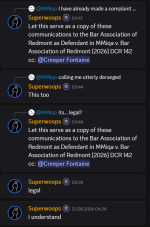
On August 23rd, Judge Superwoops sent an unprompted message containing the word "legal" in the #legal channel of the DemocracyCraft Discord server.
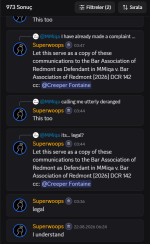
Shortly thereafter, MMiqa, the Plaintiff in this case, replied to the message (with a ping) saying: "its... legal?" and in another message, said "calling me utterly deranged"

Judge Superwoops referred these out-of-court statements to the Defendant in this case through a ping in #legal.

Plaintiff MMiqa replied to the PO's referral (with a ping) and said: "I have already made a complaint about this, he has said this in the lawsuit." Followed by a link to a specific post in this case.

Judge Superwoops referred these out-of-court statements to the Defendant in this case through a ping in #legal.

Order

In light of the facts above, Plaintiff @MMiqa is ordered to answer the following question within 72 hours:
- Why should this Court not find you guilty of Ex Parte Communication under the Act of Congress - Criminal Code Act?

The Defense (cc: @CreeperTD) may also post a legal brief on this conduct, if they so wish.

P.S. Parties may find the relevant exchanges starting from the following message.
P.S.S. It is a common occurrence for me to send unprompted messages containing just the word "legal" in #legal as a trivial thing. See the following piece of evidence:
1787536677279.png

So ordered,
Judge Superwoops

 
Last edited:

Brief


IN THE DISTRICT COURT OF THE COMMONWEALTH OF REDMONT
RESPONSE TO ORDER TO SHOW CAUSE

Your Honour,

This Court should not find the Plaintiff guilty of Ex Parte Communication because the elements of that offence are not met, on multiple independent grounds.

First, the Plaintiff's message was not directed at the presiding officer. The ping the Plaintiff sent, was directed at Theory Fontaine, not at Judge Superwoops. Judge Superwoops was not the recipient of the Plaintiff's communication and inserted himself into the conversation unprompted by replying "legal" to an exchange the Plaintiff was having with someone else. Judge Superwoops was not asked a question before writing "legal", Judge Superwoops did not answer to anyone in #legal, the discord channel #legal is open to both the Plaintiff and the Defendant. A communication cannot be "made... with the presiding officer" within the meaning of this offence when the presiding officer was never the intended recipient and joined the conversation on his own initiative.

Second, the Court's own Order confirms that the presiding officer, not the Plaintiff, introduced himself into this exchange. The Order states that "Judge Superwoops sent an unprompted message containing the word 'legal'" in a public Discord channel. The Plaintiff's reply was a response to a message the presiding officer had already posted publicly, not an attempt to independently solicit private communication with the Court. The Plaintiff wishes to state that this "legal" message was the first message sent by the Judge Superwoops after more than a day not writing in the #legal channel, written right after the Plaintiff sent a message to Theory Fontaine, when the Judge said "legal" out of nowhere, the Plaintiff thought that the Judge states that CreeperTD's action of calling the Plaintiff "utterly deranged" was legal or not, since the Judge out of nowhere replied legal to the Plaintiff after they have made their complaint about a misconduct and disrespect to court.

Third, the communication occurred entirely in #legal, a public channel visible to the community, not a private message or any non-public channel. Nothing about the exchange was concealed from any party.

Fourth, and most importantly, the Court itself, within the same exchange, forwarded a copy of the communications directly to the Defense with a ping to CreeperTD, stating "Let this serve as a copy of these communications to the Bar Association of Redmont as Defendant... cc: @Creeper Fontaine." The Defense was made aware of the substance of this exchange immediately and by the Court's own action, before any possible prejudice could occur. The core purpose of the Ex Parte Communication prohibition is to prevent one party from secretly influencing a presiding officer without the other side's knowledge. That did not happen here: the exchange was public, the Plaintiff did not address the presiding officer, the presiding officer inserted himself unprompted, and the Defense was disclosed to in real time.

In the Judicial Code of Ethics Section 3(3), it is stated that "Ex parte communication (private discussion with one party about a case) is prohibited except where expressly authorized by procedure."

Is this a private discussion with one party about a case? How can the #legal discord channel in the DemocracyCraft where CreeperTD, along with dozens of lawyers present be a private discussion about a case?

Finding the Plaintiff guilty for this is a direct contradiction to what has been stated in the Judicial Code of Ethics.

For these reasons, the Plaintiff respectfully submits that the elements of Ex Parte Communication are not satisfied and requests that no finding of guilt be entered.


1787537214995.png


1787537252739.png


1787537578538.png


Attachments

  • 1787537456544.png
    1787537456544.png
    125 KB · Views: 1
  • 1787537564030.png
    1787537564030.png
    136.6 KB · Views: 1
Last edited:

Brief


IN THE DISTRICT COURT OF THE COMMONWEALTH OF REDMONT
RESPONSE TO ORDER TO SHOW CAUSE

Your Honour,

This Court should not find the Plaintiff guilty of Ex Parte Communication because the elements of that offence are not met, on multiple independent grounds.

First, the Plaintiff's message was not directed at the presiding officer. The ping the Plaintiff sent, was directed at Theory Fontaine, not at Judge Superwoops. Judge Superwoops was not the recipient of the Plaintiff's communication and inserted himself into the conversation unprompted by replying "legal" to an exchange the Plaintiff was having with someone else. Judge Superwoops was not asked a question before writing "legal", Judge Superwoops did not answer to anyone in #legal, the discord channel #legal is open to both the Plaintiff and the Defendant. A communication cannot be "made... with the presiding officer" within the meaning of this offence when the presiding officer was never the intended recipient and joined the conversation on his own initiative.

Second, the Court's own Order confirms that the presiding officer, not the Plaintiff, introduced himself into this exchange. The Order states that "Judge Superwoops sent an unprompted message containing the word 'legal'" in a public Discord channel. The Plaintiff's reply was a response to a message the presiding officer had already posted publicly, not an attempt to independently solicit private communication with the Court. The Plaintiff wishes to state that this "legal" message was the first message sent by the Judge Superwoops after more than a day not writing in the #legal channel, written right after the Plaintiff sent a message to Theory Fontaine, when the Judge said "legal" out of nowhere, the Plaintiff thought that the Judge states that CreeperTD's action of calling the Plaintiff "utterly deranged" was legal or not, since the Judge out of nowhere replied legal to the Plaintiff after they have made their complaint about a misconduct and disrespect to court.

Third, the communication occurred entirely in #legal, a public channel visible to the community, not a private message or any non-public channel. Nothing about the exchange was concealed from any party.

Fourth, and most importantly, the Court itself, within the same exchange, forwarded a copy of the communications directly to the Defense with a ping to CreeperTD, stating "Let this serve as a copy of these communications to the Bar Association of Redmont as Defendant... cc: @Creeper Fontaine." The Defense was made aware of the substance of this exchange immediately and by the Court's own action, before any possible prejudice could occur. The core purpose of the Ex Parte Communication prohibition is to prevent one party from secretly influencing a presiding officer without the other side's knowledge. That did not happen here: the exchange was public, the Plaintiff did not address the presiding officer, the presiding officer inserted himself unprompted, and the Defense was disclosed to in real time.

In the Judicial Code of Ethics Section 3(3), it is stated that "Ex parte communication (private discussion with one party about a case) is prohibited except where expressly authorized by procedure."

Is this a private discussion with one party about a case? How can the #legal discord channel in the DemocracyCraft where CreeperTD, along with dozens of lawyers present be a private discussion about a case?

Finding the Plaintiff guilty for this is a direct contradiction to what has been stated in the Judicial Code of Ethics.

For these reasons, the Plaintiff respectfully submits that the elements of Ex Parte Communication are not satisfied and requests that no finding of guilt be entered.


Objection


IN THE DISTRICT COURT OF REDMONT
OBJECTION - IMPROPER EVIDENCE

Your Honor,

The Defense objects to the above brief in post #123 for Improper Evidence. The Plaintiff submitted three pieces of evidence in their brief, labeled P-001, P-002, and P-003. However, the Plaintiff already submitted evidence P-001 and P-002 in post #108. This new evidence is improperly labeled, and the Defense requests it be struck.


Objection


IN THE DISTRICT COURT OF REDMONT
OBJECTION - IMPROPER EVIDENCE

Your Honor,

The Defense objects to the above brief in post #123 for Improper Evidence. The Plaintiff submitted three pieces of evidence in their brief, labeled P-001, P-002, and P-003. However, the Plaintiff already submitted evidence P-001 and P-002 in post #108. This new evidence is improperly labeled, and the Defense requests it be struck.

Response to Objection

Editing the Evidences, sorry Your Honor, its very late for me and I have made this mistake because of it.
 
Back
Top