Lawsuit: In Session MMiqa v. Bar Association of Redmont [2026] DCR 142

Objection


IN THE DISTRICT COURT OF THE COMMONWEALTH OF REDMONT
OBJECTION - BREACH OF PROCEDURE

The Plaintiff has spoken out of turn, therefore the Defense requests this response to be struck.

Overruled, Plaintiff is allowed to respond to objections without permission from the PO.
 

Objection


IN THE DISTRICT COURT OF THE COMMONWEALTH OF REDMONT
OBJECTION - BREACH OF PROCEDURE

The Plaintiff has spoken out of turn, therefore the Defense requests this response to be struck.

Overruled, Plaintiff is allowed to respond to objections without permission from the PO.
 

Objection


IN THE DISTRICT COURT OF THE COMMONWEALTH OF REDMONT
OBJECTION - PERJURY

Your Honour,

The Defense's argument does not support its position.

First, the Defense stated that 'The assertion that one cannot vote abstain on a motion because abstain isn't mentioned in the law is absurd' but the Plaintiff never said an abstain vote is invalid or cannot be cast; the Plaintiff's argument has always been that the Act does not define abstention's effect on the calculation of a majority, not that abstention itself is invalid.

Second, the Defense characterized the Plaintiff's argument as an attempt to 'misinterpret the text to serve their own purposes,' but every proposition the Plaintiff has advanced rests directly on the text of Part IV, Section 2(2) itself, quotation rather than interpretation.

Third, the Defense presented the Constitution's Dynamic Majority provision, Part I, Section 10(2), as though it were a general rule, when the provision appears under the heading 'THE CONGRESS,' immediately following Section 10(1), which expressly limits it to 'all voting conducted in Congress,' meaning the text itself confines this rule to Congress.

The Plaintiff respectfully requests that the Court charge the Defense with perjury for these three statements, each made in a filing before this Court.

DATED: This 12th day of August, 2026

MMiqa
Plaintiff, Self-Represented

Plaintiff, please review the Information - Court Rules and Procedures before throwing perjury objections around. You need proof that the statement is false, and proof that it was made in knowledge of its falsity.
This objection does not prove that any statements were false. In fact, many items are under contention and will be resolved upon the conclusion of this trial.
Objection overruled.
 

Objection


IN THE DISTRICT COURT OF THE COMMONWEALTH OF REDMONT

OBJECTION - BREACH OF PROCEDURE

Your Honor,

The Defendant's own response, currently on the record, contains argumentative language starting from the first sentece of their response, including the following statements:


These are not neutral statements of fact. They are characterizations offered to persuade the Court, made by the Defendant, in this case.

Plaintiff, this is your last warning. Do not bloat this Court with meritless objections.
The language used is fully permissible. Objection overruled.
 
IN THE DISTRICT COURT OF THE COMMONWEALTH OF REDMONT
SUBMISSION OF INTERROGATORIES

Your Honour,
The Plaintiff submits the following interrogatories to the Defendant:

1. On August 11, 2026, two days after this lawsuit was filed, did you co-author, with Representative _GreyMC, a bill titled the "BAR Rendition Act," which proposes to strike the current text of Part IV, Section 2(2), "All decisions of the Council shall be passed by a simple majority of all sitting Councillors," in its entirety, and replace it with new text reading, "All decisions of the Council shall pass with a simple majority, unless otherwise provided by law, of ayes out of all non-abstention votes cast, and will be rejected with a simple majority, unless otherwise provided by law, of nays out of all non-abstention votes cast"? Please answer Yes or No.


2. You, CreeperTD Executive Advisor and the BAR Chairperson, stated that:

As defined by the BAR act, the motion had received a simple majority of votes, as a councillor voting abstain means that their vote will count towards the quorum, but not count as either an Aye or a Nay.

Can you please quote the specific section and text of the Bar Association of Redmont Act, as it was valid on August 5 2026, the date this Motion to Censure occurred, that supports your statement?

3. CreeperTD, you have co-authored BAR Rendition Act with _GreyMC. Did you fully comprehend and research the current Bar Association of Redmont Act before co-authoring the BAR Rendition Act?

4. The president vetoed the Bar Rendition Act, stating that changing the "a majority of the all sitting Councillors" to "a majority of ayes among non-abstention votes cast." was "a lower threshold than the Act has ever set and I do not believe it is what was intended." The current Bar Association of Redmont Act does not include the role of abstaining and how it should be counted towards the majority. This change was requested on August 11 and it was vetoed.

What made you sure that a section from an Act that was in draft on August 11, and it was vetoed by the President on August 14 was valid to be shown as a legal ground here?


The Plaintiff reserves the right to ask any further interrogatories up to the 5 interrogatory limit.
 
IN THE DISTRICT COURT OF THE COMMONWEALTH OF REDMONT
SUBMISSION OF INTERROGATORIES

Your Honour,
The Plaintiff submits the following interrogatories to the Defendant:

1. On August 11, 2026, two days after this lawsuit was filed, did you co-author, with Representative _GreyMC, a bill titled the "BAR Rendition Act," which proposes to strike the current text of Part IV, Section 2(2), "All decisions of the Council shall be passed by a simple majority of all sitting Councillors," in its entirety, and replace it with new text reading, "All decisions of the Council shall pass with a simple majority, unless otherwise provided by law, of ayes out of all non-abstention votes cast, and will be rejected with a simple majority, unless otherwise provided by law, of nays out of all non-abstention votes cast"? Please answer Yes or No.


2. You, CreeperTD Executive Advisor and the BAR Chairperson, stated that:


Can you please quote the specific section and text of the Bar Association of Redmont Act, as it was valid on August 5 2026, the date this Motion to Censure occurred, that supports your statement?

3. CreeperTD, you have co-authored BAR Rendition Act with _GreyMC. Did you fully comprehend and research the current Bar Association of Redmont Act before co-authoring the BAR Rendition Act?

4. The president vetoed the Bar Rendition Act, stating that changing the "a majority of the all sitting Councillors" to "a majority of ayes among non-abstention votes cast." was "a lower threshold than the Act has ever set and I do not believe it is what was intended." The current Bar Association of Redmont Act does not include the role of abstaining and how it should be counted towards the majority. This change was requested on August 11 and it was vetoed.

What made you sure that a section from an Act that was in draft on August 11, and it was vetoed by the President on August 14 was valid to be shown as a legal ground here?


The Plaintiff reserves the right to ask any further interrogatories up to the 5 interrogatory limit.

Objection


IN THE DISTRICT COURT OF THE COMMONWEALTH OF REDMONT
OBJECTION - ASSUMES FACT NOT IN EVIDENCE; BREACH OF PROCEDURE

Your honor,
The Plaintiff has referenced a bill written by a specific member of the BAR Council in interogatory questions directed to the entirety of the Bar Association of Redmont. Although the BAR is being represented by myself, Chairperson CreeperTD, I am not the entirety of the BAR Council. Therefore, presenting these interrogatories to the Plaintiff as a whole is improper for this stage of the case, and should be witness questioning made to myself as an individual. The defense humbly requests that the questions should be struck in their entirety based off of this breach of procedure alone.

In addition, these questions reference a bill and the vetoing of said bill. The Plaintiff has not submitted to the court anything to do with that bill. The bills contents, and the veto mentioned by the plaintiff, are not law, therefore the Plaintiff should be required to submit the specific passages mentioned as evidence to the court, as they aren't part of an act of congress, before they are brought up as facts for the purposes of questioning. Unless this evidence is submitted, the Defense humbly requests that the court strike these questions for assuming facts not in evidence.


Evidence


IN THE DISTRICT COURT OF THE COMMONWEALTH OF REDMONT
SUBMISSION OF DISCOVERY EVIDENCE

Your Honour,

The Plaintiff submits the following evidence into the record:

P-001 — BAR Rendition Act, co-authored by BAR Chairperson CreeperTD and Representative _GreyMC, introduced in Congress on August 11, 2026.


P-002 — Presidential Veto of the BAR Rendition Act, issued by President Theory Fontaine on August 14, 2026.


These are submitted to establish the contents of the BAR Rendition Act and the President's veto message referenced in the Plaintiff's interrogatories to the Defense.


Objection


IN THE DISTRICT COURT OF THE COMMONWEALTH OF REDMONT
OBJECTION - ASSUMES FACT NOT IN EVIDENCE; BREACH OF PROCEDURE

Your honor,
The Plaintiff has referenced a bill written by a specific member of the BAR Council in interogatory questions directed to the entirety of the Bar Association of Redmont. Although the BAR is being represented by myself, Chairperson CreeperTD, I am not the entirety of the BAR Council. Therefore, presenting these interrogatories to the Plaintiff as a whole is improper for this stage of the case, and should be witness questioning made to myself as an individual. The defense humbly requests that the questions should be struck in their entirety based off of this breach of procedure alone.

In addition, these questions reference a bill and the vetoing of said bill. The Plaintiff has not submitted to the court anything to do with that bill. The bills contents, and the veto mentioned by the plaintiff, are not law, therefore the Plaintiff should be required to submit the specific passages mentioned as evidence to the court, as they aren't part of an act of congress, before they are brought up as facts for the purposes of questioning. Unless this evidence is submitted, the Defense humbly requests that the court strike these questions for assuming facts not in evidence.

RESPONSE TO OBJECTION

The Plaintiff wishes to clear the confusion. The Defendant is here to represent the BAR and is the Chairperson of the BAR. For question 2, the Defendant and also the Chairperson of the BAR co-authored an Act, an Act they quoted here when it was not passed. Other members of the BAR but CreeperTD cannot give full information based on the act CreeperTD had done alone with greymc.

Rule 4.8 states that "The Plaintiff and Defendant may ask up to 5 relevant questions while within discovery to each other that they must answer truthfully and to the best of their ability."

Therefore, what the Defendant has said here is also false.
Therefore, presenting these interrogatories to the Plaintiff as a whole is improper for this stage of the case, and should be witness questioning made to myself as an individual.

In the Rule 4.8, there are no exemptions. CreeperTD is the Defendant, and we are in Discovery. This is not the first time the Defendant asked for exemptions that has no basis in the rules.

The Plaintiff was also asked questions when representing themselves in the past as Interrogatories.

CreeperTD quoted a section, which they have said that it was in the Bar Association of Redmont Act, but it actually exist in the Bar Rendition Act, which was vetoed. Other Council members would not be able to answer questions about an Act that CreeperTD alone co-authored with greymc.

The Defendant is representing the BAR here, and they are being questioned about a mistake they have made in this Court. They have misquoted a section claiming it was in the Bar Association of Redmont Act, but actually it existed in a vetoed act they co-authored.

Every question the Plaintiff has asked emerged from the responses of the Defendant made in this court while they were representing the BAR, and now they can't fall back on the:
I am not the entirety of the BAR Council

When they are questioned by their actions that was done in this Court while representing the BAR Council.

On the veto by the president. The president actively defends the Plaintiff's position in their veto, stating "The amendment at Part II §1(5) replaces a majority of all sitting Councillors with a majority of ayes among non-abstention votes cast."

The Plaintiff wishes to show a double standard issued by the Defendant:

As defined by the BAR act, the motion had received a simple majority of votes, as a councillor voting abstain means that their vote will count towards the quorum, but not count as either an Aye or a Nay

Here, the Defendant did not give the link to the Bar Association of Redmont Act, and did not disclose which section in the Act supports their claim, yet they make the claim that what Plaintiff said should be struck since they did not gave a link to a public information that can be easily found in this website since the Plaintiff gave which section they were referring to. As said, this is not the first time the Defendant is asking for exemptions. However, in order to show transparency, the Plaintiff uploaded the evidences in the correct format.

In summary, the Defendant has said that "As defined by the BAR act, the motion had received a simple majority of votes, as a councillor voting abstain means that their vote will count towards the quorum, but not count as either an Aye or a Nay", which does not exist in the Bar Association of Redmont Act, and it exists in the Bar Rendition Act.

This is the justification of the bringing up the Bar Rendition Act, an Act they co-authored with greymc days after this lawsuit was filed, completely amending the Part IV 2(2) of the Bar Association of Redmont Act, where the Plaintiff's claim based on, which was vetoed by the president, and in the veto the president openly supports the view the Plaintiff has.

President's veto is also important since it defends the Plaintiff's position and they have claimed that "That is a lower threshold than the Act has ever set and I do not believe it is what was intended." when they were talking about the amendment request on Part IV 2(2), openly defending that the intention was "a majority of all sitting Councillors".

All material above is relevant Your Honor, the Plaintiff kindly request this objection to be overruled.
 
Last edited:
IN THE DISTRICT COURT OF THE COMMONWEALTH OF REDMONT

SUBMISSION OF WITNESS LIST

Your Honor,

Pursuant to Rule 4.9, the Plaintiff submits the following witness list:

1. CreeperTD
2. OwnedBlock
3. xVoltrix
4. asexualdinosaur

These people were the Councillors that have voted on the Motion to Censure MMiqa.
 
RESPONSE TO OBJECTION

The Plaintiff wishes to clear the confusion. The Defendant is here to represent the BAR and is the Chairperson of the BAR. For question 2, the Defendant and also the Chairperson of the BAR co-authored an Act, an Act they quoted here when it was not passed. Other members of the BAR but CreeperTD cannot give full information based on the act CreeperTD had done alone with greymc.

Rule 4.8 states that "The Plaintiff and Defendant may ask up to 5 relevant questions while within discovery to each other that they must answer truthfully and to the best of their ability."

Therefore, what the Defendant has said here is also false.


In the Rule 4.8, there are no exemptions. CreeperTD is the Defendant, and we are in Discovery. This is not the first time the Defendant asked for exemptions that has no basis in the rules.

The Plaintiff was also asked questions when representing themselves in the past as Interrogatories.

CreeperTD quoted a section, which they have said that it was in the Bar Association of Redmont Act, but it actually exist in the Bar Rendition Act, which was vetoed. Other Council members would not be able to answer questions about an Act that CreeperTD alone co-authored with greymc.

The Defendant is representing the BAR here, and they are being questioned about a mistake they have made in this Court. They have misquoted a section claiming it was in the Bar Association of Redmont Act, but actually it existed in a vetoed act they co-authored.

Every question the Plaintiff has asked emerged from the responses of the Defendant made in this court while they were representing the BAR, and now they can't fall back on the:


When they are questioned by their actions that was done in this Court while representing the BAR Council.

On the veto by the president. The president actively defends the Plaintiff's position in their veto, stating "The amendment at Part II §1(5) replaces a majority of all sitting Councillors with a majority of ayes among non-abstention votes cast."

The Plaintiff wishes to show a double standard issued by the Defendant:


Here, the Defendant did not give the link to the Bar Association of Redmont Act, and did not disclose which section in the Act supports their claim, yet they make the claim that what Plaintiff said should be struck since they did not gave a link to a public information that can be easily found in this website since the Plaintiff gave which section they were referring to. As said, this is not the first time the Defendant is asking for exemptions. However, in order to show transparency, the Plaintiff uploaded the evidences in the correct format.

In summary, the Defendant has said that "As defined by the BAR act, the motion had received a simple majority of votes, as a councillor voting abstain means that their vote will count towards the quorum, but not count as either an Aye or a Nay", which does not exist in the Bar Association of Redmont Act, and it exists in the Bar Rendition Act.

This is the justification of the bringing up the Bar Rendition Act, an Act they co-authored with greymc days after this lawsuit was filed, completely amending the Part IV 2(2) of the Bar Association of Redmont Act, where the Plaintiff's claim based on, which was vetoed by the president, and in the veto the president openly supports the view the Plaintiff has.

President's veto is also important since it defends the Plaintiff's position and they have claimed that "That is a lower threshold than the Act has ever set and I do not believe it is what was intended." when they were talking about the amendment request on Part IV 2(2), openly defending that the intention was "a majority of all sitting Councillors".

All material above is relevant Your Honor, the Plaintiff kindly request this objection to be overruled.

Objection


IN THE DISTRICT COURT OF THE COMMONWEALTH OF REDMONT
OBJECTION - BREACH OF PROCEDURE

Your Honor,

The Plaintiff appears to have forgotten what a response to objection actually is. Rather than responding to the content of the objection, a majority of their objection consists of using their inquest questions to make further legal arguments. Not only does this show that the Plaintiff created leading questions, in which they attempted to testify as counsel, but it also simply isn’t a response to objection, rather they are attempting to use the response to the objection to make legal arguments that belong in an opening statement or the initial complaint. The Defense requests that the court strikes this response for breach of procedure.


Objection


IN THE DISTRICT COURT OF THE COMMONWEALTH OF REDMONT
OBJECTION - BREACH OF PROCEDURE

Your Honor,

The Plaintiff appears to have forgotten what a response to objection actually is. Rather than responding to the content of the objection, a majority of their objection consists of using their inquest questions to make further legal arguments. Not only does this show that the Plaintiff created leading questions, in which they attempted to testify as counsel, but it also simply isn’t a response to objection, rather they are attempting to use the response to the objection to make legal arguments that belong in an opening statement or the initial complaint. The Defense requests that the court strikes this response for breach of procedure.

RESPONSE TO OBJECTION

Your Honor,

The Defendant has stated:
1-)
The Plaintiff has not submitted to the court anything to do with that bill
The Plaintiff has submitted the bill's link and gave reasons why that bill is relevant in their first response to objection.

2-)
Although the BAR is being represented by myself, Chairperson CreeperTD, I am not the entirety of the BAR Council.

For this, the Plaintiff has given the answer, that is here:

Rule 4.8 states that "The Plaintiff and Defendant may ask up to 5 relevant questions while within discovery to each other that they must answer truthfully and to the best of their ability."

3-)
Therefore, presenting these interrogatories to the Plaintiff as a whole is improper for this stage of the case, and should be witness questioning made to myself as an individual.
The answer is the same, rule 4.8 states that "the Plaintiff and Defendant may ask up to 5 relevant questions while within discovery".

The Plaintiff wishes to also draw attention to the fact that there is not a "specific guideline" when it comes to response to objection. The objection done by the Defendant itself was vague and did not target any singular question at all, they took the approach that they cannot answer since they represent the BAR and can't talk for all, but forgot the fact that they are the Defendant in this case and thats all that matters according to the Rule 4.8 and there are no exceptions stated in the rule.

The Plaintiff has shown that they have a right to ask up to 5 relevant questions, quoted the rule with link, and he has shown how these questions were relevant.

He has given grounds for every question, why they are valid, and according to the rule 4.8 the Plaintiff and the Defendant can ask themselves up to 5 relevant questions.

Since the Defendant did not give specifics on which question was invalid, since some were directly given as a representative of the BAR in this lawsuit, and some were in the Bar Rendition Act (where they have represented himself only), and they have given no legal ground for the claim that they may not answer the questions, the Plaintiff wished not to take risks and explained in detail how all the questions are relevant.

The Plaintiff wishes to draw attention that the response included solely the justification of the submissions of interrogatories, and did not talk in any argumentative tone, whatever they have talked about was linked throughout and was facts with proof, the Plaintiff legitimized and explained in detail how all the questions asked were relevant since the Defendant did not claim which question was breaching the procedure specifically and again, the Plaintiff wished not to take risks on this matter.

For example, the Defendant talked about a claim the Plaintiff has never done before, but when objected, the Judge overruled.
The assertion that one cannot vote abstain on a motion because abstain isn't mentioned in the law is absurd

Again, for summary, the Plaintiff simply asked questions, and explained how these questions were relevant when objections to questions occured. If the Defendant gives specific objections rather than vague ones, the Plaintiff is open to answer the specific objections if given by the Defendant as well.

I am respectfully requesting from the honorable Judge to overrule this objection since the Plaintiff only talked about how relevant the questions were to this case when questioned and they have simply talked about which rule gives them right to ask Defendant up to 5 relevant questions.
 
RESPONSE TO OBJECTION

The Plaintiff wishes to clear the confusion. The Defendant is here to represent the BAR and is the Chairperson of the BAR. For question 2, the Defendant and also the Chairperson of the BAR co-authored an Act, an Act they quoted here when it was not passed. Other members of the BAR but CreeperTD cannot give full information based on the act CreeperTD had done alone with greymc.

Rule 4.8 states that "The Plaintiff and Defendant may ask up to 5 relevant questions while within discovery to each other that they must answer truthfully and to the best of their ability."

Therefore, what the Defendant has said here is also false.


In the Rule 4.8, there are no exemptions. CreeperTD is the Defendant, and we are in Discovery. This is not the first time the Defendant asked for exemptions that has no basis in the rules.

The Plaintiff was also asked questions when representing themselves in the past as Interrogatories.

CreeperTD quoted a section, which they have said that it was in the Bar Association of Redmont Act, but it actually exist in the Bar Rendition Act, which was vetoed. Other Council members would not be able to answer questions about an Act that CreeperTD alone co-authored with greymc.

The Defendant is representing the BAR here, and they are being questioned about a mistake they have made in this Court. They have misquoted a section claiming it was in the Bar Association of Redmont Act, but actually it existed in a vetoed act they co-authored.

Every question the Plaintiff has asked emerged from the responses of the Defendant made in this court while they were representing the BAR, and now they can't fall back on the:


When they are questioned by their actions that was done in this Court while representing the BAR Council.

On the veto by the president. The president actively defends the Plaintiff's position in their veto, stating "The amendment at Part II §1(5) replaces a majority of all sitting Councillors with a majority of ayes among non-abstention votes cast."

The Plaintiff wishes to show a double standard issued by the Defendant:


Here, the Defendant did not give the link to the Bar Association of Redmont Act, and did not disclose which section in the Act supports their claim, yet they make the claim that what Plaintiff said should be struck since they did not gave a link to a public information that can be easily found in this website since the Plaintiff gave which section they were referring to. As said, this is not the first time the Defendant is asking for exemptions. However, in order to show transparency, the Plaintiff uploaded the evidences in the correct format.

In summary, the Defendant has said that "As defined by the BAR act, the motion had received a simple majority of votes, as a councillor voting abstain means that their vote will count towards the quorum, but not count as either an Aye or a Nay", which does not exist in the Bar Association of Redmont Act, and it exists in the Bar Rendition Act.

This is the justification of the bringing up the Bar Rendition Act, an Act they co-authored with greymc days after this lawsuit was filed, completely amending the Part IV 2(2) of the Bar Association of Redmont Act, where the Plaintiff's claim based on, which was vetoed by the president, and in the veto the president openly supports the view the Plaintiff has.

President's veto is also important since it defends the Plaintiff's position and they have claimed that "That is a lower threshold than the Act has ever set and I do not believe it is what was intended." when they were talking about the amendment request on Part IV 2(2), openly defending that the intention was "a majority of all sitting Councillors".

All material above is relevant Your Honor, the Plaintiff kindly request this objection to be overruled.
The answer is the same, rule 4.8 states that "the Plaintiff and Defendant may ask up to 5 relevant questions while within discovery".

The Plaintiff wishes to draw attention that the response included solely the justification of the submissions of interrogatories, and did not talk in any argumentative tone, whatever they have talked about was linked throughout and was facts with proof, the Plaintiff legitimized and explained in detail how all the questions asked were relevant since the Defendant did not claim which question was breaching the procedure specifically and again, the Plaintiff wished not to take risks on this matter.

Objection


IN THE DISTRICT COURT OF THE COMMONWEALTH OF REDMONT
OBJECTION - PERJURY

Your honor,

The plaintiff has repeatedly misrepresented facts about this case despite having been told that they are wrong, proving that they are, in fact, doing so intentionally. The Plaintiff has, on two occasions, claimed that the Defendant is CreeperTD, the BAR Chairperson. See:

RESPONSE TO OBJECTION

The Plaintiff wishes to clear the confusion. The Defendant is here to represent the BAR and is the Chairperson of the BAR. For question 2, the Defendant and also the Chairperson of the BAR co-authored an Act, an Act they quoted here when it was not passed. Other members of the BAR but CreeperTD cannot give full information based on the act CreeperTD had done alone with greymc.

Rule 4.8 states that "The Plaintiff and Defendant may ask up to 5 relevant questions while within discovery to each other that they must answer truthfully and to the best of their ability."

Therefore, what the Defendant has said here is also false.

In the Rule 4.8, there are no exemptions. CreeperTD is the Defendant, and we are in Discovery. This is not the first time the Defendant asked for exemptions that has no basis in the rules.

The Plaintiff was also asked questions when representing themselves in the past as Interrogatories.

CreeperTD quoted a section, which they have said that it was in the Bar Association of Redmont Act, but it actually exist in the Bar Rendition Act, which was vetoed. Other Council members would not be able to answer questions about an Act that CreeperTD alone co-authored with greymc.

The Defendant is representing the BAR here, and they are being questioned about a mistake they have made in this Court. They have misquoted a section claiming it was in the Bar Association of Redmont Act, but actually it existed in a vetoed act they co-authored.

Every question the Plaintiff has asked emerged from the responses of the Defendant made in this court while they were representing the BAR, and now they can't fall back on the:

Here, the Defendant did not give the link to the Bar Association of Redmont Act, and did not disclose which section in the Act supports their claim, yet they make the claim that what Plaintiff said should be struck since they did not gave a link to a public information that can be easily found in this website since the Plaintiff gave which section they were referring to. As said, this is not the first time the Defendant is asking for exemptions. However, in order to show transparency, the Plaintiff uploaded the evidences in the correct format.

In summary, the Defendant has said that "As defined by the BAR act, the motion had received a simple majority of votes, as a councillor voting abstain means that their vote will count towards the quorum, but not count as either an Aye or a Nay", which does not exist in the Bar Association of Redmont Act, and it exists in the Bar Rendition Act.

There are many more instances of this, but the Plaintiff has repeatedly and deliberately referred to myself, CreeperTD, the person representing the BAR in this civil action, as the Defendant, and in each quote I have highlighted each time the Plaintiff has referred to CreeperTD as such. Not only is this absurd to do, but it is an intentional misrepresentation of the facts being made by the Plaintiff to justify their actions. Part II §1 of the Legal Entity Act provides for the existence of government entities. Subsection (1) states,
(1) A governmental entity shall be formed by:

(a) executive order;

(b) law;

(c) town bylaw; or,

(d) town constitution.
The government entity involved in this lawsuit, the Bar Association of Redmont, was formed by the Bar Association of Redmont Act, meaning that it was legally formed according to the LEA. Part I §2(3) states that "Legal entities shall be a legal person with separate rights and liabilities, strictly distinct from their shareholders, members, and agents." Given that the individual CreeperTD is considered the director of the BAR with regards to LEA Part II §4, which states:
(4) If not defined, the director or directors of a governmental entity shall be either:

(a) each person in a body of equal persons, notwithstanding the possibility of a chair and/or vice chair or equivalent position being elected or appointed out of that body; or if not present,

(b) the most senior person leading the entity.
What is important to take away from these laws is that CreeperTD is not and cannot be considered the Defendant in any way, shape, or form, unlike what the Plaintiff has intentionally misrepresented to the court. CreeperTD may be the Defendant's director and legal representative, but he cannot have interrogatories directed towards him. The Plaintiff's statements, which include Posts numbered 106, 109, and 112, should be struck as perjurious and the Plaintiff themselves should be charges with Perjury, as it is clear that they are making these statements despite having been informed that they are wrong, and the law clearly proving that their statements are false.

 
INTERROGATORIES
The Defense submits the following question to the Plaintiff:
After being asked in #legal “so.. you didn't do research before filing..?”, you stated that “I did, but the question of what he had voted was a mystery since I had not have the bars discord and the voting was not revealed, I made an educated guess since there was no way he would have abstained (he did).” Is this statement true? Did you, in fact, make the assertion that then Councillor CreeperTD voted aye on the motion to censure based off an educated guess, without any evidence to support the assertion?
 
Response to Objection

Your Honor,

Although the BAR is being represented by myself, Chairperson CreeperTD, I am not the entirety of the BAR Council.

The Defense’s own filing states: “the BAR is being represented by myself, Chairperson CreeperTD.” Having admitted he represents the Defendant, CreeperTD cannot claim it is perjury to be addressed as the Defendant.

Every question the Plaintiff asked concerns statements CreeperTD himself made in this case as that representative, including his claim that a rule existed “as defined by the BAR act,” when it in fact existed only in the BAR Rendition Act he co-authored, a mistake he made himself, in his own words, while representing the Defendant.

CreeperTD has answered to complaint, has filed motions and objections, since they are representing the BAR in this Court.

What is important to take away from these laws is that CreeperTD is not and cannot be considered the Defendant in any way

When CreeperTD makes a motion, answer or objection in this court, they do it as a representative of the BAR. They are the Chairperson of the BAR, they voted on the Motion to Censure MMiqa, he is not the sole Defendant, but he is part of the Defense.

When he makes a mistake, such as stating a fact that does not exist in the BAR act but it does exist in another Act that he co-authored, the question arose from their actions when he was representing the BAR in this lawsuit.

The Plaintiff did not ask specific questions to CreeperTD because they think he is the BAR, the questions arose from the statements CreeperTD had done in this lawsuit while representing the BAR.

CreeperTD is a part of the Defense, not only because they are representing the BAR in this lawsuit, because he was and still is in the BAR, along with other current members of the BAR. CreeperTD is not the only person in the Defense, but they are a part of it and his individual actions are also questionable.

These questions could have include OwnedBlock, since they also are a part of Defense, same reason with CreeperTD.

There is no perjury here. The Plaintiff respectfully requests this objection be overruled.
 
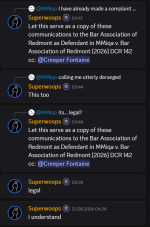
In conjunction with the above filing, the Defense wishes to submit the following as evidence.

1787526736582.png
 
Back
Top