
Appeal: Pending INTERLOCUTORY MasterCaelen v. Hon. Magistrate Dr_Eksplosive [2026] FCR 14

Franciscus

26th President
State Department
Congressional Staff
Supporter
Oakridge Resident
Homeland Security Department
Health Department
President
Multiman155
Multiman155
Electoral Manager
Joined
Apr 25, 2025
Messages
1,528


Username: Multiman155

I am representing a client

Who is your Client?: MasterCaelen

File(s) attached

What Case are you Appealing?: BurgersBeware v. Modzy & Spyders_Crypt [2026] DCR 23

Link to the Original Case: Lawsuit: Pending - BurgersBeware v. Modzy & Spyders_Crypt [2026] DCR 23

Basis for Appeal: INTERLOCUTORY APPEAL - See Brief Below

Supporting Evidence: See Brief Below
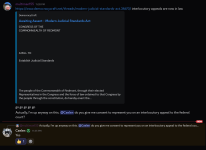
 

Attachments

  • consent to represent.png
    consent to represent.png
    151.8 KB · Views: 6

Brief


IN THE FEDERAL COURT OF THE COMMONWEALTH OF REDMONT

INTERLOCUTORY APPEAL​

MasterCaelen,
Appellant

v.

Hon. Magistrate Dr_Eksplosive
Appellee​

SUMMARY
In BurgersBeware v. Modzy & Spyders_Crypt [2026] DCR 23, the District Court has issued an Emergency Injunction effectively freezing $6 million worth of the Appellant's rightful assets, even as the Appellant is not a party to that case. The Emergency Injunction was sought by the Plaintiff to "the loss of any meaningful ability to collect on a final judgment due to dissipation of assets during litigation", and the Plaintiff sought a total of $76,500 in damages.

This Emergency Injunction is greatly disproportionate to the harm caused, exceeds the jursidiction of the District Court, and causes more harm to Appellee than it prevents for the underlying case's Plaintiff. Additionally, as the Appellant is not a named party to the underlying case, and has not been summoned thereto, the Appellant has no way to challenge this ruling in the District Court. Appellant alleges that the District Court erred at Common Law and acted unconstitutionally, causing immediate harm to the Plaintiff that impact the fairness and accuracy of the underlying case, and for which waiting until a final judgement in the underlying case would only worsen existing conditions. The Appellant thus appeals on an interlocutory basis and prays that the Federal Court intervene to release the Appellant from the Emergency Injunction on an emergency basis.​

I. Factual and Legal Background​

I.I. The underlying case, and the emergency injunction​

On 19 February, BurgersBeware v. Modzy & Spyders_Crypt [2026] DCR 23 ("the Underlying Case") was filed. In the Underlying Case, BurgersBeware was listed as Plaintiff (hereafter "Underlying Case Plaintiff"), Modzy was listed as "First Defendant", and Spyders_Crypt was listed as "Second Defendant". Appellant was not named as a party, ([2026] DCR 23, Post No. 1). When summonses to Defendants were issued, Appellant was not summonsed to the case ([2026] DCR 23, Post No. 3).

Subsequent to filing the case itself, Underlying Case Plaintiff's counsel had filed a Motion for Emergency Injunction that explicitly naming this Appellant as a "relief defendant" ([2026] DCR 23, Post No. 2). The injunction sought, among other items:
  1. to prohibit Appellant "from transferring, selling, gifting, encumbering, laundering, or otherwise disposing of liquid cash and transferable assets"
  2. to require Appellant "to provide a prompt accounting identifying bank balances, liquid cash, significant item reserves, shares, and real property sufficient to implement the injunction"
  3. To have the Court "impose a constructive trust over the assets transferred from the First Defendant to MasterCaelen"
In all this, the Underlying Case Plaintiff explicitly asked for "only preservation of assets up to an amount equal to or exceeding the Prayer for Relief" in a manner "consistent with the 'freeze until the value exceeds the prayer for relief' framework previously accepted and granted in [2022] FCR 47". The harm the Underlying Case Plaintiff sought to prevent was "the loss of any meaningful ability to collect on a final judgment due to dissipation of assets during litigation".

I.I.I. The District Court granted an extremely overbroad Emergency Injunction​

The District Court Granted an Emergency Injunction ([2026] DCR 23, Post No. 4). Specifically, the District Court ordered the Department of Homeland Security to:
- Freeze and seize the assets of Spyders_Crypt to avoid harm to pending adjudication.
- Freeze and seize the assets of Modzy_ to avoid harm to pending adjudication.
- To identify, then freeze and seize the assets formerly belonging to Modzy_ that was transfered to one MasterCaelen, to avoid any disposal of assets or otherwise any form of tampering with any pending adjudication.

For the duration of this case, or until otherwise ordered by the presiding officer.
This was extremely broad. For the third of these items, the District Court froze all assets transferred by Modzy_ to MasterCaelen. The Underlying Case Plaintiff's exhibit ([2026] DCR 23, Post No. 2, Exhibit P-001) indicates that these frozen assets were worth in excess of $6 million, even as the Underlying Case Plaintiff sought a mere $76,500.00 in damages ([2026] DCR 23, Post No. 1, Prayer for Relief No. G).

I.II. Underlying Case Plaintiff made several provably false factual claims in support of the Emergency Injunction, but the Appellant can't directly challenge this in the District Court​

Why did Underlying Case Plaintiff seek this injunction? Underlying Case Plaintiff repeatedly alleged that funds were transferred from the First Defendant to the Appellant after the time of their lawsuit's filing (or at least after when the First Defendant was aware that a lawsuit was incoming)
  1. that Appellant had received assets from the First Defendant in the underlying case in a manner "contemporaneous with the filing of [the Underlying ]lawsuit and at a time when the First Defendant was aware of the pending litigation" (emphasis mine);
  2. that "MasterCaelen now holds assets that were part of the First Defendant's estate at the time of filing and that are directly traceable to the First Defendant" (emphasis mine);
  3. that frozen "assets now held by Relief Defendant MasterCaelen []are directly traceable to the First Defendant's pre-litigation estate" (emphasis mine);
There's just one problem with these contentions - the Underlying Case Plaintiff got the timeline plainly wrong.

I.II.I. A simple check of open-source materials indicates that Underlying Case Plaintiff mislead the Court with their proposed timeline​

Among the frustrations of the Appellant is that the factual record in the underlying case seems to have confused the Court into thinking that the assets were transferred from Modzy_ to the appellant after or during the alleged chicken spawning incident that spurred the underlying case. But upon review of open source material, the transfer of assets occurred well before the alleged incident. Modzy_ announced the transfer of assets at 12:38 A.M. Eastern Standard Time on 18 February 2026 (Exhibit A-002), and a news report (Exhibit A-001) dated 9:13 P.M. Eastern Standard Time on the same day indicated that the alleged chicken spawning incident would have been "early this evening" on that day. The Underling Case was filed at 2:00 A.M. EST on 19 February 2026.

A corrected timeline, thus, proceeds as follows:
  • Feb 18, 12:03 A.M. EST (Feb 17, 11:03 P.M. CST in Exhibit A-004): Modzy_ communicates to Appellant that the transaction had been completed
  • Feb 18, 12:38 A.M. EST: Modzy_ publicly indicates that he had transferred assets to MasterCaelen (see: Exhibit A-002)
  • Feb 18, 9:13 P.M.: CNN reports that "Early this evening, a player by the name of Modzy_ decided to use a large number of chicken eggs to flood spawn with dozens of baby chickens.")
  • Feb 19, 2:00 A.M.: the Underlying Case was filed.
Knowing this, let's revisit the timeline claims made by Underlying Case Plaintiff as laid out in Section I.II:
  1. that Appellant had received assets from the First Defendant in the underlying case in a manner "contemporaneous with the filing of [the Underlying ]lawsuit and at a time when the First Defendant was aware of the pending litigation" (emphasis mine);
  2. that "MasterCaelen now holds assets that were part of the First Defendant's estate at the time of filing and that are directly traceable to the First Defendant" (emphasis mine);
  3. that frozen "assets now held by Relief Defendant MasterCaelen []are directly traceable to the First Defendant's pre-litigation estate" (emphasis mine);
  1. Was the receipt of assets contemporaneous with the filing of the underlying lawsuit, and was Modzy_ aware of the pending litigation at the time he transferred assets? No. Even if the evening were to have begun at 5:00 P.M. Eastern Time from the perspective of the CNN writer, Modzy_ would have transferred assets to MasterCaelen about 17 hours prior.
  2. Were the assets publicly reported to have been transferred to MasterCaelen "part of the First Defendant's estate at the time of filing" of the underlying case? Also no. They were transferred away well before the alleged chicken spawning incident, and before any tort alleged in the Underlying Case is alleged to have occurred.
  3. Were the assets transferred to MasterCaelen part of the "pre-litigation estate" of Modzy? No, they were Caelen's.
This is all wonderful for the Appellant, and the Appellant would be happy to present this in the District Court and correct the record. Unfortunately, there is something stopping him from doing so - nobody actually named this appellant as a party to that case, so Appellant has not been summoned, and the Courts generally prevent people like Appellant from unilaterally intervening when people like Appellant has not been summoned.

I.II.II. Having not been summoned nor named as a party, appellant has had no means by which to challenge this emergency injunction in the District Court​

Individuals generally may not speak in nor file motions in Court threads unless summoned, and "Speaking in cases that you have not been summoned to has been held to automatically be contemptible" ([2025] FCR 119 - Contempt of Court Charge - Appeal, Verdict, Section II). This has even been the case when the rights of individuals may be implicated in a case to which they are not a party (see: Dusty_3 v. Commonwealth of Redmont [2023] SCR 8, Post No. 29, finding xEndeavour in Contempt of Court).

As such, absent a summons, appellant may not file motions, such as a motion to reconsider, in the underlying case. This deprives the Appellant of the ability to challenge the Emergency Injunction directly in the District Court.

I.III. Appellant is suffering immediate harm as a result of the Emergency Injunction granted in the Underlying Case​

This freeze has effectively halted the Appellant's business operations and caused significant financial damage to both Appellant and various third-parties.

A loan was taken out from Appeallant's bank, which temporarily reduced that bank's available liquidity and left it short on funds needed to cover all customer deposits. To correct this and restore stability (20M+), appellant had been actively working to sell plots to increase liquidity. However, the freeze has prevented appellant from doing so, potentially costing appellant high-value buyers and delaying appellant's ability to fully cover the loaned funds.

In addition, Appellant's companies (Vindren Holdings and Kantonic Bank; see Exhibit A-005 for a full list) have been forced to pause operations. Some of these firms were quite developed, including Kantonic (in-game /db entity for the Kantonic bank is "RKB"; see, Exhibits A-006 through A-009 for more supporting details). Customers are currently unable to deposit or withdraw funds, which directly impacts other players who rely on Appellant's bank to store and manage their money.

As a result, the Emergency Injunction risks businesses being unable to pay employees or cover operating costs. This not only harms those business, but also risks permanent damage to our reputation and risks losing long-term clients, costing us millions in potential revenue.

Vindren Holdings’ entire business model revolves around trading plots and buying/selling assets. With trading frozen, our core operations are completely shut down. Appellant and his firms are suffering substantial financial losses over a case that they are not so much as able to defend themselves in.

II. Grounds for Interlocutory Appeal​

Under the Modern Judicial Standards Act, an appellant "may petition for an interlocutory appeal to the relevant higher court when a clear error of law occurs during proceedings that materially biases the outcome of the lower court case". The Act also sets out a three-part test for how to handle interlocutory appeals.
The following conditions must be met for an interlocutory appeal to be considered:
(a) The alleged error constitutes a significant legal mistake, not merely a disagreement with the lower court's interpretation;
(b) The error substantially impacts the fairness or accuracy of the ongoing proceedings; and
(c) Delaying resolution until a final judgment would cause irreparable harm.
As shown below, the District Court made significant legal mistakes in issuing the Emergency Injunction out-of-line with statute and precedent, failing to adhere to the Charter of Rights and Freedoms in Section 35 of the Constitution, and exceeding constitutional limits to the District Court's jurisdiction. These errors impacted the fairness of the ongoing proceeding inasmuch as the Appellant is totally denied the ability to respond to them for lack of summons and inasmuch as Appellant is unable to correct the factual record. The Injunction will furthermore cause irreparable harm to the Appellant (and various third parties), as the freezing wide swaths of the Appellant's assets that have been invested in businesses will cause permanent reputational harm and worsening of conditions for the Appellant the longer that the injunction remains in force.

II.I. The District Court committed significant legal mistakes in granting the Emergency Injunction​

At issue in this appeal is whether or not the Emergency Injunction in the Underlying Case, as granted by the District Court, was caused by significant legal mistakes. As "[w]hen reviewing this case, the most important question needing to answered first is what law applies and where," (End v. Commonwealth of Redmont [2025] FCR 31), we first examine the underlying law around Emergency Injunctions.

II.I.I. Legal Error 1: The Emergency Injunction causes more harm than it prevents, violating the Common Law​

II.I.I.I. Emergency Injunctions must be granted to prevent harm, not cause harm
Under Statute, emergency Injunctions are injunctions "that are issued before the court has tried a case to prevent harm" (Judicial Standards Act, Section 9(1)(b)). The Courts have recognized in their precedent that the purpose of an emergency injunction is to be a "preventative measure against harm" (dodrio3 v. The Commonwealth of Redmont [2024] SCR 4, Post No. 2). But how does the Court determine whether issuing an Emergency Injunction might "prevent harm"?

The Supreme Court has laid out that the harm done by granting an emergency injunction must not be greater than the harm prevented by granting it (see: ToadKing v. Commonwealth of Redmont [2025] SCR 18, Post No. 5, "Supreme Court will not be granting an emergency injunction... the harm done by removing one third of all Judges for perhaps a month or more is far greater than allowing her to continue her work"), as has the Federal Court (see: RaiTheGuy v. Department of Commerce [2025] FCR 29, Post No. 3, "The goal of preventing harm for other bidders does not presently outweigh the harm caused by shutting down the mystery box program"). The Federal Court has also laid out that Emergency Injunctions may not generally bring about "preemptive action [that] would undermine the principle of a fair trial and due process" (Redmont Bar Association (RBA) v. AlexanderLove [2024] FCR 117, Post No. 9; ibid, Post No. 61, re-affirming on Motion to recondiser).

In other words, Emergency Injunctions are granted to prevent harm, but (1) the Court must also consider the harm caused by the granting of the Emergency Injunction; (2) the Court must not grant an emergency injunction when the harm caused by granting it exceeds the harm prevented by granting it; and (3) the Court must not violate the principles of fair trial and due process when granting an Emergency Injunction.

Now that this is settled, let's turn to whether the District Court adhered to this framework.

II.I.I.II. The harm caused by freezing and seizing ~$6 million worth of appellant's assets is in gross excess of the harm prevented by protecting the Underlying Case Plaintiff's ability to collect $76,500.

The Underlying Case Plaintiff, in seeking an emergency injunction, sought to prevent "the loss of any meaningful ability to collect on a final judgment due to dissipation of assets during litigation" ([2026] DCR 23, Post No. 2). The Underlying Case Plaintiff's prayers for relief, if all granted in full, would grant the Plaintiff a total of "$76,500.00" ([2026] DCR 23, Post No. 1, Prayer for Relief No. G).

As discusses supra, the District Court ordered the Department of Homeland Security "[t]o identify, then freeze and seize the assets formerly belonging to Modzy_ that was transfered to one MasterCaelen, to avoid any disposal of assets or otherwise any form of tampering with any pending adjudication" ([2026] DCR 23, Post No. 4). The Underlying Case Plaintiff had presented the Court with evidence that the value of these assets exceeded $6 million ([2026] DCR 23, Post No. 2, Exhibit P-001).

Seizing $6 million worth of assets is extraordinary and plainly nonsensical to secure the Underlying Case Plaintiff's ability to collect on a potential relief of $76,500. It beggars belief that the seizure of ~80 times the amount of assets sought by the Underlying Case Plaintiff would plausibly be required ensure that the Underlying Case Plaintiff receives full payment should they succeed on all their claims. This was an extreme overreach by the District Court, as such a broad and sweeping seizure was not necessary to prevent the harm.

Emergency Injunctions must be issued to prevent harm, not cause it. As this Emergency Injunction caused more harm than it prevented, the District Court plainly erred.

II.I.II. Legal Error 2: The Emergency Injunction's sweeping scope of seizure constitutes unreasonable seizure under Const. 35(15)​

Having established that it was not necessary to seize the whole of assets transferred from Modzy_ to the Appellant in order to protect the Underlying Case Plaintiff (see II.I.I and subsections thereof), we now turn to the question of whether or not this seizure ordered by the Court was unconstitutional.

The Redmont Charter of Rights and Freedoms guarantees the rights set out within it, subject only to "reasonable limits prescribed by law that are justified in a free and democratic society" (Const. 35). Among these rights is "the right to be secure against unreasonable search or seizure" (Const. 35(15)).

The Emergency Injunction seized assets from the Appellant which the Underlying Case Plaintiff represented as being at or in excess of $6 million ([2026] DCR 23, Post No. 2, Section (a), describing assets and including P-001; [2026] DCR 23, Post No. 4, granting injunction). The Underlying Case Plaintiff communicated that the very reason for seizing assets would be to prevent asset flight, but one cannot reasonably conclude that the seizure of ~80 times the amount of assets sought by the Underlying Case Plaintiff as prayers for relief in the Underlying Case would be reasonably tailored in that manner.

The District Court could have limited the seizure to be only for assets up to $76,500 from among the defendants, fully bonding the amount sought in prayers for relief. It went so far beyond that point that we are no longer in reasonable territoriy. Doing so was an error of law by the District Court

II.I.III. Legal Error 3: The District Court lacks constitutional jurisdiction to freeze $6 million in assets​

We must examine whether the District Court erred on jurisdictional grounds when freezing all of the Appellant's assets acquired from Modzy_.

Jurisdiction for the District Court is principally laid out in the 15th and 16th Sections of Constitution. The purpose of the District Court is to " hear[] ‌all‌ ‌minor‌ ‌civil‌ ‌and‌ ‌criminal‌ ‌disputes‌ ‌in‌ ‌the‌ ‌first‌ ‌instance" (Const. 15). Specifically, minor civil cases are those "whose‌ ‌value‌ ‌does‌ ‌not‌ ‌exceed‌ more than $120,000 dollars" (Const. 16).

The Underlying Case Plaintiff represented the assets transferred from Modzy_ to the Appellant as being at or in excess of $6 million ([2026] DCR 23, Post No. 2, Section (a), describing assets and including P-001 therein). Why then, can the District Court issue an emergency injunction that would ensnare these assets?

Our answer is that it cannot. The Constitution empowers the Federal Court with original jurisdiction over "Major ‌civil‌ ‌cases‌ ‌whose‌ ‌value‌ exceeds $120,000 dollars... and [a]ny cases of significance that do not fit within the established bounds of court jurisdictions" (Const. 18(c-d)). If there were a court with proper jurisdiction to issue such an Emergency Injunction, it would be the Federal Court, not the District Court.

Thus, the District Court committed an error of law in issuing the Emergency Injunction without constitutional jurisdiction to do so.

II.I.IV. Legal Error 4: The District Court failed to provide the Appellant an opportunity to be heard, violating Const. 35(9) and Const. 35(14)​

Next, we turn to whether or not the District Court violated Const. 35(9) and Const. 35(14) in enjoining their assets without providing the appellant an opportunity to be heard in the case.

Citizens in Redmont are afforded a "right to a speedy and fair trial presided over by an impartial Judicial Officer, and to be informed of the nature and cause of the accusation, and to be confronted with the evidence against them, and to have the assistance of legally qualified counsel for their defence" (Const. 35(9)). Additionally, "[e]very citizen has the right to life, liberty, and security of the person and the right not to be deprived thereof except in accordance with the principles of fundamental justice" (Const. 35(14)).

As discussed supra in Section II.I.I.I, Emergency Injunctions may not generally bring about "preemptive action [that] would undermine the principle of a fair trial and due process" (Redmont Bar Association (RBA) v. AlexanderLove [2024] FCR 117, Post No. 9; ibid, Post No. 61, re-affirming on Motion to recondiser).

In this case, the Appellant was not a named party in the Complaint of the original case. The Underlying Case Plaintiff was not suing the Appellant. And, even so, the District Court froze assets in the possession of the appellant and ordered seizure of these assets from the Appellant without allowing the Appellant to present their own defense—not even after the Emergency Injunction was issued.

When an individual's rights are at jeopardy, that individual has a constitutional right to present their own defense at trial. This has been recognized by the Supreme Court in a criminal prosecution context (see: [2022] SCR 20 - Appeal Request, accepting an appeal when appellant "was criminally prosecuted without representation" in the context of a broader civil trial), but applies equally in a civil context. Crucially, in the appeal of [2022] SCR 20, the largest underlying crime in [2022] SCR 20 was a series of ticking Contempt of Court charges arising from alleged violations of an Emergency Injunctions that affected a party not summoned to the case. The appeal implicitly recognizes that people bound by Emergency Injunctions must be afforded a right to represent themself in Court.

In failing to issue a summons to the Appellant for defense of Appellant's rights, the District Court has effectively denied the ability of the Appellant to have counsel file motions on their behalf in that case. This has constructively deprived Appellant of a right to fair trial, denied Appellant the ability to confront evidence against them in the District Court, and left the Appellant with no means by which to get the District Court to reconsider its decision other than this appeal. It has deprived the Appellant of the security of their person and possessions without due process.

Every citizen must have the ability to contest legal claims made that would negatively impact them. This injunction, without a summons to Appellant, thus undermines the principle of a fair trial and due process guaranteed under the Charter and recognized by Supreme Court precedent. This error must be reversed.

II.II. The legal errors substantially impacted the fairness and accuracy of the Underlying Case's proceedings​

The four legal errors in issuing the emergency injunction in the Underlying case have caused the proceedings to become unfair towards the Appellant, and have damaged the accuracy of the proceedings. This includes unfairness due to deprivation of due process and various other constitutional rights, as well as inaccuracies in the trial record presently left unrefuted by this Appellant who lacks the ability to introduce evidence and make factual representations in their own defense.

II.II.I. Fundamental fairness is compromised by the District Court's issuance of an Emergency Injunction that violates the constitution, causes more harm than it prevents, and/or falls outside of the District Court's jurisdiction, all while the District Court has not provided the Appellant an opportunity to be heard​

Each and every legal error identified this appeal impacts fundamental fairness. The District Court acted unfairly in issuing a sweeping emergency injunction that seizes ~80 times more than is necessary for securing the Underlying Case Plaintiff's ability to collect, causing constitutional injury to Appellant in multiple ways, exceeding jurisdictional limits, and in all this failing to invite the Appellant to be heard.

The ongoing procedings are prejudiced by this, inasmuch as there is no way at present for this Appellant to intervene on his own behalf, to present novel arguments, to engage in discovery, and to answer factual allegations in his own right; absent a statutory general right or creation of a (not-in-existence) motion to intervene under the Court rules, there is no way to solve this except by relief from this Court.

II.II.II. Failing to provide the Appellant an opportunity to be heard has impacted the accuracy of the trial court's factual record​

As described supra in Section I.II et seq. there are numerous factual errors on the record in the District Court that may have affected the justification for the emergency injunction. These errors include several attestations as to the timing of the transfer of assets between the First Defendant and the Appellant made by the Underlying Case Plaintiff that appear to line up with neither public records nor the truth of the matter. To keep the matter short (see I.II et seq for the full analysis), the Underlying Case Plaintiff repeatedly represented to the Court that the transfer of assets to Appellant occurred during or after the alleged torts occurred, even as public records and the ultimate truth of the matter indicate that the Appellant received the materials over half-a-day before any alleged action contributing to the Underlying Case's Claims for relief occurred.

As such, the factual accuracy of the underlying proceeding suffers from the lack of the Appellant's participation, prejudicing the ongoing proceeding. If the District Court were to make factual conclusions that affect the Appellant without the Appellant's participation, and if these errors of fact were to be left uncorrected, a Court judgement in finding the facts to be as alleged by the Underlying Case Plaintiff would risk irreparable harm.

II.III. Delaying resolution until final judgement in the underlying case would irreparably harm the Appellant​

Appellant is, at present, unable to intervene in the District Court proceedings, despite appellant's assets being indefinitely seized. In the interim, the Appellant is simply subject to the injunction, which threatens to essentially freeze a tax-exempt bank he has worked very hard to get to the market (Kantonic, in-game as RKB), freeze a ginormous chunk of the Appeallant's assets, and subject the Appellant to continuous constitutional injury in doing so.

Cases can take many months from inception to completions—YeetGlazer v. Commonwealth of Redmont [2025] FCR 76 was filed on 3 August 2025 and was completed over 6 months later on 8 February 2026—and we have no crystal ball that lets us to know how long the Underlying Case will take. Every additional day that this seizure goes on is additional harm that the Appellant suffers, and indefinite extension of constitutional harm (see supra at Sections II.I.II, II.I.II and II.I.IV) is plainly irreparable. And there is no way to repair the damage that will be done if the whole Underlying Case proceeds without the ability for the Appellant to be heard; the exclusion from the case until after final judgement would be the cause of harm itself.

II.IV. Conclusion​

The District Court committed four major legal errors in the issuance of the Emergency Injunction:
  1. The extreme breadth Emergency Injunction caused substantially more harm to the Appellant than harm to the Underlying Case Plaintiff it prevented (and more harm than was necessary to secure the rights of the Underlying Case Plaintiff), in violation of the Common Law;
  2. The Emergency Injunction's sweeping seizure of $6 million+ of assets constitutes unreasonable seizure under Const. 35(15) when the purported reason for the seizure was to ensure that the Underlying case Plaintiff could collect $76,500 in the case that Underlying Case Plaintiff were to have won the case;
  3. The District Court exceeded its jurisdiction granted under Sectiosn 15-16 of the Constitution by freezing $6 million+ in assets;
  4. In all of this, the District Court failed to provide the Appellant an opportunity to be heard, violating the Appellant's ninth and fourteenth Charter Rights.
These legal errors impacted the fairness of the underlying proceeding as well as the factual accuracy thereof, as this Appellant has no means by which to intervene in the District Court to contest each of these errors. And Delaying resolution until final judgement would only compound the issues and cause more harm to the Appellant.

Therefore, this interlocutory appeal should be granted, and the Federal Court should provide relief to the Appellant.

III. Prayer for Relief​

  1. Declaratory Relief. The Appellant Prays that the Federal Court declare:
    1. That the District Court's Emergency Injunction to be overbroad and cause more harm to the Appellant than (a) is necessary for preventing harm to the Underlying Case Plaintiff, and (b) than would be prevented by issuing the Emergency Injunction in the first place;
    2. That the District Court's Emergency Injunction is unconstitutional under Section 35(15).
    3. That the District Court lacks jurisdiction to freeze assets in excess of the $120,000 limit for civil cases given in Const. 16.
    4. That the District Court's lack of summons to the Appellant, and consequent lack of the Appellant to be heard by the Court on the Emergency Injunction even after issuance thereof, breaches the fair trial and due process rights established by the text and penumbra of Const. 35(9) and Const. 35(14).
  2. Injunctive Relief. The appellant Prays that the Federal Court enter an injunction to remediate the harms caused by the District Court, seeking that the FCR:
    1. Permanently enjoin enforcement of the District Court's Emergency Injunction as it pertains to the Appellant and remand the issue to the District Court for a new injunction in line with this Court's Declaratory Judgements.
    2. Order that any assets seized therefrom by the Commonwealth pursuant to the Emergency Injunction in the Underlying Case be returned to the Appellant as soon as practicable.
  3. Other Relief. Any further equitable or monetary relief as the Federal Court may see fit to enter, including legal fees if applicable.

IV. Exhibits​

1772477355209.png
1772477363547.png
1772477373232.png
1772477379741.png
Archive URL: https://archive.is/SuyX3
PDF Copy: See Attached PDF whose title begins with Exhibit A-006
Archive URL: https://archive.is/tR76i
PDF Copy: See Attached PDF whose title begins with Exhibit A-007
Tax Exempt Entities List
See attached PDF whose title begins with Exhibit A-008
1772477392184.png


Attachments

Motion


IN THE FEDERAL COURT OF THE COMMONWEALTH OF REDMONT
MOTION FOR EMERGENCY INJUNCTION

Your Honor,

The Emergency Injunction in the case BurgersBeware v. Modzy & Spyders_Crypt [2026] DCR 23 is causing immediate and irreparable harm to the appellant in this case through the seizure of what that case's Plaintiff has described as $6 million worth of the Appellant's assets. This is actively prohibiting the Appellant from conducting business and is causing both active loss of enjoyment (in the opportunities that are being missed) and worsening of existing conditions (inasmuch as reputation damage may be sustained), as well as constitutional injury due to unreasonable seizure.

The Appellant has put forward a plausible case in the Appeal that the Emergency Injunction in [2026] DCR 23, as applied to Appellant, was granted through several errors of law. Appellant argues that the balance of equities would favor releasing the appellant from the Emergency Injunction at this time until this appeal is fully resolved.

Therefore, the Appellant requests the following Emergency Injunction be issued:

  1. The Department of Homeland Security is Enjoined from enforcing against the Appellant the Emergency Injunction granted by the District Court at 9:55 A.M. on 3 March 2026, until such a time as this interlocutory appeal is fully handled;
  2. The Emergency Injunction granted by the District Court at 9:55 A.M. on 3 March 2026 is stayed pending resolution of this appeal.
We pray to Your Honor for this swift Emergency Relief.

 
Back
Top