Lawsuit: Pending Slime_Mario v. Commonwealth of Redmont and Vernicia [2026] DCR 148

Slime_Mario

Citizen
Slime_Mario
Slime_Mario
Solicitor
Joined
May 27, 2026
Messages
41

Case Filing


IN THE DISTRICT COURT OF THE COMMONWEALTH OF REDMONT

CIVIL ACTION


Slime_Mario
Plaintiff

v.

The Commonwealth of Redmont (Department of Homeland Security) & Vernicia
Defendants


COMPLAINT

The Plaintiff complains against the Defendants as follows:

WRITTEN STATEMENT FROM THE PLAINTIFF

Vernicia evicted the Plaintiff from a leased office in Lil Rossiya solely because he publicly disagreed with her policy opinions in the community Discord. When the Plaintiff continued to renew his lease lawfully through server commands, Vernicia prompted the Department of Homeland Security (DHS) to fine him repeatedly without legal justification.
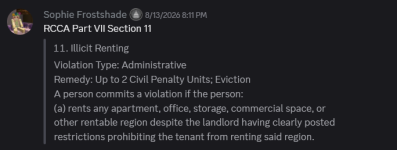
DHS debited three fines totaling $720.00 from the Plaintiff for alleged "Illicit Renting" under the Redmont Civil Code Act (RCCA) Part VII, Section 11. However, Illicit Renting requires a tenant to rent property despite "clearly posted restrictions" on the premises. No restrictions were ever posted at the property. DHS issued these fines without notice and without giving the Plaintiff an opportunity to respond. Had the property been inspected, no restriction would have been found.
The Plaintiff was subsequently removed from the property twice without refunding his prepaid rent properly, and second time the leasehold was transferred directly to Vernicia, automatically vaulting all of the Plaintiff's blocks and items. The Plaintiff brings this action to reverse the unlawful fines, obtain full restitution, recover unrefunded rent, and hold both Defendants accountable for wrongful eviction and due process violations.

I. PARTIES
  1. Slime_Mario (Plaintiff)
  2. Department of Homeland Security (Defendant)
  3. Vernicia (Defendant)

II. FACTS

  1. The Plaintiff leased 432office-1 in Lil Rossiya from Defendant Vernicia for $25.00 per 30d. (P-001)
  2. All timestamps in this Complaint are stated in server time (UTC).
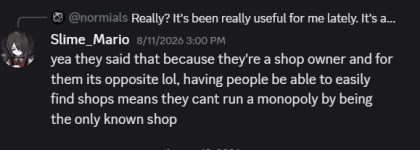
  3. On August 10, 2026, Defendant Vernicia advocated in Discord for the removal of the /find shop search command. (P-002)
  4. On August 11, 2026, at 19:00 UTC, the Plaintiff publicly disagreed with Vernicia, stating that removing /find would protect established shop owners from market competition. (P-002)
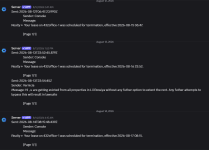
  5. On August 12, 2026, at 06:47 UTC, Vernicia evicted the Plaintiff from 432office-1. The eviction took effect through the Realty system, which notified him that his lease was scheduled for termination on August 15, 2026. Every Console notice in this Complaint records an eviction initiated by Vernicia. A tenant may reset a scheduled termination by ending and immediately re-taking the lease through the server rental commands. (P-003)
  6. Vernicia alleged no lease violation, property damage, inactivity, or rule breach by the Plaintiff. (P-003)
  7. On August 12, 2026, at 16:08 UTC, the Plaintiff terminated and immediately re-rented 432office-1 through the server's ordinary rental commands, receiving an automated refund of $25.00 and paying $25.00. This reset the scheduled termination. He did so as any tenant may, and at that time no restriction of any kind had been posted at the property prohibiting him from doing so. That payment predates the transaction ledger extract at Exhibit P-006, which is why only its subsequent refund of $23.84 appears there. (P-010)
  8. On August 13, 2026, at 23:06 UTC, during a Discord discussion on chestshop taxes, the Plaintiff argued for policies supporting small shops. Vernicia referred to the Plaintiff as an "evicted guy" and declared him "forever banned from Lil Rossiya." The Plaintiff noted that these messages did not alter in-game lease rights. (P-005)
  9. During that same exchange, Vernicia stated to the Plaintiff: "Thingis work out for many players who actualy are not complaining , if u was not contantly toxic on me i woud even give u refund for your rent like to others" [sic]. Vernicia thereby confirmed that she refunds rent to other tenants, and that she withheld the same treatment from the Plaintiff because of his criticism of her. (P-005)
  10. On August 13, 2026, at 23:52 UTC, while that exchange was still in progress, Vernicia evicted the Plaintiff a second time. The Console notified him that his lease was scheduled for termination on August 16, 2026. Again she alleged no breach of tenancy. (P-003)
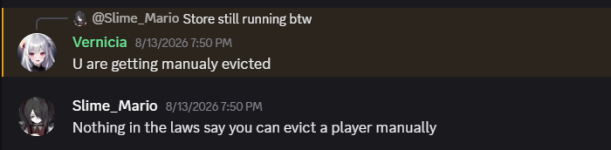
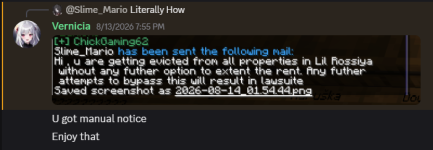
  11. Two minutes later, at 23:54 UTC, Vernicia sent the Plaintiff a direct Discord message stating: "Hi , u are getting evicted from all properties in Lil Rossiya without any futher option to extent the rent. Any futher attempts to bypass this will result in lawsuite" [sic]. (P-004)
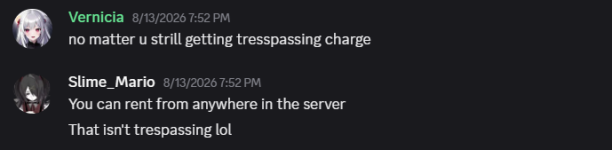
  12. At 23:55 UTC, Vernicia announced in public Discord chat that she had served a "manual notice" and threatened to report the Plaintiff to DHS for trespassing. (P-005)
  13. The Plaintiff inspected 432office-1 and confirmed that no restriction or notice prohibiting him from renting was posted on the lectern or anywhere in the region. (P-008, P-009)
  14. At no point did Vernicia post any restriction or prohibition at 432office-1. Her purported ban existed solely in private Discord messages. (P-002, P-004, P-005, P-008)
  15. On August 14, 2026, at 01:40 UTC, the Plaintiff again reset his lease on 432office-1, receiving an automated refund of $23.84 and paying $25.00. This reset the second eviction. (P-006)
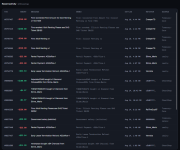
  16. On August 14, 2026, at 09:32 UTC, DHS debited a fine of $250.00 from the Plaintiff's account for "Illicit Renting," referencing DHS Ticket 38152. The Plaintiff received no prior notice and no opportunity to contest the charge. He was not online: 09:32 UTC corresponds to 05:32 in his own timezone, and he was asleep. The sum was deducted automatically, without any message, summons, or requirement that he acknowledge or even observe it. (P-006)
  17. That penalty was not accompanied by any forced eviction. DHS imposed the fine and left the Plaintiff's tenancy of 432office-1 undisturbed.
  18. Under RCCA Part VII, Section 11, the maximum penalty for Illicit Renting is 2 Civil Penalty Units ($240.00). The $250.00 fine exceeded the statutory maximum.
  19. On August 16, 2026, at 16:07 UTC, the Plaintiff reset his lease on 432office-1, receiving an automated refund of $22.83 and paying $25.00. He was at that time still unaware that any penalty had been imposed on August 14. (P-006)
  20. Shortly after that payment the Plaintiff was removed from 432office-1. No refund of the $25.00 he had just paid was issued. The region was thereupon advertised in the server chat as available to rent. (P-006)
  21. At 16:30 UTC, believing the removal to have been an error and seeing the office openly advertised as available, the Plaintiff rented it again, paying a further $25.00. (P-006)
  22. On August 16, 2026, at 16:30 UTC and 16:33 UTC, DHS issued two successive $240.00 fines against the Plaintiff for Illicit Renting, again without prior notice or hearing. (P-006)
  23. At 16:43 UTC, DHS refunded the initial $250.00 fine, and at 16:44 UTC issued a replacement fine of $240.00 ("Corrected Fine Amount for Illicit Renting x1 fine 7491"). (P-006)
  24. In total, three $240.00 penalties currently stand against the Plaintiff, totaling $720.00. (P-006)
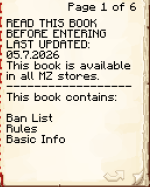
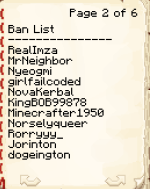
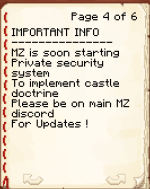
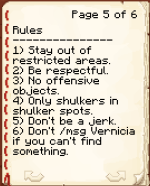
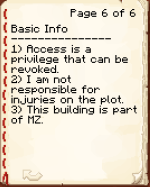
  25. The lectern book at 432office-1 has never displayed the Plaintiff's username. Its pages are reproduced at Exhibit P-008, photographed on August 16, 2026. (P-008)
  26. The Plaintiff was then removed from 432office-1 a second time. Again no refund was issued. This totalled $50.00 in pre-paid rent paid on August 16, of which nothing was returned to him. (P-006)
  27. Neither of the two credits appearing in the ledger relates to that $50.00. The $23.84 credited on August 14 refunded the lease cycle the Plaintiff paid for before the ledger extract begins; the $22.83 credited at 16:07 on August 16 refunded the cycle paid for on August 14. Both were issued automatically because on those occasions the Plaintiff himself ended the lease early. No refund of any kind followed the payments of 16:07 and 16:30 on August 16. (P-006)
  28. The absence of an automated refund mechanism for a transferred lease would not explain the failure. DHS moved funds by hand that same afternoon: at 16:43 UTC it credited $250.00 to the Plaintiff's balance while fixing its own miscalculated penalty. (P-006)
  29. The leasehold for 432office-1 was transferred directly to Vernicia, listing her simultaneously as landlord and renter. (P-007)
  30. Upon the transfer the contents of 432office-1 were automatically vaulted. The Plaintiff's blocks and items were recoverable, but the experience stored within the furnaces he had constructed there was not, experience being incapable of vaulting. That experience was lost. (P-007)

III. CLAIMS FOR RELIEF

1. Wrongful Seizure of Property & Denial of Due Process against the Commonwealth of Redmont

  1. Under RCCA Part XI, Section 4, a government officer commits a violation by seizing property without lawful authority, for which the remedy is restitution. Account balances constitute property.
  2. Furthermore, under RCCA Part XI, Section 6, making a decision affecting rights or interests without notice and a hearing warrants reversal of the decision.
  3. The Commonwealth lacked lawful authority to fine the Plaintiff because no Illicit Renting occurred under RCCA Part VII, Section 11, which strictly requires "clearly posted restrictions prohibiting the tenant from renting said region." Because no restrictions were ever posted at the property, DHS seized $720.00 from the Plaintiff's balance without legal basis, without advance notice, and without an opportunity to be heard.
  4. The Plaintiff requests reversal of all three standing penalties and full restitution of the $720.00 seized

2. Wrongful Eviction, against Defendant Vernicia

  1. Under RCCA Part VII, Section 5, a person commits a violation if they evict a tenant without providing an owed refund (§5(b)) or in retaliation for exercising legal rights (§5(c)).
  2. Under the Property Standards Act (PSA) Part IV, Section 21(4), a tenant who is evicted "must receive a full refund of any prepaid rent," subject only to exceptions for a tenant permanently banned or deported, neither of which applies to the Plaintiff.
  3. Vernicia terminated the Plaintiff's tenancy in direct retaliation for his public policy commentary on Discord, in violation of Section 5(c). The chronology admits no innocent reading. The Plaintiff criticised her position on the /find command at 19:00 UTC on August 11; less than twelve hours later she scheduled his lease for termination. He argued for chestshop tax policy at 23:06 UTC on August 13; forty-eight minutes into that same exchange, at 23:54 UTC, she declared him barred from all her properties with "no futher option to extent the rent," and announced it publicly a minute later. Twice the Plaintiff criticised Vernicia in public, and twice his tenancy was terminated within hours.
  4. She has never alleged a single breach of his tenancy, because none occurred. She said as much herself during that exchange: "if u was not contantly toxic on me i woud even give u refund for your rent like to others," expressly conditioning the refund on his political speech.
  5. Vernicia is thus also answerable under Section 5(b). She had stated plainly that she would not refund the Plaintiff as she refunds her other tenants. She then procured his removal with the DHS ticket, and no refund was given for that removal.
  6. She is the only party to this action who both wished the refund withheld and profited from its being withheld. The Plaintiff does not, however, contend that Vernicia controlled the mechanism of repayment at the moment of eviction. That was DHS, and the failure to comply with Section 21(4) is pleaded against the Commonwealth at Claim 3. Vernicia's liability under Section 5(b) lies in having sought and obtained an eviction while intentionally ensuring that his prepaid rent went unreturned.
  7. The Plaintiff seeks 50 Civil Penalty Units ($6,000.00) against Vernicia, and recovery of the $50.00 in unrefunded rent against Vernicia.

3. Wrongful Eviction, against the Commonwealth of Redmont

  1. Under RCCA Part VII, Section 5(b), a person commits a violation by evicting a tenant "without providing a refund where one is owed."
  2. PSA Part IV, Section 21(4) establishes that the refund is owed: "If a tenant is evicted, they must receive a full refund of any prepaid rent," subject only to exceptions for a tenant permanently banned or deported, neither of which applies to the Plaintiff.
  3. Section 5 is not confined to landlords. It provides that "a person commits a violation if the person... evicts a tenant," whereas Section 4 immediately preceding it begins "being a landlord, enters a tenant's rented region." The drafters restricted that provision to landlords and did not restrict this one. Section 5 therefore reaches whoever performs the eviction. On August 16 that was DHS. DHS removed the Plaintiff from 432office-1 twice on the afternoon of August 16, and on the second occasion transferred the leasehold to Vernicia. He had paid $25.00 at 16:07 and, after the first removal left the office advertised as available, a further $25.00 at 16:30. Neither payment was refunded. While each removal was separately an eviction without the refund Section 21(4) requires, the Plaintiff seeks a single penalty in respect of both.
  4. The two credits appearing in the ledger relate to earlier lease cycles: the $23.84 refunded a cycle paid for before the ledger extract begins, and the $22.83 refunded the cycle paid for on August 14. Neither touches the $50.00.
  5. The Plaintiff anticipates that the rental system may provide no automated means of refunding a tenant whose lease is transferred or forcefully removed, and does not dispute it. The obligation of a refund is not conditioned on administrative convenience, and the capacity to move funds by hand was exercised that very afternoon as at 16:43 DHS credited $250.00 to the Plaintiff's balance. Whoever could credit $250.00 at 16:43 could have credited $50.00 for rent taken at 16:07 and 16:30.
  6. Nor can DHS answer that the landlord did not want the Plaintiff refunded. While Vernicia had said as much publicly three days earlier, whether she repeated it in DHS Ticket 38152 is a matter presently known only to the Defendants. Section 21(4) imposes the obligation of a refund on the entity carrying out the eviction. A public officer may not ignore a statutory duty in favor of the private party who complained to him. If anything, a request to illegaly withhold a refund ought to have prompted the officer to examine the complaint further.
  7. That examination would have ended the matter, as no signs or lecterns were posted with the Plantiff's name to prohibit him from renting. DHS carried out an eviction it had no authority to carry out.
  8. The Plaintiff seeks 50 Civil Penalty Units ($6,000.00) against the Commonwealth of Redmont.

4. Consequential Damages: Loss of Enjoyment, against Defendant Vernicia

  1. Under RCCA Part III, Section 5(1)(a)(iii), a plaintiff is entitled to consequential damages for Loss of Enjoyment, evaluated under the reasonable person standard in Atreides Clients (Class Action Group) v. Atreides [2024] FCR 87.
  2. Vernicia's retaliatory eviction deprived the Plaintiff of an office he had rented continuously and lawfully. When the leasehold was transferred, his blocks and items were vaulted and remain recoverable, but the experience stored in the furance experience farms he had constructed there was lost, as experience is incapable of vaulting. The Plaintiff acknowledges that he holds no record of the quantity of experience lost and seeks no separate damages count; he pleads it as part of the deprivation of the office. A reasonable person in his position would suffer a comparable loss of enjoyment.
  3. The Plaintiff requests $2,500.00 in consequential damages.

5. Punitive Damages, against Defendant Vernicia

  1. Under RCCA Part III, Section 3, punitive damages may be awarded where a defendant's conduct is outrageous, involves bad faith, an abuse of power, or repeated misconduct (§3(2)(b)(ii), (iv), (v)).
  2. Vernicia engaged in willful misconduct by retaliating against lawful speech, threatening baseless criminal action, and misusing DHS enforcement. Punitive damages are warranted to deter such abuse of landlord authority.
  3. The Plaintiff requests Punitive Damages in an amount determined by the Court.

IV. PRAYER FOR RELIEF

The Plaintiff seeks the following from the Defendant:
  1. Reverse all three standing administrative penalties ($720.00 total) issued under DHS Ticket 38152 for Illicit Renting.
  2. Order the Commonwealth to make full restitution to the Plaintiff in the amount of $720.00.
  3. Award 50 Civil Penalty Units ($6,000.00) against Defendant Vernicia on Claim 2 (Wrongful Eviction).
  4. Award 50 Civil Penalty Units ($6,000.00) against the Commonwealth of Redmont on Claim 3 (Wrongful Eviction), for evicting the Plaintiff without lawful authority and without providing a refund where one was owed.
  5. Order the Defendant Vernicia to pay the Plaintiff $50.00 in unrefunded prepaid rent.
  6. Award $2,500.00 in Consequential Damages (Loss of Enjoyment) against Defendant Vernicia on Claim 2.
  7. Award Punitive Damages against Defendant Vernicia in an amount determined by the Court.
  8. Award Legal Fees pursuant to RCCA Part III, Section 7(2)(a) and (d) (30% of direct damages/penalties, subject to the $3,000.00 District Court mandatory minimum).
EVIDENCE
  • P-001: Screenshot of the /rl info 432office-1 command establishing rental rate of $25.00 per 30d.
    • 1786994217700.png
  • P-002: Discord transcript (attached below in p-002.txt) and screenshots of the /findcommand discussion (August 10–11, 2026).
    • 1786993321570.png
    • 1786993354932.png
  • P-003: Screenshots of Console lease termination notices (August 12–13, 2026).
    • 1786993376686.png
  • P-004: Screenshot of mail message from Vernicia threatening eviction and lawsuit (August 13, 2026)
    • 1786993370193.png
  • P-005: Discord transcript (attached below in p-005.txt) and screenshots of the chestshop tax discussion and DHS trespassing threats (August 13, 2026).
    • 1786993391648.png
    • 1786993395895.png
    • 1786993402094.png
    • 1786993406313.png
    • 1786993410358.png
    • 1786993422105.png
    • 1786993428076.png
    • 1786993432365.png
    • 1786993437401.png
    • 1786993442724.png
    • 1786993448591.png
    • 1786993453391.png
    • 1786993456919.png
  • P-006: Screenshot of economy transaction ledger showing rent payments, DHS fines, and corrections (August 13–16, 2026).
    • 1786993490498.png
  • P-007: Screenshot of /rl info 432office-1showing region transfer to Vernicia as both landlord and renter.
    • 1786993503709.png
  • P-008: Screenshots of every page of the lectern book at 432office-1, photographed on the 16th of August, 2026., showing that the Plaintiff's username does not appear and that no restriction prohibiting him from renting is recorded.
    • 1786993594948.png
    • 1786993599206.png
    • 1786993605680.png
    • 1786993609188.png
    • 1786993613937.png
    • 1786993617808.png
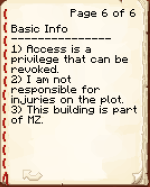
  • P-009: Screenshot of 432office-1 showing no posted signage or notice restricting rental.
    • 1786993647183.png
  • P-010: Screenshot of economy transaction ledger excerpt for August 12, 2026, evidencing the reset of the lease at 16:08 UTC (refund $25.00, payment $25.00).
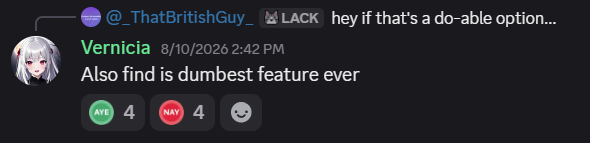
    • 1786993478286.png

WITNESSES

  • None

By making this submission, I agree I understand the penalties of lying in court and the fact that I am subject to perjury should I knowingly make a false statement in court.

DATED: This 17th day of August, 2026.


Attachments
  • 1786993642953.png
    1786993642953.png
    30.1 KB · Views: 29
  • p-005.txt
    p-005.txt
    7.7 KB · Views: 38
  • p-002.txt
    p-002.txt
    1.2 KB · Views: 26
  • 1786993414893.png
    1786993414893.png
    18.5 KB · Views: 39
Last edited:

Motion


IN THE DISTRICT COURT OF THE COMMONWEALTH OF REDMONT
MOTION FOR AN ORDER OF IMMEDIATE INSPECTION AND PRESERVATION OF EVIDENCE

The Plaintiff respectfully moves this Court for an order directing the immediate inspection and preservation of any posted notices at 432office-1, Lil Rossiya, and in support thereof alleges:

  1. Every penalty imposed on the Plaintiff was imposed under Redmont Civil Code Act Part VII, Section 11, which is engaged only where a tenant rents "despite the landlord having clearly posted restrictions prohibiting the tenant from renting said region."
  2. The Plaintiff's case is that no restriction bearing his username has ever been posted at 432office-1. He inspected the lectern on August 13, 2026 and found none, and inspected the book again on August 16, 2026 and found none.
  3. Presently, a lectern book may be edited, and a sign may be placed, by any person with access to the region, including Defendant Vernicia.
  4. The Plaintiff does not have access to the /inspect command.
WHEREFORE, the Plaintiff respectfully requests that this Court:
  1. Direct a government employee nominated by the Court who is not a party to this action, to record the contents of every page of the signs, books, or other posted communication located in the plot leading to 432office-1.
  2. Direct that the /inspect command be used upon any such posting, and that its output be recorded.
  3. Order both Defendants, and any person acting at their direction, to refrain from creating, editing, removing, or otherwise altering any lectern, book, sign, or other posted communication at 432office-1 or its approaches until this matter is determined.


Writ of Summons


@Vernicia and @Matthew100x (or any Prosecutor) is commanded to appear in the District Court in the case of Slime_Mario v. Commonwealth of Redmont and Vernicia [2026] DCR 148

Failure to appear within 72 hours of this summons will result in a default judgement based on the known facts of the case.

Both parties should make themselves aware of the Court Rules and Procedures, including the option of an in-game trial should both parties request one.

 
Your Honor,

I am present to represent Vernicia.
1787761268470.png

Motion


IN THE DISTRICT COURT OF THE COMMONWEALTH OF REDMONT
MOTION FOR AN ORDER OF IMMEDIATE INSPECTION AND PRESERVATION OF EVIDENCE

The Plaintiff respectfully moves this Court for an order directing the immediate inspection and preservation of any posted notices at 432office-1, Lil Rossiya, and in support thereof alleges:

  1. Every penalty imposed on the Plaintiff was imposed under Redmont Civil Code Act Part VII, Section 11, which is engaged only where a tenant rents "despite the landlord having clearly posted restrictions prohibiting the tenant from renting said region."
  2. The Plaintiff's case is that no restriction bearing his username has ever been posted at 432office-1. He inspected the lectern on August 13, 2026 and found none, and inspected the book again on August 16, 2026 and found none.
  3. Presently, a lectern book may be edited, and a sign may be placed, by any person with access to the region, including Defendant Vernicia.
  4. The Plaintiff does not have access to the /inspect command.
WHEREFORE, the Plaintiff respectfully requests that this Court:
  1. Direct a government employee nominated by the Court who is not a party to this action, to record the contents of every page of the signs, books, or other posted communication located in the plot leading to 432office-1.
  2. Direct that the /inspect command be used upon any such posting, and that its output be recorded.
  3. Order both Defendants, and any person acting at their direction, to refrain from creating, editing, removing, or otherwise altering any lectern, book, sign, or other posted communication at 432office-1 or its approaches until this matter is determined.

Response:
Your Honor, we respectfully request that this motion be denied.

The Plaintiff has already preserved the "evidence" of the lectern and surrounding property from the relevant period.

The Plaintiff has also provided no evidence that Vernicia has attempted or intends to destroy or alter any relevant evidence.

Finally, this request is unnecessarily broad. It would prohibit Vernicia from creating, editing, or removing any posted communication at the property for the duration of this case, including restrictions or information not related to it. This would make it impossible for Vernicia to manage her property.

Thank you.
 
Your Honor,

I am present to represent Vernicia.


Response:
Your Honor, we respectfully request that this motion be denied.

The Plaintiff has already preserved the "evidence" of the lectern and surrounding property from the relevant period.

The Plaintiff has also provided no evidence that Vernicia has attempted or intends to destroy or alter any relevant evidence.

Finally, this request is unnecessarily broad. It would prohibit Vernicia from creating, editing, or removing any posted communication at the property for the duration of this case, including restrictions or information not related to it. This would make it impossible for Vernicia to manage her property.

Thank you.
I am appearing for the Commonwealth of Redmont.

Please prepare your Answers within 48 hours. The Motion is not dispositive and a abeyance will not be made.
 
Please prepare your Answers within 48 hours. The Motion is not dispositive and a abeyance will not be made.
Your Honor,

I request a 48-hour extension. I will be single-parenting for at least a day, starting in 1 hour, and will not be able to submit on time. Everything is fine, Wifeslap is on a little gals trip.
 
Your Honor,

I request a 48-hour extension. I will be single-parenting for at least a day, starting in 1 hour, and will not be able to submit on time. Everything is fine, Wifeslap is on a little gals trip.

Tell the child to write the answer. (DENIED!) Extension granted.
I am also requesting a 48-hour extension to work on this over the weekend.

Granted.
 

Answer to Complaint


IN THE DISTRICT COURT OF THE COMMONWEALTH OF REDMONT

ANSWER TO COMPLAINT

Slime_Mario
Plaintiff

v.

The Commonwealth of Redmont
Defendant

The Commonwealth of Redmont, by and through Attorney General Matthew100x, submits this Answer to the Complaint.

I. ANSWER TO COMPLAINT

1. The Defendant AFFIRMS Fact 1. The Plaintiff leased 432office-1 in Lil Rossiya from Defendant Vernicia.

2. The Defendant does not contest Fact 2.

3. The Defendant does not contest Fact 3.

4. The Defendant does not contest Fact 4.

5. The Defendant does not contest Fact 5. The Defendant further states that the alleged actions of Defendant Vernicia do not, standing alone, establish any culpability on the part of the Commonwealth.

6. The Defendant does not contest Fact 6 and further states that the allegation concerns Defendant Vernicia and does not independently establish liability against the Commonwealth.

7. The Defendant does not contest Fact 7 and further states that the allegation does not independently establish culpability against the Commonwealth.

8. The Defendant does not contest Fact 8 and further states that the allegation concerns Defendant Vernicia and does not independently establish culpability against the Commonwealth.

9. The Defendant does not contest Fact 9 and further states that the allegation concerns Defendant Vernicia and does not independently establish culpability against the Commonwealth.

10. The Defendant does not contest Fact 10.

11. The Defendant does not contest Fact 11.

12. The Defendant does not contest Fact 12.

13. The Defendant does not contest Fact 13.

14. The Defendant does not contest Fact 14.

15. The Defendant does not contest Fact 15.


16. The Defendant AFFIRMS IN PART and DENIES IN PART Fact 16. The Defendant affirms that DHS assessed an initial $250.00 penalty for Illicit Renting. The Defendant denies, however, any implication that the Plaintiff lacked notice that his continued re-renting of the property was prohibited. The Plaintiff had repeatedly re-rented a region after the landlord requested that he cease doing so. The Defendant further denies that a pre-enforcement hearing was legally required for the assessment of an administrative violation. Administrative violations are enforceable through an immediate penalty without a formal trial and may thereafter be contested before a judicial officer. (see Part II, § 7(5), Redmont Civil Code Act).

17. The Defendant does not contest that the initial penalty was not accompanied by a forced eviction. The Defendant further states that, by this point, the Plaintiff had been placed on notice that continued prohibited renting could result in enforcement for Illicit Renting.

18. The Defendant AFFIRMS that the initial $250.00 penalty exceeded the maximum penalty of two Civil Penalty Units applicable to Illicit Renting. The Defendant states, however, that this error was subsequently corrected: the original $250.00 penalty was refunded and replaced by a lawful maximum penalty of $240.00. Illicit Renting carries a remedy of up to two Civil Penalty Units. (see Part VII, § 11, Redmont Civil Code Act). Accordingly, no additional $10.00 refund remains outstanding.

19. The Defendant does not contest Fact 19 and further states that the allegation does not independently establish culpability against the Commonwealth.

20. The Defendant does not contest Fact 20 and further states that the allegation does not independently establish culpability against the Commonwealth.

21. The Defendant does not contest Fact 21 and further states that the allegation does not independently establish culpability against the Commonwealth.


22. The Defendant AFFIRMS IN PART and DENIES IN PART Fact 22. The Defendant affirms that DHS assessed two successive $240.00 penalties after the Plaintiff again rented the region despite having previously been directed to cease doing so. The Defendant denies that a pre-enforcement hearing was required. Illicit Renting is classified as an Administrative Violation, and administrative violations are enforceable by a government entity through an immediate penalty without the necessity of a formal trial, subject to subsequent judicial contest. (see Part II, § 7(5), § 9(5), and Part VII, § 11, Redmont Civil Code Act).

23. The Defendant AFFIRMS Fact 23. DHS refunded the initial erroneous $250.00 fine and imposed the corrected $240.00 penalty. The statutory overcharge identified in Fact 18 was therefore corrected.

24. The Defendant AFFIRMS Fact 24 insofar as three $240.00 administrative penalties were imposed. The Defendant states that those penalties represented enforcement of the law against repeated instances of conduct DHS determined constituted Illicit Renting.

25. The Defendant does not contest Fact 25 and states that this allegation concerns the conditions of Defendant Vernicia's property and does not independently establish culpability against the Commonwealth.

26. The Defendant does not contest Fact 26 and states that the allegation does not, standing alone, establish culpability against the Commonwealth.

27. The Defendant does not contest Fact 27 and states that the allegation does not, standing alone, establish culpability against the Commonwealth.


28. The Defendant DENIES Fact 28 insofar as it alleges or implies that DHS's correction of an administrative penalty established either an automated or legally equivalent refund mechanism for a transferred private lease. DHS's correction of its own governmental penalty was distinct from any rent payment associated with the private lease between the Plaintiff and Defendant Vernicia and does not establish that DHS possessed or was legally responsible for an automated private-lease refund mechanism.

29. The Defendant does not contest Fact 29 and states that the allegation does not independently establish culpability against the Commonwealth.

30. The Defendant does not contest Fact 30 and states that the allegation does not independently establish culpability against the Commonwealth.


II. DEFENCES

1. LAWFUL ADMINISTRATIVE ENFORCEMENT AND NO DENIAL OF DUE PROCESS

The Plaintiff's due-process theory incorrectly assumes that DHS was required to provide a trial or hearing before assessing an administrative penalty. Redmont law expressly defines an “Administrative Violation” as a regulatory breach enforceable by a government entity “through an immediate penalty, without the need for a formal trial,” with the affected person permitted to contest the penalty before a judicial officer after enforcement. (see Part II, § 7(5), Redmont Civil Code Act).

The Code further provides that Administrative Violations may be enforced directly by a government entity and are subject to a clear-and-convincing-evidence standard. (see Part II, § 9(5), Redmont Civil Code Act).

Illicit Renting is expressly classified as an Administrative Violation. (see Part VII, § 11, Redmont Civil Code Act).

The Plaintiff therefore had no entitlement to a pre-enforcement formal trial simply because DHS assessed an administrative penalty. The statutory scheme itself contemplates immediate enforcement followed by the opportunity for judicial review.

This is independently confirmed by the Denial of Due Process provision. Although that cause of action generally protects against governmental decisions affecting rights or interests without notice and an opportunity to be heard, the Code expressly provides that the violation does not occur where “there is no statutory requirement to provide notice or an opportunity to be heard for the decision affecting the plaintiff.” (see Part XI, § 6(d), Redmont Civil Code Act).

Moreover, when the Plaintiff challenged the amount of the original $250.00 penalty, DHS refunded that penalty and replaced it with the correct $240.00 amount. This demonstrates that the administrative process remained capable of correction rather than establishing a denial of process.

2.WRONGFUL SEIZURE — LAWFUL STATUTORY POWER
The Plaintiff cannot establish Wrongful Seizure merely by showing that money was deducted from his account. The statutory violation requires property to have been seized “without lawful authority,” and expressly does not occur where the seizure was conducted pursuant to lawful statutory power. (see Part XI, § 4(a), (c), Redmont Civil Code Act).

Part VII § 11 authorizes an administrative monetary remedy of up to two Civil Penalty Units for each instance of Illicit Renting. (see Part VII, § 11, Redmont Civil Code Act). The Civil Code permits administrative violations to be enforced directly by a governmental entity through immediate penalties. (see Part II, § 7(5), § 9(5), Redmont Civil Code Act).

Accordingly, to the extent DHS established the statutory elements of Illicit Renting, assessment of the resulting $240.00 administrative penalties constituted the exercise of lawful statutory enforcement power and falls within the express exception to Wrongful Seizure contained in Part XI § 4(c).

The Commonwealth acknowledges that the initial $250.00 assessment exceeded the statutory maximum by $10.00. That assessment, however, was reversed in full and replaced with a $240.00 penalty. The Commonwealth therefore retained no money attributable to the original overassessment.

3. WRONGFUL EVICTION — THE COMMONWEALTH DID NOT RETALIATORILY EVICT THE PLAINTIFF
The Plaintiff attempts to attribute Defendant Vernicia's alleged motives to the Commonwealth. The Commonwealth denies liability on that basis.

Wrongful Eviction encompasses eviction without reasonable notice, eviction without a refund where one is owed, or eviction in retaliation for the exercise of legal rights. (see Part VII, § 5(a)–(c), Redmont Civil Code Act).

The Commonwealth did not initiate the underlying landlord-tenant dispute because of the Plaintiff's political speech, nor did DHS take enforcement action in retaliation for the Plaintiff's exercise of any legal right. DHS's involvement arose from enforcement requests relating to the Plaintiff's continued rental of the property after the landlord had sought his removal.

The Plaintiff therefore cannot establish retaliatory eviction against the Commonwealth merely by alleging retaliatory motives on the part of the separate private Defendant.

4. NO RENT REFUND IS OWED FOR RENT PAID IN AN INSTANCE OF ILLICIT RENTING
The Plaintiff relies on the general private-tenant rule requiring prepaid rent to be refunded upon eviction. (see Part IV, § 21(4), Property Standards Act).

However, Redmont's statutory provisions concerning Illicit Renting specifically provide that restrictions may prevent a tenant from extending a rental after such restrictions take effect and that an unauthorized extension constitutes Illicit Renting. More importantly, the statute expressly provides: “No refunds shall be granted for rent paid in instances of illicit renting.” (see § 7(1), (3), Criminal Terminology Act).

Accordingly, where the Plaintiff's renewed rental constituted Illicit Renting, the Plaintiff had no statutory entitlement to recovery of the rent paid for that illicit rental. Because Wrongful Eviction under Part VII § 5(b) requires a failure to provide a refund “where one is owed,” the Commonwealth cannot be liable under § 5(b) for failing to provide a refund that Redmont law expressly states shall not be granted. (see Part VII, § 5(b), Redmont Civil Code Act; see § 7(3), Criminal Terminology Act).

5. THE PLAINTIFF MUST ESTABLISH EACH STATUTORY ELEMENT OF ILLICIT RENTING
The Commonwealth recognizes that Part VII § 11 requires a person to rent a region despite the landlord having “clearly posted restrictions” prohibiting that person from renting the region. (see Part VII, § 11(a), Redmont Civil Code Act).

The Criminal Terminology Act further provides that restrictions must be posted before becoming legally enforceable and specifies that qualifying restrictions are to be posted on a sign or in a clearly marked and publicly readable lectern book at every public entrance. (see § 7(1)–(2), Criminal Terminology Act).

The Commonwealth's legal defense concerning the validity of the Illicit Renting penalties therefore depends upon the evidentiary record concerning the restrictions applicable to 432office-1 and the information upon which DHS acted. The Commonwealth reserves its ability to develop that defense through discovery consistent with the Rules of Court.

6. THE PLAINTIFF'S ALLEGATIONS CONCERNING VERNICIA DO NOT AUTOMATICALLY ESTABLISH COMMONWEALTH LIABILITY
A substantial portion of the Complaint concerns Defendant Vernicia's alleged statements, motivations, Discord communications, decisions as landlord, and treatment of the Plaintiff. Those allegations cannot, merely by their existence, establish that the Commonwealth committed Wrongful Seizure, Denial of Due Process, or Wrongful Eviction.

The Commonwealth's liability must instead be determined by reference to the statutory elements governing its own actions, including whether DHS exercised lawful administrative authority, whether any pre-enforcement procedure was statutorily required, and whether the Commonwealth itself performed an eviction for which a refund was legally owed.

EVIDENCE

The Commonwealth reserves the submission of properly labeled defense exhibits during discovery pursuant to the Court Rules

WITNESSES

None identified at this time.

By making this submission, I agree I understand the penalties of lying in court and the fact that I am subject to perjury should I knowingly make a false statement in court.

DATED: This 28th day of August, 2026


Answer to Complaint


IN THE DISCOURT COURT OF THE COMMONWEALTH OF REDMONT
ANSWER TO COMPLAINT
Slime_Mario
Plaintiff
v.

Vernicia
Defendant

I. ANSWER TO COMPLAINT

1. Affirm
2. Affirm
3. Affirm
4. Affirm in Part, Deny in Part. The Defendant agrees that the Plaintiff disagreed with their position on /find. The Defendant denies that this was the reason for the eviction.
5. Affirm in Part, Deny in Part. The Defendant denies that the Plaintiff can repeatedly escape eviction by re-taking a new lease.
6. Affirm in Part, Deny in Part. The Defendant does not contend that the initial eviction arose from any of the items listed in the fact. The Defendant denies that a private landlord is required to establish one of those grounds before deciding to evict someone.
7. Affirm in Part, Deny in Part. The Defendant denies the Plaintiff's interpretation that their re-renting stunt allows them to circumvent eviction.
8. Affirm in Part, Deny in Part. The Defendant admits to making these claims, but denies that it did not alter in-game lease rights.
9. Affirm
10. Affirm
11. Affirm
12. Affirm
13. Deny. The Defendant denies that the Plaintiff's unilateral inspection conclusively means that no applicable restriction or notice ever existed.
14. Deny. The Plaintiff themselves identify a public communication in which Vernicia announced that the Plaintiff was prohibited from renting in Lil Rossiya.
15. Affirm in Part, Deny in Part. The Defendant denies the Plaintiff's interpretation that their re-renting stunt allows them to circumvent eviction.
16. Neither Affirm Nor Deny. This is an action taken by the DHS, not Vernicia.
17. Neither Affirm Nor Deny. This is an action taken by the DHS, not Vernicia.
18. Neither Affirm Nor Deny. This is an action taken by the DHS, not Vernicia.
19. Affirm in Part, Neither Affirm Nor Deny in Part. The Defendant cannot affirm that the Plaintiff had personal knowledge of something.
20. Neither Affirm Nor Deny. This is an action taken by the DHS, not Vernicia.
21. Affirm in Part, Deny in Part. The Defendant denies the Plaintiff's belief that he remained authorized to rent the property after being told otherwise.
22. Neither Affirm Nor Deny. This is an action taken by the DHS, not Vernicia.
23. Neither Affirm Nor Deny. This is an action taken by the DHS, not Vernicia.
24. Neither Affirm Nor Deny. This is an action taken by the DHS, not Vernicia.
25. Deny. The Defendant denies that a lectern is the exclusive way to place a restriction.
26. Neither Affirm Nor Deny. This is an action taken by the DHS, not Vernicia.
27. Neither Affirm Nor Deny. This is an action taken by the DHS, not Vernicia.
28. Neither Affirm Nor Deny. This is an action taken by the DHS, not Vernicia.
29. Neither Affirm Nor Deny. This is an action taken by the DHS, not Vernicia.
30. Deny. There is no evidence of this.

II. DEFENCES​

Claim 1​

Not applicable; this claim is against the Commonwealth, not Vernicia.

Claim 2​

Plaintiff has not established that Vernicia evicted him in retaliation for exercising a legal right. The fact that the Plaintiff and the Defendant disagreed politically before the termination does not itself establish that the political disagreement caused the termination.

In actuality, the Plaintiff's evidence has shown that Vernicia and the Plaintiff has had a toxic relationship. The Plaintiff has this evidence submitted, but is instead asking the Court to infer that the actual motive of the eviction was political speech.

The Plaintiff is not liable under Section 5(b). The Plaintiff established that DHS controlled the repayment mechanism at the time of eviction and alleges that DHS carried out those evictions.

The Property Standards Act provides that if the Government evicts a tenant, it must refund the prepaid rent. The Plaintiff cannot establish Vernicia's liability for the eviction refund, and also alleges that the DHS controlled the process.

Claim 3​

Not applicable; this claim is against the Commonwealth, not Vernicia.

Claim 4​

The Plaintiff has admitted to not having any record of the quantity of experience allegedly lost. Consequential damages must be proven on the balance of probabilities, and the RCCA requires the Court to deny an award where proof is not there.

Claim 5​

Vernicia attempted to terminate a private rental relationship, told the Plaintiff he could no longer rent the office, and sought Government assistance after the Plaintiff repeatedly circumvented those attempts. The Plaintiff has not established the wilfull, dishonest, oppreseive, reckliss, or outrageous conduct necessary for punitive damages.

Plaintiff's Own Conduct​

Plaintiff admits that he repeatedly terminated and immediately re-rented 432office-1 in order to reset the scheduled eviction.

After Vernicia expressly informed Plaintiff that further rentals were prohibited, Plaintiff nevertheless continued doing so and even rented the office again after DHS had removed him.

Those intentional acts are relevant to causation, mitigation, and the reasonableness of any damages Plaintiff seeks.

Failure to Establish Retaliatory Motive​

The chronological proximity between political disagreement and an eviction does not establish that Vernicia acted because Plaintiff exercised a legal right.

Plaintiff must prove retaliation, not merely disagreement followed by an adverse decision.


III. EVIDENCE AND WITNESSES​

None.


Case Filing


IN THE DISTRICT COURT OF THE COMMONWEALTH OF REDMONT
COUNTERSUIT
Vernicia
Counter-Plaintiff
v.

Slime_Mario
Counter-Defendant

FACTS​

1. Vernicia was the landlord of 432office-1 inside of Lil Rossiya.
2. Counter-Defendant Slime_Mario rented 432office-1.
3. Vernicia attempted to evict the Counter-Defendant.
4. The Counter-Defendant was aware of the eviction attempt.
5. The Counter-Defendant admits that on August 12, he terminated and immediately re-rented 432office-1 specifically to reset the pending eviction.
6. Vernicia informed the Counter-Defendant that attempts to bypass eviction and ban from 432office-1 would result in legal action.
7. Despite having notice that Vernicia did not authorize his continued rental, the Counter-Defendant terminated and re-rented 432office-1.
8. The Plaintiff has admitted to doing the termination and re-renting on August 12, August 14, and August 16.
9. The Counter-Defendant's repeated conduct prevented or delayed Vernicia from regaining control over 432office-1.
10. During this same period, Vernicia had a prospective replacement for the office.
11. On August 13, unalign specifically expressed an interest in renting 432office-1 saying "ill rent it ngl"

Claims for Relief​

Claim 1 - Nuisance​

The RCCA Part VII Section 6 states that a person commits nuisance where they cause substantial and unreasonable interference with another's use and enjoyment of property, and the interference would be offensive to a reasonable person.

The Counter-Defendant had knowledge that Vernicia wanted to evict him and did not consent to a continuous renewal. Rathering than letting the eviction happen, the Counter-Defendant sought to abuse the system to defeat and reset the eviction. This was after being told that any further rentals were not allowed.

The Counter-Defendant's repeated conduct interfered with Vernicia's ability to control, manage, and rent her property. This repeated, deliberate interference would be offensive and unreasonable to a landlord in Vernicia's position.

Claim 2 - Trespass​

The RCCA Part VII Section 3 prohibits entering or remaining on land in another's possession without consent or legal privilege.

Vernicia communicated that she no longer consented to the Counter-Defendant's continued rental of 432 office-1. The Counter-Defendant knew this and decided to repeatedly re-rent and occupy 432office-1.

Claim 3 - Tortious Interference with Business Relations​

The RCCA Part X Section 3 prohibits intentional interference with prospective business dealings or economic relationships where the interference is accomplished through improper means or for an improper purpose and causes economic harm.

Vernicia operated 432office-1 as a rental property and intended to make the office available to a replacement following the eviction of the Counter-Defendant. There was even an identifiable prospective replacement, unalign, who specifically expressed an intention to rent 432office-1.

The Counter-Defendant knew that Vernicia did not want them to continue to rent the property.

Despite this, the Counter-Defendant repeatedly terminated and reacquired the property through the automated rental system to defeat Vernicia's termination. By doing so, the Counter-Defendant prevented Vernicia from making 432office-1 available to her prospective renter.

Plaintiff's interference was undertaken for an improper purpose because Plaintiff was knowingly using the automated rental process to frustrate Vernicia's decision to evict them.

Plaintiff's interference caused Vernicia economic harm by preventing her from renting the office to a prospective tenant who had shown intent to begin renting the office.

RELIEF​

The Counter-Plaintiff requests the following relief:

1. Compensatory Damages equal to 50 Civil Penalty Units for the claim of Nuisance.
2. Compensatory Damages equal to $5,000 for the claim of Trespass.
3. Compensatory Damages equal to $5,000 for the claim of Tortious Interference with Business Relations.
4. Punitive Damages in the amount the Court deems warranted due to the Counter-Defendant's intentional and repeated conduct.
5. Legal Fees.

EVIDENCE​

1788034107006.png

 
Pursuant to Rule 4.7 (Request for Discovery, Opposing Party Movement), the Plaintiff requests the Defendant Department of Homeland Security to produce the following materials relevant to the case:

1. The complete contents of DHS Ticket 38152, including the original complaint or report that opened it, all internal notes, and the identity and rank of the DHS officer(s) who assessed the three "Illicit Renting" penalties.

2. Any record of an inspection of 432office-1 made by DHS in connection with Ticket 38152, including any /inspect log of the lectern, screenshots, or officer notes.
 
Your Honour,

Vernicia's objection raises three points. None of them supports denying the Motion.

First, screenshots cannot show when a book was edited. While I expect the neutral screenshots to simply match mine, if they do not, then using the /inspect command would show exactly when the book was last edited. This timing can be checked against the time of the eviction. Redmont law already requires a government employee to verify a posted restriction with /inspect in Criminal Code Act Part VIII Section 1(a)(i), for exactly this reason.

Second, I never claimed Vernicia intends to alter anything. But without an order preserving it, that could change at any moment, and there would be no way to prove it ever changed.

Third, the objection is right that "for the duration of this case" is broader than it needs to be. I agree to narrow the no-edit order to only covering only the lecterns/signs at issue, and only until the inspection is completed and filed.

WHEREFORE, the Plaintiff renews the Motion as narrowed above and asks the Court to order the inspection without further delay.

Slime_Mario
Plaintiff, Self-Represented
 
Pursuant to Rule 4.7 (Request for Discovery, Opposing Party Movement), the Plaintiff requests the Defendant Department of Homeland Security to produce the following materials relevant to the case:

1. The complete contents of DHS Ticket 38152, including the original complaint or report that opened it, all internal notes, and the identity and rank of the DHS officer(s) who assessed the three "Illicit Renting" penalties.

2. Any record of an inspection of 432office-1 made by DHS in connection with Ticket 38152, including any /inspect log of the lectern, screenshots, or officer notes.
Your honor,

We're submitting an opposition to the requests.

1. The ticket in reference was created by co-defendant Vernicia, so they are the proper person to be making this request too regarding DHS Ticket 38152. Additionally, internal notes on the ticket itself would've auto deleted at the time that the ticket was closed.

We are willing to stipulate to whoever the arresting officers are and their associated rank at the time of the incident.

2. There was no use of the /inspect command by DHS officers because no warrant was obtained to do that kind of investigation here.
 
Your Honour,

Vernicia's objection raises three points. None of them supports denying the Motion.

First, screenshots cannot show when a book was edited. While I expect the neutral screenshots to simply match mine, if they do not, then using the /inspect command would show exactly when the book was last edited. This timing can be checked against the time of the eviction. Redmont law already requires a government employee to verify a posted restriction with /inspect in Criminal Code Act Part VIII Section 1(a)(i), for exactly this reason.

Second, I never claimed Vernicia intends to alter anything. But without an order preserving it, that could change at any moment, and there would be no way to prove it ever changed.

Third, the objection is right that "for the duration of this case" is broader than it needs to be. I agree to narrow the no-edit order to only covering only the lecterns/signs at issue, and only until the inspection is completed and filed.

WHEREFORE, the Plaintiff renews the Motion as narrowed above and asks the Court to order the inspection without further delay.

Slime_Mario
Plaintiff, Self-Represented

Objection


IN THE DISTRICT COURT OF THE COMMONWEALTH OF REDMONT
OBJECTION - BREACH OF PROCEDURE

Plaintiff is not afforded an opportunity to respond to a response under Court Rules and Procedures. The above statement has been filed out of turn, thereby breaching procedure.


Motion


IN THE DISTRICT COURT OF THE COMMONWEALTH OF REDMONT
MOTION TO STRIKE

Per the above objection, the Commonwealth moves to strike any quoted statements that only serve to respond to the response to the Motion for an Order of Immediate Inspection and Preservation of Evidence, except for the portion relating to the narrowing of said Motion.


As a notice to the court, I will be representing the Commonwealth in this case from here on out. Thank you.
 
Pursuant to Rule 4.7 (Request for Discovery, Opposing Party Movement), the Plaintiff requests the Defendant Department of Homeland Security to produce the following materials relevant to the case:

3. Any policy, system configuration, or documentation establishing that DHS ticket internal notes are automatically deleted upon a ticket's closure, together with the specific date and time Ticket 38152's internal notes were deleted or became unavailable, and any system log recording that deletion.
4. That DHS use the /inspect command on the lectern book(s) and any other posted communication leading to 432office-1, Lil Rossiya, and produce the complete output, including edit history, so the Court and both parties can determine whether any restriction naming the Plaintiff has ever been posted there and whether any edits have occurred.
 
Your Honour, the Plaintiff withdraws the Motion for an Order of Immediate Inspection and Preservation of Evidence (Post #2) and Post #14, conditioned on the Defendant Department of Homeland Security actually complying with the Plaintiff's discovery request (Item 4) to run the /inspect command and produce its output. If DHS declines to do so, such as by repeating the "no warrant" position taken in Post #15, the Plaintiff reserves the right to renew this Motion.
 
Pursuant to Rule 4.7 (Request for Discovery, Opposing Party Movement), the Plaintiff requests the Defendant Department of Homeland Security to produce the following materials relevant to the case:

3. Any policy, system configuration, or documentation establishing that DHS ticket internal notes are automatically deleted upon a ticket's closure, together with the specific date and time Ticket 38152's internal notes were deleted or became unavailable, and any system log recording that deletion.
4. That DHS use the /inspect command on the lectern book(s) and any other posted communication leading to 432office-1, Lil Rossiya, and produce the complete output, including edit history, so the Court and both parties can determine whether any restriction naming the Plaintiff has ever been posted there and whether any edits have occurred.
Again, we object. This is entirely duplicative of the first request for information.

3. All Discord tickets, as part of the Tickets Discord bot, automatically delete the notes section when the ticket is closed.

4. We don't mind checking the lecturn using /inspect with a Court order. That said, the Commonwealth believes the Plaintiff is working off of an unsubstantiated claim and that granting the request threatens the privacy of the co-defendant here.
 

Motion


IN THE DISTRICT COURT OF THE COMMONWEALTH OF REDMONT
MOTION FOR AN ORDER OF IMMEDIATE INSPECTION AND PRESERVATION OF EVIDENCE

The Plaintiff respectfully moves this Court for an order directing the immediate inspection and preservation of any posted notices at 432office-1, Lil Rossiya, and in support thereof alleges:

  1. Every penalty imposed on the Plaintiff was imposed under Redmont Civil Code Act Part VII, Section 11, which is engaged only where a tenant rents "despite the landlord having clearly posted restrictions prohibiting the tenant from renting said region."
  2. The Plaintiff's case is that no restriction bearing his username has ever been posted at 432office-1. He inspected the lectern on August 13, 2026 and found none, and inspected the book again on August 16, 2026 and found none.
  3. Presently, a lectern book may be edited, and a sign may be placed, by any person with access to the region, including Defendant Vernicia.
  4. The Plaintiff does not have access to the /inspect command.
WHEREFORE, the Plaintiff respectfully requests that this Court:
  1. Direct a government employee nominated by the Court who is not a party to this action, to record the contents of every page of the signs, books, or other posted communication located in the plot leading to 432office-1.
  2. Direct that the /inspect command be used upon any such posting, and that its output be recorded.
  3. Order both Defendants, and any person acting at their direction, to refrain from creating, editing, removing, or otherwise altering any lectern, book, sign, or other posted communication at 432office-1 or its approaches until this matter is determined.


Without regard for any statements made between the submission of this moment now, this motion is DENIED. It's excessively broad and prejudicial to Co-Defendant Vernicia.
Pursuant to Rule 4.7 (Request for Discovery, Opposing Party Movement), the Plaintiff requests the Defendant Department of Homeland Security to produce the following materials relevant to the case:

1. The complete contents of DHS Ticket 38152, including the original complaint or report that opened it, all internal notes, and the identity and rank of the DHS officer(s) who assessed the three "Illicit Renting" penalties.

2. Any record of an inspection of 432office-1 made by DHS in connection with Ticket 38152, including any /inspect log of the lectern, screenshots, or officer notes.

Point #1 is redirected to Vernicia (@ameslap vis;)
Your honor,

2. There was no use of the /inspect command by DHS officers because no warrant was obtained to do that kind of investigation here.

Request 2 is granted, insofar considering the CW's response. Ideally this is within the ticket requested under #1 or within a DHS log somewhere. The stipulation from the CW is welcome.
Your Honour, the Plaintiff withdraws the Motion for an Order of Immediate Inspection and Preservation of Evidence (Post #2) and Post #14, conditioned on the Defendant Department of Homeland Security actually complying with the Plaintiff's discovery request (Item 4) to run the /inspect command and produce its output. If DHS declines to do so, such as by repeating the "no warrant" position taken in Post #15, the Plaintiff reserves the right to renew this Motion.

Disregarded as the motion was denied.
Pursuant to Rule 4.7 (Request for Discovery, Opposing Party Movement), the Plaintiff requests the Defendant Department of Homeland Security to produce the following materials relevant to the case:

3. Any policy, system configuration, or documentation establishing that DHS ticket internal notes are automatically deleted upon a ticket's closure, together with the specific date and time Ticket 38152's internal notes were deleted or became unavailable, and any system log recording that deletion.
4. That DHS use the /inspect command on the lectern book(s) and any other posted communication leading to 432office-1, Lil Rossiya, and produce the complete output, including edit history, so the Court and both parties can determine whether any restriction naming the Plaintiff has ever been posted there and whether any edits have occurred.

With respect to #3, the Court is aware of the Tickety bot, the autodeletion of child threads is known and shall be treated as a fact.

With respect to #4, the Court didn't know what /inspect was so I asked a disinterested police officer. On that advise and considering arguments by counsel, the Court issues the following order.


Court Order


IN THE DISTRICT COURT OF THE COMMONWEALTH OF REDMONT
Writ of Mandamus

Pursuant to Section 9(1)(e) of the Privacy Act, the Court orders the Department of Homeland Security to dispatch an officer to review the lectern(s) AND wooden signs located at the gate(s) leading to "Lil_Rossiya", including any book(s) placed therein and associated placement or edit history. No other blocks shall be inspected.

Co-Defendant Vernicia is ordered to assist the DHS in this matter to the extent required to perform the commands requested.

Inspection Location:
#1 4079,74,4136
#2 4184,74,4134


So ordered,
Justice Mug in the District Court

 
Your Honor, thank you for the order. For clarification, the rental is named 432office-1, Lil Rossiya is just a nickname for the apartment complex that the rental is contained in. Apologies for any confusion.
 
Your Honor, thank you for the order. For clarification, the rental is named 432office-1, Lil Rossiya is just a nickname for the apartment complex that the rental is contained in. Apologies for any confusion.

That's why I gave the coordinates counselor...
 
As a heads-up, we're still waiting to see if we can get this done. We had a captain attempt to run the command, and they did not have access. I have not been able to get a deputy secretary to see if they can run the command. This may need to be done by staff and should highlight the fact that the DHS does not typically run /inspect; nor would we have any reason to, as we're here to enforce the law as requested by the landlord.
 
Your Honour, the Plaintiff respectfully asks the Court to discharge the Writ of Mandamus ordering the DHS to inspect the lecterns at 432office-1 as it is no longer necessary. Discovery closed on 9/3/26 at 9 pm EDT, and at no point during discovery did Defendant Vernicia submit any evidence disputing Exhibit P-008 or P-009 showing no restriction was ever posted. With discovery closed and no dispute for the inspection to resolve, the Plaintiff does not wish to further delay proceedings awaiting DHS's compliance.
 
Your Honour, the Plaintiff respectfully asks the Court to discharge the Writ of Mandamus ordering the DHS to inspect the lecterns at 432office-1 as it is no longer necessary. Discovery closed on 9/3/26 at 9 pm EDT, and at no point during discovery did Defendant Vernicia submit any evidence disputing Exhibit P-008 or P-009 showing no restriction was ever posted. With discovery closed and no dispute for the inspection to resolve, the Plaintiff does not wish to further delay proceedings awaiting DHS's compliance.

Understood, the Court will make no inferences as to what the writ may or may not have produced.


@Slime_Mario @Matthew100x Counselors there are no witnesses. There is no need for a trial-phase.

@Slime_Mario Please take 5 days to prepare a closing brief outlining your case. Include all arguments, fact-finding analysis, and any other statements required to develop your case.


You have until 9/8/26 at 9pm EDT. @Matthew100x The CW shall have 5 days afterwards for the same purpose.
Extensions will be granted within your timeframe, just advise.
 
Understood, the Court will make no inferences as to what the writ may or may not have produced.


@Slime_Mario @Matthew100x Counselors there are no witnesses. There is no need for a trial-phase.

@Slime_Mario Please take 5 days to prepare a closing brief outlining your case. Include all arguments, fact-finding analysis, and any other statements required to develop your case.


You have until 9/8/26 at 9pm EDT. @Matthew100x The CW shall have 5 days afterwards for the same purpose.
Extensions will be granted within your timeframe, just advise.
Your honor,

Did the Defendant Vernicia and her Counter Claim get waived or will we be settling that at a later stage?
 
Your Honour, the Counterclaim Defendant apologizes for filing this Answer to Counterclaim after the general discovery deadline under Rule 3.6 (Default Judgment, Failure to Submit Defense), and asks the Court to accept it now.

Answer to Complaint


IN THE DISTRICT COURT OF THE COMMONWEALTH OF REDMONT
ANSWER TO COUNTERCLAIM

Vernicia
Counter-Plaintiff
v.

Slime_Mario
Counter-Defendant

The Counterclaim Defendant answers the Counterclaim as follows:

I. ANSWER TO COMPLAINT​

  1. AFFIRM.
  2. AFFIRM.
  3. AFFIRM.
  4. AFFIRM.
  5. AFFIRM.
  6. AFFIRM.
  7. DENY that "Vernicia did not authorize his continued rental" as a private message is not a legally effective restriction on renting.
  8. AFFIRM.
  9. AFFIRM.
  10. NEITHER AFFIRM NOR DENY. Insufficient information to determine if Vernicia had a replacement tenant "lined up".
  11. AFFIRM.

II. DEFENCES​

1. Nuisance​

  1. RCCA Part VII, §6(d) excepts interference that "results from the ordinary and reasonable use of the defendant's own property." A tenant renewing their a lease through the server rental commands is exactly that.§6(a) requires "a substantial and unreasonable interference"; Vernicia was the one initiating the eviction commands.

2. Trespass​

  1. RCCA Part VII, §3's only remedy is "An order to prevent further trespass." No monetary damages are available under this violation. The $5,000.00 demanded on this count has no statutory basis.
  2. §3(a) requires entry "without consent or legal privilege." No restriction on entry was ever posted at the lectern leading to Lil Rossiya (Exhibit P-008).

3. Tortious interference​

  1. The claim fails RCCA Part X, §3(b), "improper means or improper purposes" as using the server rental commands as any citizen may isn't improper. The claim also fails §3(c), "causes economic harm to the plaintiff" as the rental price never increased and Vernicia is earning the same amount of money with unalign as tenant. (Exhibit P-001) Counterclaim' Fact 11 places unalign's interest on August 13, after Vernicia's initial eviction attempt.

DATED: This 3rd day of September, 2026.


Respectfully submitted,

Slime_Mario
Counterclaim Defendant, Self-Represented
Licensed Solicitor
 
Last edited:
Your Honour, the Counterclaim Defendant apologizes for filing this Answer to Counterclaim after the general discovery deadline under Rule 3.6 (Default Judgment, Failure to Submit Defense), and asks the Court to accept it now.

Answer to Complaint


IN THE DISTRICT COURT OF THE COMMONWEALTH OF REDMONT
ANSWER TO COUNTERCLAIM

Vernicia
Counter-Plaintiff
v.

Slime_Mario
Counter-Defendant

The Counterclaim Defendant answers the Counterclaim as follows:

I. ANSWER TO COMPLAINT​

  1. AFFIRM.
  2. AFFIRM.
  3. AFFIRM.
  4. AFFIRM.
  5. AFFIRM.
  6. AFFIRM.
  7. DENY that "Vernicia did not authorize his continued rental" as a private message is not a legally effective restriction on renting.
  8. AFFIRM.
  9. AFFIRM.
  10. NEITHER AFFIRM NOR DENY. Insufficient information to determine if Vernicia had a replacement tenant "lined up".
  11. AFFIRM.

II. DEFENCES​

1. Nuisance​

  1. RCCA Part VII, §6(d) excepts interference that "results from the ordinary and reasonable use of the defendant's own property." A tenant renewing their a lease through the server rental commands is exactly that.§6(a) requires "a substantial and unreasonable interference"; Vernicia was the one initiating the eviction commands.

2. Trespass​

  1. RCCA Part VII, §3's only remedy is "An order to prevent further trespass." No monetary damages are available under this violation. The $5,000.00 demanded on this count has no statutory basis.
  2. §3(a) requires entry "without consent or legal privilege." No restriction on entry was ever posted at the lectern leading to Lil Rossiya (Exhibit P-008).

3. Tortious interference​

  1. The claim fails RCCA Part X, §3(b), "improper means or improper purposes" as using the server rental commands as any citizen may isn't improper. The claim also fails §3(c), "causes economic harm to the plaintiff" as the rental price never increased and Vernicia is earning the same amount of money with unalign as tenant. (Exhibit P-001) Counterclaim' Fact 11 places unalign's interest on August 13, after Vernicia's initial eviction attempt.

DATED: This 3rd day of September, 2026.


Respectfully submitted,

Slime_Mario
Counterclaim Defendant, Self-Represented
Licensed Solicitor

Objection


IN THE DISTRICT COURT OF THE COMMONWEALTH OF REDMONT
Breach of Procedure

Under Rule 3.6, a defendant must submit the answer to the complaint before the end of discovery. Here, the Counter-Defendant did not.

This court has addressed this exact issue before in [2026] DCR 37. The court sustained an objection to an answer for it not being filed timely.


Motion


IN THE DISTRICT COURT OF THE COMMONWEALTH OF REDMONT
Motion For Default Judgement

Under Rule 3.6, a defendant must submit the answer to the complaint before the end of discovery. The rule expressly states that failure to provide an answer is grounds for a Default Judgement.

In [2026] DCR 37, the court sustained the same motion due to the same circumstances.

For those reasons, we request the Counter Claim move to a Default Judgement in favor for the Counter-Plaintiff.


Response


IN THE DISTRICT COURT OF THE COMMONWEALTH OF REDMONT
RESPONSE TO OBJECTION AND MOTION FOR DEFAULT JUDGMENT

I. The late filing deprived the record of nothing​


Rule 3.6 makes an undefended fact or claim "grounds for plaintiffs to request" default judgment, but not self-executing. In Maxib02 v. iLatteralus [2026] DCR 32, the Court held that a motion for default judgment is "cognizable to the District Court as a sanction," available under Rule 3.6 but "needn't be so." Two equitable standard were applied: the Court "will decline to do so unless (1) reasonable suspicion is shown that omission of such documents would be plausibly material to the case's evidentiary record; and (2) we don't have an alternative that could more narrowly address the noncompliance."

Neither standard is met.

1. The Answer to Counterclaim submitted no evidence. All evidence it relies on was available to the Court and Counterclaim Plaintiff. The defenses are legal arguments entirely from the text of the statutes the Counterclaim itself invokes. Additionally, nothing in the Answer could have caused the Counterclaim Plaintiff to gather different or additional evidence. The omission was not "plausibly material to the case's evidentiary record" because the filing causes no modification to evidentiary record at all.

2. The most narrow remedy available is simply to decide the Counterclaim on the Answer already filed.

II. The Motion would be vacated anyway​

Rule 3.6.3 (Motion to Vacate Default) provides that the Court "shall entertain such a motion upon a showing of good cause for the party's prior failure to respond."

The Counterclaim Defendant is Self-Represented and a newly licensed Solicitor, and has litigated the case alongside a Motion for Inspection, Motion to Strike, and discovery requests to two separate Defendants. The counterclaim answer was missed in that volume of activity, not withheld.

At Post #12, immediately after the counterclaim was filed, the Court's entire comment was: "The Court notes a counterclaim filed by Vernicia against Slime_Mario. Discovery on all actions is open and shall be open until 9/3/26 at 9pm EDT." There was no order, deadline, or reminder for the Answer to Counterclaim at any point before discovery closed.

The rule specifies that "if default is vacated on Rule 3.6 (Default Judgment on Failure to Submit Defense), the Court will re-enter discovery for 72 hours to allow amendments to the answer."


Respectfully submitted,
Slime_Mario
Licensed Solicitor
Plaintiff, self-represented
 

Motion


IN THE DISTRICT COURT OF THE COMMONWEALTH OF REDMONT
Motion For Default Judgement

Under Rule 3.6, a defendant must submit the answer to the complaint before the end of discovery. The rule expressly states that failure to provide an answer is grounds for a Default Judgement.

In [2026] DCR 37, the court sustained the same motion due to the same circumstances.

For those reasons, we request the Counter Claim move to a Default Judgement in favor for the Counter-Plaintiff.


With respect to the counterclaim, motion granted. The Court won't adjudicate this matter until the final verdict on all controversies.
 

Motion


IN THE DISTRICT COURT OF THE COMMONWEALTH OF REDMONT
Motion To Vacate Default Judgement

Under, Rule 3.6.3 (Motion to Vacate Default) the Court "shall entertain such a motion upon a showing of good cause for the party's prior failure to respond."

The Counterclaim Defendant is Self-Represented and a newly licensed Solicitor, and has litigated the case alongside a Motion for Inspection, Motion to Strike, and discovery requests to two separate Defendants. The counterclaim answer was missed in that volume of activity, not withheld.

At Post #12, immediately after the counterclaim was filed, the Court's entire comment was: "The Court notes a counterclaim filed by Vernicia against Slime_Mario. Discovery on all actions is open and shall be open until 9/3/26 at 9pm EDT." There was no order, deadline, or reminder for the Answer to Counterclaim at any point before discovery closed.

 
Your Honour,
My closing brief was due on 8 September 2026 and was not filed. I apologize to the Court and ask for an 48-hour extension to file it.

Respectfully submitted,
Slime_Mario
Licensed Solicitor
Plaintiff, self-represented
 

Closing Statement


IN THE DISTRICT COURT OF THE COMMONWEALTH OF REDMONT
CLOSING BRIEF

Your Honour,

Redmont Civil Code Act (RCCA) Part VII, §11 makes Illicit Renting an offense only where the landlord has "clearly posted restrictions prohibiting the tenant from renting said region." If no restriction was posted at 432office-1, there was no offense, and every penalty and eviction was unlawful.

No Defendant has produced any evidence of a restriction. Exhibits P-008 and P-009 show that there was no restriction at 432office-1. D2-001 shows that no officer ever checked for any restriction. Vernicia denied Facts 13, 14 and 25 in her Answer, but a denial is not evidence by itself, and she produced no evidence during discovery.

I. No restriction was posted


D2-001 is the whole of DHS Ticket 38152. Across three officers and two department transfers, nobody asks whether a restriction was posted or requests an inspection to find one. The fine issued based entirely on Vernicia stating that the Plaintiff was "banned".

A Discord message is not a posted restriction. The Criminal Terminology Act (CTA), §7(2) says that "Posted restrictions must be posted on a sign or in a clearly marked and publicly readable book on a lectern, at every public entrance to the property. Failing to notice such signage shall not be a defense against illicit renting."

The only methods of restrictions allowed are either on a sign, or on a book on a lectern. Restrictions must be at every public entrance. A Discord message is neither, and cannot be physically at an entrance.

When denying Fact 14, the Defendant Vernicia pointed to "a public communication in which Vernicia announced that the Plaintiff was prohibited from renting in Lil Rossiya." Answering Fact 25, she denied "that a lectern is the exclusive way to place a restriction." Her case is not that a sign or a book existed at 432office-1. Her case is that she did not need one and a Discord message was sufficient, despite the law saying otherwise and not recognizing Discord messages as a restriction.

II. Every penalty and eviction was unlawful

The officer who issued the first penalty of Illicit Renting wrote that he was "not entirely familiar with that, however, so please allow time for me to make sure I know it." He issued the $250 fine minutes later, applying the repealed "Illicit Renting Act," despite acknowledging that it was repealed in the ticket. While the DHS later claimed this was a mistake, the Federal Court has rejected this excuse before. In GnomeWhisperer v. Commonwealth of Redmont [2025] FCR 11, the court dismissed the argument that a DHS officer confusing one offense with another was a mistake and that it was attempted to be remedied immediately. The Court held "the situation at hand was definitely negligent at the least, and even further agrees that the act was malicious," and awarded full damages against the Commonwealth.

A provision authorizing a penalty for a violation is not authority to take money when there was no violation. All three penalties were issued under Ticket 38152 for Illicit Renting. Under the Redmont Civil Code Act (RCCA) Part 7 §11(a), Illict Renting requires "clearly posted restrictions prohibiting the tenant from renting said region", and none existed. Thus, no Illicit Renting offense could have existed. The DHS cannot give itself the "Lawful Statutory Power" to seize money when no offense has occurred.

RCCA Part II, §9(5) states that for Administrative Violations "The burden of proof shall be by clear and convincing evidence." Illicit Renting is an Administrative Violation. There is no evidence that any restriction was posted provided by the Commonwealth.

The Commonwealth is right that CTA §7(3) withholds refunds "in instances of illicit renting." But no instances of illict renting has occured, so the Commmonwealth owed the Plaintiff a refund under Property Standards Act (PSA) §21(4).

RCCA Part VII §5(b) states that Wrongful Eviction is committed when a person "evicts a tenant without providing a refund where one is owed."

The Commonwealth argues that "DHS's involvement arose from enforcement requests relating to the Plaintiff's continued rental of the property after the landlord had sought his removal," and that Vernicia's motives are not its own. Both are correct and not disputed by the Plaintiff. However, Claim 3 does not allege the Commonwealth acted out of retaliation as it is pleaded under §5(b).

III. Vernicia's liability

Claim 2 is under RCCA Part VII, §5, which carries "Up to 50 Civil Penalty Units; Recovery of rental fees." A person commits it who "(c) evicts a tenant in retaliation for exercising their legal rights."

Vernicia terminated the Plaintiff's tenancy in direct retaliation for his public commentary on policy on Discord, in violation of §5(c). The Plaintiff criticized her position on the /find command at 19:00 UTC on August 11. Less than twelve hours later, she scheduled his lease for termination. He argued for chestshop tax policy at 23:06 UTC on August 13. In that same exchange she dismissed him as an "evicted guy," a statement her Answer admits making. She told him that "Thingis work out for many players who actualy are not complaining". Then, 48 later minutes later in that same exchange, at 23:52 UTC, while that exchange was still in progress, she evicted him a second time (P-003). She then declared him barred from all her properties with "no futher option to extent the rent," and announced it publicly a minute later. Twice the Plaintiff criticized Vernicia in public, and twice his tenancy was terminated within hours.

While Vernicia says timing does not prove retaliation, the Plaintiff does not rely on timing alone. She admitted herself, in writing, during the second exchange: "if u was not contantly toxic on me i woud even give u refund for your rent like to others". She withheld the Plaintiff's refund because of his political speech, in violation of §5(c).

Section 5(c) requires that the Plaintiff was exercising a legal right. Constitution Part IV, §33(6) guarantees "Freedom of Political Communication" under the ""Rights & Freedoms" section. Criticizing someone's policy positions in a public channel is the exercise of that freedom.

IV. The Counterclaim

The Court has granted default judgment on Vernicia's Counterclaim and said it will not adjudicate it until the final verdict on all controversies. The Plaintiff's defenses to the Counterclaim are in his Answer to Counterclaim. A Motion to Vacate Default under Rule 3.6.3 is before the Court and undecided. If it is granted, the Court will decide the Counterclaim on that Answer. If it is refused, what follows is the Plaintiff's only submission on the Counterclaim.

A default establishes the facts pleaded against a party, but does not remove the limits on what may be awarded.

Her Relief asks for "Compensatory Damages equal to 50 Civil Penalty Units" on the claim of Nuisance, and "Compensatory Damages equal to $5,000" on both Trespass and Tortious Interference. RCCA Part III, §2(2)(a) provides that "Compensatory damages will not be awarded without proof of pecuniary loss, including compensation for harm to property, harm to earning capacity, and the creation of liabilities; unless they are special damage," and §2(2)(b) limits them to "either the authorised statute's limit or the actual amount of damages, whichever is lower."

No pecuniary loss or damages are identified for any count. The rent was $25.00 per lease cycle, and as shown in P-001, the prospective tenant, unalign, was paying the same amount.

Conclusion

  1. Discovery closed on September 3, 2026. Neither Defendant provided evidence of a restriction posted at 432office-1, or any evidence contradicting the Plaintiff's photographs.
  2. The officer who issued the first penalty said he did not know the law and applied one that had been repealed. Only the amount was corrected, days later.
  3. The DHS enforced a violation it never verified and made no attempt to collect evidence of one.
  4. The DHS ultimately applied three seperate counts of Illicit Renting for the same incident and took $720.00.
  5. The DHS removed him from his tenancy twice, refunding neither payment.
  6. Vernicia initially tried to evict his tenancy after he criticized her in public, has never offered any alternate reason for eviction, and admitted in writing that she would have refunded him if not for his political speech.
The Plaintiff asks the Court to weigh those facts against the law pleaded in the Complaint and grant the relief set out in the Complaint. On the Counterclaim, he asks that the Court award nothing the pleaded provisions and evidence do not support.

Additionally, the Plaintiff asks for a permanent injunction against the Commonwealth of Redmont. Judicial Standards Act Part V, §1(1) provides that "A court may issue an injunction to compel a litigant in a case to do or to refrain from doing an act," and §1(2)(a) provides that a permanent injunction may be issued "When the court issues a judgment." The Plaintiff asks the Court to prevent the Department of Homeland Security from applying a penalty for Illicit Renting unless its own record contains evidence of a restriction posted in the manner CTA §7(2) requires.


Respectfully submitted,

Slime_Mario
Plaintiff, Self-Represented
Licensed Solicitor
 

Motion


IN THE DISTRICT COURT OF THE COMMONWEALTH OF REDMONT
Motion To Vacate Default Judgement

Under, Rule 3.6.3 (Motion to Vacate Default) the Court "shall entertain such a motion upon a showing of good cause for the party's prior failure to respond."

The Counterclaim Defendant is Self-Represented and a newly licensed Solicitor, and has litigated the case alongside a Motion for Inspection, Motion to Strike, and discovery requests to two separate Defendants. The counterclaim answer was missed in that volume of activity, not withheld.

At Post #12, immediately after the counterclaim was filed, the Court's entire comment was: "The Court notes a counterclaim filed by Vernicia against Slime_Mario. Discovery on all actions is open and shall be open until 9/3/26 at 9pm EDT." There was no order, deadline, or reminder for the Answer to Counterclaim at any point before discovery closed.


Motion to Vacate Default under 3.6.3 GRANTED.

Although not a rule, it is generally expected that the Court invite parties to answer. In this action, the Court did not do that, so to punish Plaintiff by not submitting an Answer in a timely manner to the Counterclaim is too strict a reading of the Rules.

The Answer submitted by Plaintiff to the Counterclaim is timely and shall be considered in opposition to the Counterclaim.

@Slime_Mario You have 48 Hours to add a supplemental brief (if needed) to your closing brief to address additional points as required for the counterclaim.

@Matthew100x You have until 9/15/26 at 9pm EDT to submit a closing brief.
@ameslap You have until 9/17/26 at 9pm EDT to submit a closing brief.


Extensions are automatically granted for periods no greater than 3 days if made within your deadline period, please just say that you're using more time.
 

Closing Statement


IN THE DISTRICT COURT OF THE COMMONWEALTH OF REDMONT
SUPPLEMENTAL CLOSING BRIEF

Your Honour,

The default judgment on the Counterclaim was vacated under Rule 3.6.3, and the Plaintiff’s Answer to Counterclaim was accepted.

Vernicia now bears the burden of proof for proving each element of her counterclaim. She has failed to establish the required elements or any pecuniary loss

Her relief asks for compensatory damages. Under RCCA Part III, §2(2)(a), compensatory damages cannot be awarded without proof of pecuniary loss. Vernicia received the full $25.00 rental fee for every cycle the Plaintiff occupied the unit.

I. Nuisance​

Vernicia demands 50 Civil Penalty Units for Nuisance under Redmont Civil Code Act (RCCA) Part VII, §6.

Under RCCA Part VII, §6(d), nuisance does not apply where the interference "results from the ordinary and reasonable use of the defendant's own property." A leasehold is a property interest. The Plaintiff held a valid leasehold over 432office-1, established through the server's official rental plugin. Resetting a lease by re-renting with the rental commands is ordinary and reasonable use of that leasehold. The statute explicitly shields this conduct from liability.


II. Trespass​

Vernicia demands $5,000.00 for Trespass under RCCA Part VII, §3, but this relief is legally baseless.

The Remedy field of RCCA Part VII, §3 is strictly "An order to prevent further trespass." The Civil Code provides no monetary damages, no civil penalty units, and no financial recovery for trespass.

Additionally, the Counterclaim Defendant had the privilege to enter. Under §3(a), trespass requires entry onto property "without consent or legal privilege." Every entry to 432office-1 by the Plaintiff was made under an active leasehold registered in the server's Realty plugin.

III. Tortious Interference​

Vernicia demands $5,000.00 for Tortious Interference with Business Relations under RCCA Part X, §3.

Under RCCA Part X, §3(f), this violation "shall not occur where: (f) the defendant was exercising a legal right." The Plaintiff was maintaining a valid leasehold through the server's rental commands. The Plaintiff exercised a legal right to protect their property.

Element (b) requires intentional interference through "improper means or for an improper purpose." Using the landlord's own public rental system at the advertised price is lawful, not improper.

Her sole evidence is a single Discord comment by unalign on August 13 saying "ill rent it ngl." A casual remark in Discord chat is not a prospective business relationship. The Plaintiff was already the lawful tenant, and a tenant does not tortiously interfere with prospective applicants simply by staying in possession of a valid lease. Furthermore, unalign would have paid the same $25.00 rate that the Plaintiff was already paying, so Vernicia lost zero dollars.

IV. The counterclaim is bad-faith retaliation​

In Exhibit P-005, Vernicia admitted her true motive in writing: "if u was not contantly toxic on me i woud even give u refund for your rent like to others." That is a direct admission that she singled out the Plaintiff and pursued evictions and penalties because he criticized her policy opinions in public.

Vernicia attempted to use eviction to silence that speech. When the Plaintiff sued to defend his rights, she filed this Counterclaim.

Conclusion​

Vernicia has failed to prove each required element of Nuisance, Trespass, and Tortious Interference. She has not proved any financial loss.

The Plaintiff respectfully requests that the Court dismiss all three counts of Vernicia's Counterclaim with prejudice, and award the Plaintiff statutory legal fees as the prevailing party on the Counterclaim pursuant to RCCA Part III, Section 7(3)(b).


Respectfully submitted,

Slime_Mario
Plaintiff, Self-Represented
Licensed Solicitor
 

Closing Statement


IN THE DISTRICT COURT OF THE COMMONWEALTH OF REDMONT
CLOSING STATEMENT


Your Honor,

The Plaintiff presents this case as though every action taken by the Commonwealth was unlawful merely because he disputes the underlying administrative determination. That is not the statutory test. The Court must separately determine whether the administrative process was lawful, whether DHS acted pursuant to statutory authority, whether the Commonwealth itself committed each alleged civil violation, and whether each requested remedy has been proven. The Commonwealth respectfully submits that the Plaintiff has not established the full scope of liability or relief requested.

The Commonwealth maintains the defenses pleaded in its Answer to Complaint. The Plaintiff repeatedly renewed or retook a lease after the landlord had directed him to leave and prohibited him from returning. DHS became involved only after the landlord requested enforcement. The Commonwealth did not originate the private dispute, choose the landlord's reasons for ending the tenancy, or act because of the Plaintiff's political statements. Its officers responded to a report of continued renting and treated that conduct as Illicit Renting. The legal consequences of those actions must be assessed under the statutes governing administrative enforcement, rather than by attributing every alleged act or motive of Defendant Vernicia to the Commonwealth.

I. The absence of a pre-enforcement hearing did not deny due process

The Plaintiff's due-process theory begins with the mistaken premise that DHS was required to conduct a formal hearing before imposing an administrative penalty. Redmont law expressly defines an Administrative Violation as a regulatory breach enforceable by a government entity through an immediate penalty without a formal trial, after which the affected person may contest the enforcement before a judicial officer. Administrative violations are directly enforceable by a government entity and are governed by the clear-and-convincing-evidence standard (see Part II, § 7(5), § 9(5), Act of Congress - Redmont Civil Code Act).

Illicit Renting is expressly classified as an Administrative Violation. Its available remedies include up to two Civil Penalty Units and eviction (see Part VII, § 11, Act of Congress - Redmont Civil Code Act). The Legislature therefore authorized the precise procedural sequence challenged here: immediate administrative action followed by judicial review.

The separate civil violation of Denial of Due Process does not occur where no statute requires notice or an opportunity to be heard before the governmental decision (see Part XI, § 6(d), Act of Congress - Redmont Civil Code Act). The Plaintiff identifies no provision requiring DHS to convene a hearing before assessing an Illicit Renting penalty. Nor does the fact that the Plaintiff was offline when an assessment was entered transform an authorized immediate penalty into a denial of process.

The Plaintiff has now invoked the judicial process contemplated by the Code. He filed this action, submitted exhibits and arguments, conducted discovery, and received consideration from this Court. The Commonwealth does not contend that later review can cure the failure to perform some distinct procedure expressly required by law. Rather, the point is narrower: no such pre-enforcement procedure has been identified, and the Code expressly permits post-enforcement judicial contest. Claim 1 therefore fails insofar as it rests merely on the absence of a hearing before the fines were entered.

II. A lawful Illicit Renting determination supplies authority for the fines and removal

Wrongful Seizure requires the Plaintiff to prove that a government officer seized or retained property without lawful authority. The violation expressly does not occur when the seizure is conducted pursuant to lawful statutory power (see Part XI, § 4(a), (c), Act of Congress - Redmont Civil Code Act).

Here, the alleged seizure consists of administrative penalties imposed for Illicit Renting. The Civil Code authorizes DHS to enforce an Administrative Violation immediately, and Illicit Renting authorizes both a monetary penalty and eviction (see Part II, § 7(5), § 9(5), and Part VII, § 11, Act of Congress - Redmont Civil Code Act). Consequently, if the statutory elements of Illicit Renting were established, the fines and removal were exercises of lawful power and cannot simultaneously constitute Wrongful Seizure.

The Commonwealth recognizes the central factual issue. Illicit Renting requires a person to rent a region despite the landlord having clearly posted restrictions prohibiting that person from renting it (see Part VII, § 11(a), Act of Congress - Redmont Civil Code Act). Restrictions become enforceable only when posted beforehand, and qualifying restrictions must appear on a sign or in a clearly marked, publicly readable lectern book at every public entrance. A landlord may prohibit extension after a restriction takes effect, and an unauthorized extension then constitutes Illicit Renting (see § 7(1)–(2), Act of Congress - Criminal Terminology Act).

The Court should distinguish between the validity of the underlying Illicit Renting determination and the Plaintiff's separate theories of due process, retaliatory eviction, damages, and causation. A defect in one statutory element does not automatically prove every other alleged civil violation or entitle the Plaintiff to every remedy requested.

III. The Commonwealth did not retaliate against the Plaintiff

Wrongful Eviction may occur when a person evicts a tenant without reasonable notice, without a refund where one is owed, or in retaliation for exercising legal rights (see Part VII, § 5(a)–(c), Act of Congress - Redmont Civil Code Act). Those are distinct grounds, and the Plaintiff must connect the Commonwealth's own conduct to the ground asserted against it.

The Plaintiff's retaliation allegations concern Vernicia's statements, political disagreements, alleged motives, and decisions as landlord. The Commonwealth did not participate in the underlying debate about the <span>/find</span> command or chest-shop policy. There is no allegation that DHS opposed the Plaintiff's political views or acted to punish his speech. DHS became involved when the landlord reported that the Plaintiff continued to rent after being directed to leave.

The Plaintiff may ask the Court to infer a motive on Vernicia's part from her communications and timing. That inference cannot automatically be imputed to a separate governmental defendant. The fact that DHS responded to Vernicia's request does not establish that DHS adopted every alleged private motive behind that request. The Commonwealth therefore cannot be held liable for retaliatory eviction under § 5(c) without proof that the Commonwealth itself evicted the Plaintiff in retaliation for his exercise of a legal right.

This separation matters to causation as well as liability. Standing requires an unlawful injury caused by a clear second party and a remedy applicable under law (see Rule 2.1, Information - Court Rules and Procedures). To the extent the asserted injury arises from Vernicia's decision to end the tenancy, withhold a private refund, or retaliate for criticism, that injury cannot be shifted wholesale to the Commonwealth merely because DHS later responded to an enforcement request. At minimum, relief must be apportioned according to the conduct of each Defendant.

IV. No rent refund is owed if the payments arose from Illicit Renting

The Plaintiff relies on the general rule that a private tenant must receive a full refund of prepaid rent upon eviction (see Part IV, § 21(4), Act of Congress - Property Standards Act). But the statute addressing Illicit Renting specifically provides that no refunds shall be granted for rent paid in instances of Illicit Renting (see § 7(3), Act of Congress - Criminal Terminology Act).

Wrongful Eviction under § 5(b) requires an eviction without a refund where one is owed. It does not impose liability whenever a refund was not made. If the Plaintiff's payments were made while illicitly re-renting or extending the region, the specific no-refund rule means that no refund was owed and the § 5(b) claim fails (see Part VII, § 5(b), Act of Congress - Redmont Civil Code Act; see § 7(3), Act of Congress - Criminal Terminology Act).

The Commonwealth acknowledges that this defense depends on the Court affirming our finding of Illicit Renting. If the required restriction was not legally posted, § 7(3) cannot independently convert an ordinary rental payment into nonrefundable rent. Even then, the Court must identify who received, controlled, and was responsible for returning the private rent. DHS's ability to correct a governmental fine does not establish that DHS received the rent or possessed the same legal responsibility as the private landlord. A manual correction to an administrative assessment is legally distinct from repayment of money arising from a private lease.

V. The corrected overassessment does not support additional recovery

The Commonwealth acknowledges that the initial $250 assessment exceeded the two-Civil-Penalty-Unit maximum by $10. The entire $250 assessment was refunded and replaced with a $240 assessment. The Commonwealth therefore retains no money attributable to that $10 error. Restitution restores property or its value to the person deprived of it; it does not provide a second recovery for value already returned (see Part II, § 7(10), (13), Act of Congress - Redmont Civil Code Act).

The correction does not, standing alone, establish that every remaining assessment was substantively valid. It does establish that the discrete mathematical overcharge was remedied. Any monetary judgment must credit that refund and avoid duplicating the $10 already returned.

The Plaintiff may rely on GnomeWhisperer v. Commonwealth of Redmont [2025] FCR 11, where the Court rejected an unsupported claim of mistake after considering evidence of the officer's conduct and concluded that the conduct was negligent and malicious. That verdict does not establish that every corrected administrative error is malicious. The cited case involved unjust imprisonment, evidence of mocking and bragging, and the defense's failure to substantiate its characterization of the event. Specifically, the Defendant's failure to remedy the mistake. (see Lawsuit: Adjourned - GnomeWhisperer v. Commonwealth of Redmont [2025] FCR 11).

Here, no comparable Commonwealth statements or retaliatory motive are alleged here. The Plaintiff specifically pleaded that we fixed the mistake in the civil penalty unit. (see Fact 23, Lawsuit: Pending - Slime_Mario v. Commonwealth of Redmont and Vernicia [2026] DCR 148). Therefore the Court should examine the evidence of the governmental actor's conduct and not impose liability from the bare existence of a corrected error

VI. The requested damages and penalties have not been established against the Commonwealth

Even if the Court finds some liability, the Plaintiff is not automatically entitled to the maximum civil penalty. The wrongful-eviction provision authorizes up to fifty Civil Penalty Units, and the Court has discretion to impose less than the maximum after considering the seriousness of the violation, the violator's intent and conduct, mitigating circumstances, compliance history, community protection, and deterrence (see Part II, § 5(1)–(3), and Part VII, § 5, Act of Congress - Redmont Civil Code Act).

The DHS responded to a landlord's report of repeated re-renting, acted under an administrative enforcement framework, and corrected the admitted $10 overassessment. Those circumstances weigh strongly against the maximum penalty.

Compensatory damages restore proven loss and ordinarily require proof of pecuniary loss. They are limited to the lower of the statutory cap or the actual proven amount (see Part III, § 2(1)(a), § 2(2)(a)–(b), Act of Congress - Redmont Civil Code Act). The Plaintiff's claimed lost experience was not quantified, and his blocks and items were recoverable. The Complaint seeks consequential and punitive damages against Vernicia, not the Commonwealth. Those allegations cannot be used to enlarge the award on the claims actually pleaded against the Commonwealth.

Nor may the Plaintiff recover the same loss twice from separate theories or parties. The Code prohibits double recovery and requires amounts restored through restitution or another award to be credited against recovery for the same loss (see Part II, § 7(13), Act of Congress - Redmont Civil Code Act). Any award concerning the $50 in rent must therefore account for the party legally responsible for the lease funds and prevent overlapping recovery against Vernicia and the Commonwealth.

VII. The Plaintiff has not established that every alleged injury was caused by the Commonwealth

The Plaintiff's case combines several different events: Vernicia's decision to terminate the tenancy; the Plaintiff's repeated decisions to retake or extend the lease; Vernicia's communications and enforcement request; DHS's administrative assessments; DHS's correction of the original amount; the removal from the property; and the operation of the server's vaulting and rental systems. Liability cannot be determined by treating that sequence as one undifferentiated act of the Commonwealth.

The Commonwealth did not cause Vernicia's alleged political disagreement, select her alleged reason for eviction, receive the Plaintiff's private rental payments merely by enforcing an administrative violation, or cause recoverable items to become irretrievable. The Court must require proof of causation for each claimed injury and award relief only against the Defendant whose unlawful conduct caused it. If the Court concludes that Vernicia's private conduct caused an injury, that conclusion does not establish a remedy against the Commonwealth.

VIII. Conclusion and prayer for relief

The Commonwealth respectfully requests that the Court:

  1. Find that the Commonwealth did not violate due process because Illicit Renting is an immediately enforceable Administrative Violation subject to later judicial contest;
  2. Find that Vernicia's alleged retaliatory motives cannot be imputed to the Commonwealth without proof that DHS itself acted in retaliation for the Plaintiff's exercise of legal rights;
  3. Find that the original $10 overassessment has already been returned and cannot support duplicative restitution;
  4. Determine the Wrongful Seizure and refund claims according to whether the statutory elements of Illicit Renting were established, including the legally required posting element;
  5. Deny any damages or penalties not supported by proof of causation, pecuniary loss, and the statutory elements applicable to the Commonwealth's own conduct;
  6. Deny the maximum fifty-Civil-Penalty-Unit award or, alternatively, impose only a proportionate remedy reflecting the Commonwealth's lack of retaliatory motive, its reliance on the landlord's enforcement request, and its correction of the overassessment; and
  7. Prevent double recovery by allocating any proven loss to the responsible Defendant and crediting amounts already restored.
Respectfully submitted,
Matthew100x
Attorney General


Closing Statement


IN THE DISTRICT COURT OF THE COMMONWEALTH OF REDMONT
Closing Statement

Your honor,

Throughout their closing, the Plaintiff repeatedly shifts the burden of proof. The Plaintiff brought these claims. It is the Plaintiff who must establish these claims on the balance of probabilities. They have failed to do so.

I. The Criminal Terminology Act Does Not Apply to the Redmont Civil Code Act.​

The Plaintiff argues that a restriction under Section 11 of the RCCA could only be imposed through a sign or lectern because the CTA says so (section 7(2)). This is not a fact.

First, the RCCA expressly establishes its own supremacy over civil violations. Part II, Section 3, provides that civil violations created by other Acts are null and void unless incorporated into the Code. Section 4 provides that where another Act conflicts with the RCCA, the RCCA prevails to the extent of the inconsistency.

Second, the CTA does not govern the RCCA. Its stated purpose in Section 2 is "to serve as a sister act to the Criminal Code Act" and to provide definitions and terms used in the Criminal Code Act. The CTA does not state that it serves as a sister act to the RCCA or that its requirements and definitions automatically apply to civil violations.

Third, the RCCA demonstrates that Congress knew exactly how to incorporate outside law when it intended to do so. Section 11 of the RCCA, which deals with Illicit Renting, requires only that the landlord have "clearly posted restrictions." Its Relevant Law field is blank. The very next violation, Breach of Property Stands, expressly links to the Property Stands Act. Elsewhere, section 14 uses "chestshop (as defined in the Criminal Terminology Act)."

Congress knows how to expressly incorporate the CTA. It did so elsewhere. It did not do so for Illicit Renting.

The Plaintiff cannot simply take an additional requirement from an Act expressly designed to supplement the Criminal Code and insert it into a separate civil violation that does not incorporate that Act.

This is important because the Plaintiff bears the burden of proof. It is not Vernicia's burden to prove that a sign or lectern existed. The Plaintiff must first establish that a sign or lectern was legally required under the RCCA at all. They have not.

The evidence instead establishes that Vernicia publicly communicated the restriction and that the Plaintiff had actual knowledge that he was prohibited from continuing to rent her properties. Nothing in RCCA, Section 11 itself states that such a restriction must be communicated exclusively through a physical sign or lectern.

II. The Plaintiff Has Not Proven Retaliatory Eviction​

The Plaintiff bears the burden of proving that Vernicia evicted him "in retaliation for exercising their legal rights."

Instead, the Plaintiff repeatedly attempts to place that burden on Vernicia.

The Plaintiff relies heavily on the timing of political disagreements and Vernicia's statement that the Plaintiff had been "constantly toxic." They then characterize "toxic" as an admission that the eviction occurred because of protected political speech.

That is not what Vernicia said. That is the Plaintiff's interpretation of what she said.

It is not Vernicia's burden to prove what "toxic" meant. It is the Plaintiff's burden to prove that the eviction was retaliation for exercising a legal right.

There is also another explanation supported by the evidence. Vernicia attempted to terminate the tenancy. The Plaintiff deliberately defeated that termination by ending and immediately renewing their lease. Vernicia then expressly informed them that they were prohibited from continuing to rent her properties. The Plaintiff continued anyway.

The Commonwealth confirms that DHS became involved due to enforcement requests regarding the Plaintiff's continued rental after Vernicia sought his removal. The Plaintiff himself expressly states that this fact is "not disputed."

Vernicia does not have to prove that this was the sole cause of the eviction. The Plaintiff must prove that retaliation for exercising a legal right was the cause.

They have not met that burden.

III. The Plaintiff Has Not Proven Wrongful Withholding of a Refund​

The Plaintiff claims that Vernicia "intentionally ensured" their prepaid rent went unreturned.

Again, where is the evidence?

The Plaintiff admits that Vernicia did not control the repayment mechanism during the DHS evictions. DHS performed the removals and controlled the administrative process.

The Plaintiff provides no evidence that Vernicia instructed DHS to withhold their prepaid rent.

Instead, they rely upon Vernicia's earlier statement that she personally would not provide him a refund and ask the Court to infer that she later caused DHS to withhold one.

The Plaintiff bears the burden of proving that connection. Vernicia does not bear the burden of disproving it.

Alleged failures by DHS cannot be attributed solely to Vernicia, as she was the one who initially sought enforcement.

IV. The Plaintiff Has Not Proven The Damages Requested​

The Plaintiff requests $2,500 in consequential damages for Loss of Enjoyment while expressly acknowledging that they possess no record of the quantity of experience allegedly lost.

The Plaintiff again bears the burden.

The Court cannot determine damages based upon speculation as to how much experience existed, how much was lost, or what value should be assigned to that loss.

The request for punitive damages is similarly unsupported. The Plaintiff's argument depends upon first accepting their disputed characterization that Vernicia retaliated against protected speech and intentionally misused DHS.

Those are the same underlying allegations they bear the burden of proving.

A contentious landlord-tenant dispute, without more, does not establish the outrageous or aggravated conduct required for punitive damages.

V. COUNTERCLAIM​

Unlike the Plaintiff, Vernicia does not attempt to reverse the burden of proof.

The default judgment has been vacated. Vernicia, therefore, accepts that she bears the burden of proving her Counterclaim.

The evidence establishes that the Plaintiff knew Vernicia was attempting to terminate his tenancy and nevertheless repeatedly circumvented those attempts by terminating and immediately reacquiring the property.

The Plaintiff argues that this constituted "ordinary and reasonable use" simply because the server's rental commands mechanically permitted them to do it.

That does not follow.

The ability to execute /rent does not itself establish a legal right to repeatedly reacquire another person's property after the owner has expressly withdrawn consent to continued rental.

The Plaintiff further argues that they possessed "legal privilege" to enter because an active lease existed. But that lease existed solely because the Plaintiff repeatedly reacquired it after Vernicia attempted to terminate it. The Court should not allow the Plaintiff to use the product of the alleged interference as proof that the interference itself was lawful.

Finally, the Plaintiff argues that Vernicia's prospective rental relationship with unalign was insufficient because unalign merely stated that he would rent the property. The Court should consider that statement for what it is: evidence that another person had expressed an intention to rent the property while the Plaintiff's repeated reacquisition prevented Vernicia from making it available.

The Court should find for Vernicia on the Counterclaim.

VI. The Plaintiff's Request for a Permanent Injunction Should Be Denied​

The Plaintiff requests a permanent injunction against DHS in his closing brief, requiring evidence of posted restrictions before future Illicit Renting enforcement.

That relief was not requested in the original Complaint.

The Plaintiff should not be permitted to introduce new relief for the first time after discovery has closed and the Defendants no longer have an opportunity to develop evidence concerning its scope or necessity.

The request should be denied.

VII. Conclusion​

The Plaintiff's closing repeatedly asks the Court to treat Vernicia's absence of evidence as evidence for the Plaintiff.

That fundamentally misunderstands the burden before this Court.

On the Plaintiff's Complaint, the Plaintiff bears the burden.

They must establish that the CTA applies to the RCCA. They must establish that Vernicia retaliated against them for exercising a legal right. They must establish that Vernicia caused their refund to be withheld. They must establish their consequential damages. And they must establish the conduct necessary for punitive damages.

Vernicia does not have to disprove those claims.

The Plaintiff asks the Court to infer that the CTA governs a separate law despite the RCCA not incorporating it; infer that "toxic" meant protected political speech; infer that political disagreement caused the eviction; infer that Vernicia controlled a refund process the Plaintiff admits was controlled by DHS; and infer damages the Plaintiff admits they cannot quantify.

Inference cannot be used at every step to shift the burden from the Plaintiff to the Defendant.

The Plaintiff has not met their burden on the balance of probabilities.

Thank You,
Ameslap

 
Back
Top