Lawsuit: In Session Commonwealth of Redmont v. Inknet [2025] FCR 123

Novakerbal

Citizen
Justice Department
Health Department
Supporter
Willow Resident
Statesman
NovaKerbal
NovaKerbal
State Prosecutor
Joined
Aug 11, 2025
Messages
48

Case Filing


IN THE FEDERAL COURT OF THE COMMONWEALTH OF REDMONT
CRIMINAL ACTION


The Commonwealth of Redmont
Prosecution

v.

Inknet
Defendant

COMPLAINT
The Prosecution alleges criminal actions committed by the Defendant as follows:

On October 20th, 2025, while conducting routine investigative work, the Commonwealth became aware of the potential sale of doctor restricted health treatment items. Upon further investigation, two chestshops owned by the defendant, Inknet, were found located on the plot Nbd020, selling wrist splints and leg splints respectively, both doctor restricted health treatment items. This amounts to Unauthorized Medical Sales, as the defendant was clearly responsible for the sale of health treatment items, in violation of the Criminal Code Act.

I. PARTIES
1. Inknet (Defendant)
2. Commonwealth of Redmont (Prosecution)
3. Rookieblue14 (Commonwealth Investigator)

II. FACTS
1. On October 20th, 2025, 2 chestshops owned by the Defendant, one selling wrist splints, and one selling leg splints, were discovered on the plot Nbd020 (P-001)
2. Doctor-restricted health treatment items are any item whose crafting recipe is only available to players who possess the doctor job, as strongly implied by the prior definition in the Criminal Code Act, Part VI, §5(a) which states "possesses a health treatment—specifically, one that can only be crafted by Doctors but not Pharmacists—outside of designated areas".
3. Wrist splints and leg splints are doctor-restricted health treatment items.
4. The Commonwealth lawfully seized 58 wrist splints from the aforementioned chestshop (P-002).
5. The Commonwealth obtained under warrant the sales records for each chestshop, and determined that a total of 150 leg splits were sold illicitly, and that a total of 5 wrist splints were sold illicitly (P-003),(P-004),(P-005),(P-006),(P-007),(P-008).
6. The Defendant, Inknet, currently retains the government job of doctor (P-009).
7. Official DOH Policy, Rules and Behavioral Guidelines, forbids the sale of doctor-only cures outside a hospital (P-010).
8. The Criminal Code Act, Part VI, §6(a), defines Unauthorized Medical Sale as "distributes, sells, or traffics any health treatment item restricted to Doctors or Pharmacists, or sells in a pharmacy not approved".
9. The Defendant's sale of health treatment items restricted to Doctors is a violation of this definition, irrespective of their status as a doctor, as implied by Official DOH Policy (P-010).

III. CHARGES
The Prosecution hereby alleges the following charges against the Defendant:
1. One Count of Unauthorized Medical Sale respecting the illicit sale of leg splints. Given that the sale of doctor-restricted health treatment items is illegal under the Criminal Code Act Part VI, §6.

2. One Count of Unauthorized Medical Sale respecting the illicit sale of wrist sprints. Given that the sale of doctor-restricted health treatment items is illegal under the Criminal Code Act Part VI, §6.

IV. SENTENCING
The Prosecution hereby recommends the following sentence for the Defendant:
1. A 400 Penalty Unit fine, and 120 minutes of imprisonment, with respect to the two counts of Unauthorized Medical Sale. With the volume of sales demonstrating an aggravating factor, justifying the higher penalty as prescribed by law.

Evidence:

e1.png
e2.png
e3.png
e4.png
e5.png
e6.png
e7.png
e8.png
e9.png
e10.png

By making this submission, I agree I understand the penalties of lying in court and the fact that I am subject to perjury should I knowingly make a false statement in court.

DATED: This 11th day of November, 2025.


Writ of Summons

@Inknet is required to appear before the Federal Court in the case of Commonwealth of Redmont v. Inknet

Failure to appear within 72 hours of this summons will result in a default judgement based on the known facts of the case.

Both parties should make themselves aware of the Court Rules and Procedures, including the option of an in-game trial should both parties request one.

 
Seeing as the Defendant has not made themselves present within 72 hours, we will assign a public defender.

Please stand by.
 
I am present as the assigned Public Defender.
 
Your Honor,

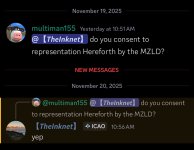
The Defendant has contacted the MZLD and has today indicated that he would like to substitute counsel in this case.

I respectfully request that 24-hour leave of the Court to read the case before presenting a plea.
 

Attachments

  • IMG_2117.jpeg
    IMG_2117.jpeg
    152.4 KB · Views: 39
Your Honor,

The Defendant has contacted the MZLD and has today indicated that he would like to substitute counsel in this case.

I respectfully request that 24-hour leave of the Court to read the case before presenting a plea.

Granted, PD @Superwoops is dismissed.
 

Plea


IN THE FEDERAL COURT OF THE COMMONWEALTH OF REDMONT
PLEA

Commonwealth of Redmont
Prosecution

v.

Inknet
Defendant

I. ENTRY OF PLEA
1. Not Guilty
2. Not Guilty

By making this submission, I agree I understand the penalties of lying in court and the fact that I am subject to perjury should I knowingly make a false statement in court.

DATED: This 21st day of November 2025

 
Thanks,

Discovery Open 11/26/25 @ 12pm EST
 
Your Honor,

Discovery ended at noon today (Post No. 9), and it is major holiday in my country tomorrow. I understand that opening statements are to be done within 48 hours of discovery closing, which would put us at them being due at noon on Friday, November 28 (Eastern Time).

I am respectfully requesting that the deadline to submit opening statements be moved to 11:59 P.M. on Saturday, November 29. I think that the trial would still be speedy with this extension; noting the lack of witnesses submitted by the prosecution and defense, and the consequent lack of need for witness questioning, I do not think that this extension will unduly extend the trial when considering the totality of the situation.
 
Your Honor,

Discovery ended at noon today (Post No. 9), and it is major holiday in my country tomorrow. I understand that opening statements are to be done within 48 hours of discovery closing, which would put us at them being due at noon on Friday, November 28 (Eastern Time).

I am respectfully requesting that the deadline to submit opening statements be moved to 11:59 P.M. on Saturday, November 29. I think that the trial would still be speedy with this extension; noting the lack of witnesses submitted by the prosecution and defense, and the consequent lack of need for witness questioning, I do not think that this extension will unduly extend the trial when considering the totality of the situation.

Opening Statements due 11/29/25 @5pm EST
 
Opening Statements due 11/29/25 @5pm EST
Your Honor,

I will be traveling for a majority of the day tomorrow(the 29th), and haven’t been able to be as active these past days due to the major holiday. I am therefore humbly requesting an extension of the opening statements deadline by 24 hours.
 
Opening Statements due 11/30/25 @ 5pm.


Might as well ask, do parties wish to have an in-game trial on this matter? There are no witnesses.
 

Opening Statement


IN THE FEDERAL COURT OF THE COMMONWEALTH OF REDMONT
OPENING STATEMENT


The question before the court is quite clear, the Defendant, Inknet, is accused of 2 counts of Unauthorized Medical Sale. The Commonwealth is confident that the evidence before the court proves beyond a shadow of a doubt that Inknet is guilty of Unauthorized Medical Sale. The evidence clearly depicts that Inknet sold the items in question, and therefore the Commonwealth aims to justify why the sale of said items was illegal under the Criminal Code Act.

I - Defining Doctor Restricted Health Treatment Items

While the Criminal Code Act does not directly define a "Health Treatment Item Restricted to Doctors", the legislative intent behind this crime is quite clear from prior crimes in the Criminal Code Act.

Part VI, §5(a) of the Criminal Code Act elaborates on which health treatment items are illegal to possess outside of a designated area by stating that "specifically, one that can only be crafted by Doctors but not Pharmacists". In this we can see the clear legislative intent behind the phrase "Health Treatment Item Restricted to Doctors", which is that the law clearly establishes items craftable by doctors only, in other words Restricted to Doctors. In the following section, Part VI, §6, the Criminal Code Act again restricts the usage of these same health treatment items, indicating that the definition from Part VI, §5(a) applies to the Doctor Restricted Health Treatment Items mentioned in Part VI, §6.

Using this definition we can clearly see that Leg Splints and Wrist Splints are Doctor Restricted Health Treatment Items, as the recipes are only available to those who have the doctor job thus making them "one that can only be crafted by Doctors". Therefore Part VI, §6 clearly applies to the sale of such items as described in this case.

II - Any Sale of Doctor Restricted Health Treatment Items is Illegal

Part VI, §6 of the Criminal Code Act is abundantly clear when it defines Unauthorized Medical Sale, in that it states "distributes, sells, or traffics any health treatment item restricted to Doctors or Pharmacists". Notably this law does not make any exceptions for Doctors themselves to sell these items, it solely defines any sale, regardless of the merchant, as being illegal under this law. Thus although the Defendant, Inknet, is a doctor employed by the DOH, this does not offer them any leeway under the law. As established prior, health treatment item restricted to Doctors refers to the ability to craft said item, not the ability to sell said item. Therefore any sale of a health treatment item restricted to Doctors is guilty of Unauthorized Medical Sale, irrespective of the job retained by the Defendant.

Indeed, official DOH policy supports this interpretation, as seen in Official DOH Rules and Behavioral Guidelines (P-010), stating that doctors should "7. Never sell doctor-only cures outside a hospital.". This clearly indicates that the DOH does not exempt Doctors from the sale of health treatment items restricted to doctors, and in fact they explicitly discourage it in accordance with the law which defines it as illegal.


III - Inknet Sold Doctor Restricted Health Treatment Items

There is no doubt that Inknet sold Wrist Splints and Leg Splints. P-001 clearly shows a chestshop, owned by the Defendant, where these items could be freely purchased. Furthermore, P-003, P-004, P-005, P-006, P-007, and P-008 all demonstrate a regular record of sales through this chestshop. The evidence is open and shut, Inknet sold 150 leg splints and 5 wrist splints, there is no doubt in this fact.

IV - Summary

In Summary, the Defendant is clearly guilty. Leg Splints and Wrist Splints are covered under the definition of Unauthorized Medical Sale, and the Defendant has been clearly proven to have sold these items. Furthermore, the law does not create any exemption for doctors, it is applied regardless of the Defendants employment. The Defendant is clearly guilty and thus should be charged with two counts of Unauthorized Medical Sale.


Opening Statement


IN THE FEDERAL COURT OF THE COMMONWEALTH OF REDMONT
OPENING STATEMENT

Your Honor,

In a Criminal Court, the burden of proof is "Proof Beyond a Reasonable Doubt" (Judicial Standards Act, Section 13(1)(c)). In this case, the Commonwealth alleges that the Defendant has committed multiple counts of Unauthorized Medical Sale as defined in Criminal Code Act Part VI, §6. Simply put: as outlined below, the defense does not believe that the Commonwealth has met this burden here.

1. Factual and Evidentiary Background​

In this case, the Prosecution has charged the defense with two distinct charges of Unauthorized Medical Sale: the first charge alleges that Unauthorized Medical Sale occurred when the Defendant allegedly sold leg splints (Complaint, Charge No. 1); the second alleges that Unauthorized Medical Sale occurred when the Defendant allegedly sold wrist splints (Complaint, Charge No. 2).

In support of this, the Prosecution has submitted ten screenshots as evidence. Nine of them lack timestamps (Exhibit P-001; P-003 through P-010), and one has a timestamp only implicitly (Exhibit P-002). A closer look at these exhibits are as follows:
  • Exhibit P-001 appears to show someone having purchased a wrist splint from Inknet for $49. The screenshot is undated.
  • Exhibit P-002 contains a screenshot of a player hovering over 57 wrist splints at the location "rev-impound"; based on the implicit timestamp, it was taken on or after Halloween. The Commonwealth alleges that the screenshot shows 58 wrist splints and that the source of these splints was from a chestshop owned by Inknet (Complaint, Charge Factual Allegation No. 4), but has not provided separate evidence nor secured witness testimony in support of either such claim.
  • Exhibits P-003 through P-008 appear to show logs of various people purchasing and selling leg/wrist splints, but do not name the Defendant; the Commonwealth alleges that this was obtained under warrant and applies to the Defendant (Complaint, Charge Factual Allegation No. 5), does has provide separate evidence nor secured witness testimony in support of either such claim.
  • Exhibit P-009 is an undated screenshot appearing to show Inknet's professions through the /about menu.
  • Exhibit P-010 is a screenshot of a portion of DOH Rules and Behavior Guidelines that shows various rules.

2. Discussion​

Before we dive into our analysis on proof, and apply the facts- and evidence-in-case to the law, we must first discuss: what is the law here?

The Prosecution alleges two separate charges, both of which represent allegations of Unauthorised Medical Sales under CCA Part VI, Section 6. The relevant clause defines the crime of "Unauthorised Medical Sales" as occurring when an individual "distributes, sells, or traffics any health treatment item restricted to Doctors or Pharmacists, or sells in a pharmacy not approved."

As no allegations nor evidence have been produced regarding pharmacy approval (or lack thereof), the defense will disregard "sells in a pharmacy not approved" for purposes of this trial.

Noting that, the prosecution must prove beyond a reasonable that, for each count, the Defendant:
  1. Distributed a "health treatment item restricted to Doctors or Pharmacists"; or
  2. Sold a "health treatment item restricted to Doctors or Pharmacists"; or
  3. Trafficked in a "health treatment item restricted to Doctors or Pharmacists".

2.1 Charge 1: The Prosecution has failed to prove the first charge (regarding the alleged sale of leg splints) beyond a reasonable doubt?​

The prosecution alleges that leg splints are doctor-restricted items (Complaint, 3rd factual allegation) and also that Inknet engaged in the sale of leg splints (Complaint, 5th factual allegation). As such, the Prosecution appears to allege that Inknet would be liable under the second numbered rule identified above. But is there enough evidence?

Our answer is simple: there is not. The prosecution has failed to prove that Exhibit P-003 through P-008 actually relate to the Defendant, and has failed to prove that leg splints were restricted to doctors at the time of the alleged sales.

2.1.1 Argument: The prosecution has failed to prove that Exhibit P-003 through P-007 relate to the Defendant?​

The prosecution alleges that Exhibit P-003 through P-007 were "obtained under warrant" (Complaint, Charge Factual Allegation No. 5) and relate to the Defendant. But the Prosecution provides no warrant, and the screenshots name a large number of people, but do not name the Defendant. The Prosecution has not called any witnesses (such as investigators) nor provided any evidence (such as affadavits of warrant returns) that could have demonstrated this to relate to the Defendant.

Had the prosecution actually obtained these screenshots via warrant, and had there actually been warrant returns that relate to the Defendant, the prosecution could have called witnesses and provided evidence to demonstrate that Exhibit P-003 through P-007 show transactions that relate to the Defendant. They have not.

We are left with naked assertions by a prosecution, but naked assertions do not provide for proof beyond a reasonable doubt.

2.1.2 Argument 2: Has the prosecution failed to prove that leg splints were "restricted to Doctors or Pharmacists" at the time of the alleged sales in Exhibit P-003 through P-007?​

The 3rd factual allegation states that "Wrist splints and leg splints are doctor-restricted health treatment items" (Complaint). Again, no evidence has been provided for this; the prosecuting attorney has not produced any lists of items restricted to doctors, nor called any witnesses to this effect. No law defines what these items are, and this Court cannot conclude that such items are indeed doctor-restricted absent proof in evidence.

2.2 Charge 2: The prosecution failed to prove the second charge (regarding the alleged sale of leg splints) beyond a reasonable doubt?​

2.2.1 Argument: The Prosecution has failed to prove that the material in Exhibit P-002 relates to the Defendant​

The prosecution alleges that Exhibit P-002 demonstrates that "The Commonwealth lawfully seized 58 wrist splints from the aforementioned chestshop" (Complaint, Charge Factual Allegation No. 4). The screenshot is taken at a different location (the "rev-impound") than the chestshops in Exhibit P-001. No testimony or evidence was proffered in support that this screenshot actually relates to Defendant; witnesses could have been called, but weren't.

2.2.2 Argument: The prosecution has failed to prove that Exhibit P-008 relates to the Defendant​

This is largely duplicative to the argument at 2.2.1, so I have put the full argument in spoiler; the argument is very similar.
The prosecution alleges that Exhibit P-008 were "obtained under warrant" (Complaint, Charge Factual Allegation No. 5) and relate to the Defendant. But the Prosecution provides no warrant, and the screenshots name a large number of people, but do not name the Defendant. The Prosecution has not called any witnesses (such as investigators) nor provided any evidence (such as affadavits of warrant returns) that could have demonstrated that the screenshots plausibly relate to the Defendant.

Had the prosecution actually obtained these screenshots via warrant, and had there actually been warrant returns that relate to the Defendant, the prosecution could have called witnesses and provided evidence to demonstrate beyond a reasonable doubt that Exhibit P-008 shows transactions that relate to the Defendant. They have not.

We are left with naked assertions by a prosecution, but naked assertions do not provide for proof beyond a reasonable doubt.

2.2.3 Argument: Has the prosecution failed to prove that wrist splints were a "health treatment item restricted to Doctors or Pharmacists" at the time of the alleged sale in exhibit P-001?​

Again, this largely duplicaties a prior argument (2.1.2).
The 3rd factual allegation states that "Wrist splints and leg splints are doctor-restricted health treatment items" (Complaint). Again, no evidence has been provided for this; the prosecuting attorney has not produced any lists of items restricted to doctors, nor called any witnesses to this effect. No law defines what these items are, and this Court cannot conclude that such items are indeed doctor-restricted absent proof in evidence.

3. Conclusion​

Insufficient evidence to convict Inknet of either count has been submitted before this Court. As such, the Court must find Inknet not guilty on all charges, as there is clearly reasonable doubt as to his guilt based upon the evidence-in-case.

 
@Novakerbal @Franciscus

Considering there are no witnesses, how do parties wish to proceed?
Your Honor,

As there are no witnesses, the Defense would like to proceed to closing statements. We are happy to read our closing statement in-game at your courthouse, provided that we can submit a written copy on the forums and that such written copy would be considered official for all purposes—makes it easier to link to/cite things.
 
Your Honor,

As there are no witnesses, the Defense would like to proceed to closing statements. We are happy to read our closing statement in-game at your courthouse, provided that we can submit a written copy on the forums and that such written copy would be considered official for all purposes—makes it easier to link to/cite things.
The Commonwealth does not object to proceeding into closing statements.

On the Subject of reading our closing statements in-game, the Prosecutor for this case prefers not to use Voice Chat. If we were to read out closing statements in an in-game chat channel, this would feel redundant, as it would be mostly copy pasting line after line from the draft.
 
@Franciscus
@Novakerbal

Thank you counselors. We'll proceed on forums.

Deadline for Closing Statements:
Prosecution: 12/3/25 @ 5pm
Defense : 12/6/25 @ 5pm.

Extensions welcome within the window.


In review of filings, the Court requests parties answer the following question as part of their closing argument:

1) Thru the DOH, Doctors are able to respond to calls for medical attention across the Country. They create health treatment items and give it to those in need. If a player does not have Medicare, they'd otherwise be required to pay for this treatment. With Medicare, the Government undoubtedly steps in and pays on the player's behalf via the /bulkbill command.


Posed Question: What is an authorized medical treatment in consideration of the Criminal Code Act? How is this Court to apply the law in relation to existing and accepted practice?

Do not restrict your analysis to my question, I'd just like an answer to assist with my deliberations.
 
Deadlines modified.
Prosecution: 12/3/25 @ 5pm
Defense : 12/6/25 @ 5pm.
 
@Franciscus
@Novakerbal

Thank you counselors. We'll proceed on forums.

Deadline for Closing Statements:
Prosecution: 12/3/25 @ 5pm
Defense : 12/6/25 @ 5pm.

Extensions welcome within the window.


In review of filings, the Court requests parties answer the following question as part of their closing argument:

1) Thru the DOH, Doctors are able to respond to calls for medical attention across the Country. They create health treatment items and give it to those in need. If a player does not have Medicare, they'd otherwise be required to pay for this treatment. With Medicare, the Government undoubtedly steps in and pays on the player's behalf via the /bulkbill command.


Posed Question: What is an authorized medical treatment in consideration of the Criminal Code Act? How is this Court to apply the law in relation to existing and accepted practice?

Do not restrict your analysis to my question, I'd just like an answer to assist with my deliberations.
Your Honor,

The Prosecutor on this case is quite swamped with both exams and assignments irl, to avoid over-stressing my schedule I am humbly requesting that the deadline for closing statements be extended until December 7th. I understand that this a quite a large extension, but my schedule will not be clear until the weekend. I also understand that the honorable judge has expressed a potential LOA on December 8th, meaning that pushing the deadline would likely cause this case to pause until December 15th. I understand if this might be objectionable to the Defense or the Court.
 
Your Honor,

The Prosecutor on this case is quite swamped with both exams and assignments irl, to avoid over-stressing my schedule I am humbly requesting that the deadline for closing statements be extended until December 7th. I understand that this a quite a large extension, but my schedule will not be clear until the weekend. I also understand that the honorable judge has expressed a potential LOA on December 8th, meaning that pushing the deadline would likely cause this case to pause until December 15th. I understand if this might be objectionable to the Defense or the Court.

Swamped? Unacceptable, have until 12/7/25 @ 5pm
Defense 3 days after
 

Closing Statement


IN THE FEDERAL COURT OF THE COMMONWEALTH OF REDMONT
CLOSING STATEMENT

Addressing the Honorable Judge's Question

Prior to the case's reassignment to the honorable Judge AmityBlamity, Judge Muggy21 requested each party to submit an answer to the question of "What is an authorized medical treatment in consideration of the Criminal Code Act? How is this Court applying the law in relation to existing and accepted practice?"

The Commonwealth has a twofold answer to this question. Firstly, within the context of established DOH practice of treatment, we can see that established DOH treatment practices clearly do not fall under the definition of Unauthorized Medical Sale. The key factor in this is that DOH policy requires doctors to administer cures, rather than transferring the item to the patient. This is critical to the question, as the Criminal Code Act uses the language of "distributes, sells, or traffics". Whenever a doctor treats a patient, and is paid via bulk bill or directly from the patient, the doctor is administering a cure directly; that is, providing a service. They are not distributing, selling, or trafficking any of the covered health treatment items, as no item changes hands. This therefore insulates existing DOH practice from being adversely impacted by this law.

On the subject of the current DOH practice of selling common health treatment items such as leg splints in the hospital, the Commonwealth proposes that the statutory duties of the DOH require it to sell such items in order to fulfill its lawfully mandated responsibilities, and it would thus be nonsensical for the Criminal Code Act to simultaneously criminalize this practice. In particular, the Executive Standards Act § 12, 1(a) states that the DOH is responsible for the "Maintenance and upkeep of the national health system". It is unreasonable to believe that the DOH will always have active doctors online at all hours. Therefore to maintain a functional National Health System, the DOH must provide alternatives to treating common illnesses for patients seeking treatment during periods of lower activity. As the sale of emergency medical supplies through chestshops is integral to the functioning of a national health system, it would be counterintuitive to criminalize duties that have been mandated to the DOH. Therefore, the definition of Unauthorized Medical Sale cannot apply to the DOH's existing practice of selling cures via Hospitals.

Addressing the Relation of Evidence to the Defendant

The Defense alleges that the evidence labeled P-003 through P-007 is not sufficiently linked to the Defendant. Warrants do not warrant introduction, as the Honorable Judge is more than capable of seeking out said warrant to verify its authenticity. These are not naked assertions from the prosecution, but lawful evidence obtained in accordance with standard court protocol that has never been of issue in prior cases. Unless the Defense wishes to doubt the veracity of staff provided information, it is absolutely factual that the evidence provided were the chest logs for the specific containers viewed in P-001, which were owned by Inknet.

Addressing the Supposed Lack of a List of Doctor Restricted Items

The Prosecution provided a definition for Doctor-restricted items. As these items have not been defined in law nor in DOH Policy, such an official list cannot be produced. If the Defense wishes to argue that such a list is necessary to prove that leg splints are Doctor Restricted Items, then they are arguing that the crime of Unauthorized Medical Sale is entirely unenforceable, as no such list has been defined by law.

The argument thus appears to be that this provision of the CCA is legally unenforceable due to a lack of definition provided by the Legislature. As the Prosecution has already discussed, legislative intent was quite clear in defining doctor restricted health treatments as "one that can only be crafted by Doctors". Such items are ubiquitous and can be viewed through a simple in-game command. In this instance, legislative intent is clear. This statute of the CCA cannot be rendered unenforceable just due to a lack of an officially defined list, when the items covered can be reasonably inferred.

Concluding Arguments

The evidence provided by the Commonwealth is more than sufficient to prove the guilt of the defendant. While the defendant casts doubt upon its veracity, in reality, the evidence provided is easily verifiable and not baseless assertion. The burden of proof is beyond reasonable doubt, not beyond any doubt whatsoever. Staff-actioned warrants are not naked assertion, they are lawfully acquired evidence that are sufficient to prove guilt.

Furthermore, the Prosecution has provided evidence of the legislative intent behind the definition of Doctor-restricted Health Treatment Items, and believes that this is sufficient to give force to the crime of Unauthorized Medical Sale. A ruling otherwise would essentially render the crime meaningless.

The factual evidence shows that Inknet operated 2 chestshops with a record of sales of two types of Doctor-restricted Health Treatment Items. The CCA is unambiguous when it defines this crime. Inknet is guilty beyond a reasonable doubt. The evidence provided by Staff cannot be discounted as a naked assertion. We ask the Court to find the Defendant guilty on all counts as the evidence overwhelmingly proves.

 
As per the honorable Judge Mug, the defense has 72 hours to file their Closing Statement.
 

Closing Statement


IN THE FEDERAL COURT OF THE COMMONWEALTH OF REDMONT
CLOSING STATEMENT - DEFENSE

1. Introduction​

Your Honor:

The Defense thanks the Court for its attention throughout these proceedings. We remind the Court that in a criminal trial the burden of proof rests entirely on the Prosecution to establish each element of each charge beyond a reasonable doubt (Judicial Standards Act, Section 13(1)(c)). The case before us involves two counts of Unauthorized Medical Sale under Part VI, §6 of the Criminal Code Act (CCA), alleged against the Defendant, Inknet. Throughout this trial, the Defense has maintained that the Commonwealth has not met its burden of proof, and we submit that the evidence (or lack thereof) leaves the Court with clear reasonable doubt on each charge. In this closing statement, we will:
  1. Answer the question Your Honor posed in Post #19 regarding what constitutes an authorized medical treatment under our laws and how to reconcile the law with accepted medical practice (Section 2).
  2. Refute the Prosecution’s closing arguments (Post #24) point-by-point – exposing how the Prosecution improperly asks this Court to accept assertions without evidence and to fill gaps in their case that the law requires the prosecution to fill with evidence and testimony.
  3. Reiterate the failures of proof identified in our opening statement, particularly the lack of admissible evidence linking the alleged chestshop logs to the Defendant and the lack of proof-in-record that the items in question are legally "doctor-restricted" health items.
  4. Finally, we will synthesize why, given the Constitution, the laws, and the evidence-in-record, the only just verdict is Not Guilty on all charges.

2. Addressing the questions posed by Your Honor in Post No. 19

In Post No. 19, Your Honor provided each counsel with the following prompt:

In review of filings, the Court requests parties answer the following question as part of their closing argument:

1) Thru the DOH, Doctors are able to respond to calls for medical attention across the Country. They create health treatment items and give it to those in need. If a player does not have Medicare, they'd otherwise be required to pay for this treatment. With Medicare, the Government undoubtedly steps in and pays on the player's behalf via the /bulkbill command.


Posed Question: What is an authorized medical treatment in consideration of the Criminal Code Act? How is this Court to apply the law in relation to existing and accepted practice?

Do not restrict your analysis to my question, I'd just like an answer to assist with my deliberations.

The Criminal Code Act itself does not mention nor define "authorized medical treatment". Under the principle of nullum crimen sine lege, we are left to conclude that authorized medical treatments are all medical treatments except those medical treatments prohibited by the text of the Criminal Code Act.

The problem then becomes: what exactly is prohibited?

2.1 The text of the Criminal Code Act doesn't cleanly define what a health treatment is​

There are certain portions of the Criminal Code Act that more or less outsouce to statutes that list illegal items; Part VI, Sections 1-3 and 7-8 refer to "illicit substances" and "weapons of mass destruction", which are themselves defined in Criminal Terminology Act Sections 4 and 5 (see, for example, Commonwealth of Redmont v. WWW2020 [2025] DCR 91). But no such list in the Criminal Terminology Act appears to rescue us in the context of medical treatment - Part VI, Sections 5-6 don't appear to have anything in the Criminal Terminology Act that can help us.

Examining other sections of CCA Part VI, CCA VI(5)(a), defining "Unauthorised Health Treatment Possession" as occurring when an individual "possesses a health treatment—specifically, one that can only be crafted by Doctors but not Pharmacists—outside of designated areas". But that's of no help; "unauthorized" is an adjective modifying "health treatment possession" (the noun phrase); it's not merely modifying "health treatment". And, the clarification between dashes indicates that an item that "specifically, one that can only be crafted by Doctors but not Pharmacists" are prohibited seems to be opening up the possibility to other health treatments existing. Perhaps we've got a definition of health treatment from the penumbra of this ("a cure that can be crafted by doctors or pharmacists"), but upon reading CCA VI(6)(a) ("distributes, sells, or traffics any health treatment item restricted to Doctors or Pharmacists, or sells in a pharmacy not approved") it looks like not all "health treatment" under the law is per se "restricted to doctors or pharmacists" (unless we are to conclude that the additional restriction be read as meaningless).

This is all to say - the Criminal Code Act is not actually quite clear as to what a "health treatment" is from its text alone. So, where do we go from here?

2.2 A definition of "health treatment" must come from the history and traditions of Redmont absent statutory text​

The Criminal Code Act "explicitly prohibits this Court from attempting to construe criminal acts from outside of the CCA" (Commonwealth v. corstkiller00 [2025] DCR 85), and we must ensure that "any analysis of a criminal action must natively and logically arise from the CCA, with all other acts being illustrative rather than authoritative" (ibid). What's more, agency action and policy can't create new crimes: the Cabinet acts through designated executive authority (c.f. Const. 28(1)) that cannot create new laws, and department leaders are likewise not given lawmaking powers (c.f. Const. 29). Under the Constitution, only the Congress may make such laws (c.f. Const. 2(1)).

The 14th Charter right is that "Every citizen has the right to life, liberty, and security of the person and the right not to be deprived thereof except in accordance with the principles of fundamental justice" (Const. 32(14)). The Criminal Code Act likewise requires that the law be interpreted in line with "principles of natural justice and common law unless expressly excluded" (Criminal Code Act Part 1, Section 1(1)).

Where a criminal provision uses an undefined boundary term that carries substantial penalties, principles of natural justice and fundamental justice require the Court to adopt an interpretation that gives reasonable notice to officials and citizens, constrains arbitrary enforcement, and harmonizes with the broader statutory scheme. We therefore offer the following definition of a "health treatment" in line with the history and traditions of Redmont: "any item which, upon its use or consumption, may manage, alleviate, or cure a health issue".

This does not mean that health treatment may only be crafted by doctors or pharmacists - merely that a health treatment is an item which may help with an existing health issue (whether it be drunkenness, illness, or otherwise). It also renders the phrasing of "health treatment item restricted to Doctors or Pharmacists" within CCA VI(6)(a) as not containing a redundant clause while acknowledging that home remedies not requiring doctors nor pharmacists would remain classified as health treatments.

2.3 Having defined "health treatment", can we better understand (un-)authorized health treatment​

Acknoweldging a health treatment as "any item which, upon its use or consumption, may manage, alleviate, or cure a health issue" allows us to then go back in and understand what exactly is prohibited by the CCA.

Under this definition, CCA IV(5) and CCA IV(6) are given meaning. The prohibion in the latter (which is relevant to this case) is "distributes, sells, or traffics any [item which, upon its use or consumption, may manage, alleviate, or cure a health issue] restricted to Doctors or Pharmacists, or sells in a pharmacy not approved". The prohibition in the former becomes "possesses a [item which, upon its use or consumption, may manage, alleviate, or cure a health issue]—specifically, one that can only be crafted by Doctors but not Pharmacists—outside of designated areas".

Separately, in CCA Part IX, Section (16)(a), there is a restriction on when one "oversupplies treatment items meant to treat an illness".

From my reading, all else with respect to medical treatment does not appear prohibited under the criminal law. By the principle of nullum crimen sine lege, we must conclude that all else constitutes an authorized medical treatment for purposes of the CCA.

3. Refutations of Prosecution Arguments​

3.1 Regarding Relation of Evidence to the Defendant

3.1.1 Prosecution's Claim: Alleged documents not in-case demonstrate that P-003 through P-007 relates to defendant​

The prosecution argues as follows (Post No. 24):
The Defense alleges that the evidence labeled P-003 through P-007 is not sufficiently linked to the Defendant. Warrants do not warrant introduction, as the Honorable Judge is more than capable of seeking out said warrant to verify its authenticity. These are not naked assertions from the prosecution, but lawful evidence obtained in accordance with standard court protocol that has never been of issue in prior cases. Unless the Defense wishes to doubt the veracity of staff provided information, it is absolutely factual that the evidence provided were the chest logs for the specific containers viewed in P-001, which were owned by Inknet.
The prosecution relies on claims here, whether explicitly or clearly implied:
  1. An alleged warrant for obtaining P-003 through P-007 actually exists;
  2. The alleged warrant was answered by the staff team;
  3. An alleged communication from staff team indicates that the logs in Exhibits P-003 through P-007 relate to the Defendant;
  4. There is allegedly no obligation to actually present this warrant in Court because the judge can see it ("Warrants do not warrant introduction, as the Honorable Judge is more than capable of seeking out said warrant to verify its authenticity").
The first three items are claims of fact. To support these claims of fact, the Prosecution relies on a claim of law - essentially trying to state a rule for why (in their view) warrants and their returns don't actually require submission to the Court.

But the Commonwealth's claim of law is incorrect, and the claims of fact fall alongside this error. Let's start by examining what the law and procedure - the constitution, statutes, and the Court Rules - actually say.

3.1.2 Rule: The Constitution, Statutes, and Court Rules require submission of evidence in-case and in front of all parties for that evidence to be used

3.1.2.1 The Constitution guarantees a right to confront evidence and receive a fair trial
Under our Constitution, criminal defendants have a right "to be confronted with the evidence against them" in a "fair trial presided over by an impartial judicial officer" (Const. 32(9)). As displayed below, there are a few ways in which this constitutional right is actually protected in practice, including both Court Rules and statutes that pertain to ex parte communication.

3.1.2.2 Court Rules require submission of material for it to be actually used in a case
The Court's rules implement the 9th Charter rights through its rules regarding discovery, the process through which evidence enters trial. Under Rule 4.1 (Scope and Purpose of Discovery), "[t]he scope and purpose of Discovery is to allow all material to enter the court prior to the beginning of arguments for the sake of fairness" (emphasis mine). The Court, in doing so, seeks to "enable fairness by allowing the parties to view the information so that they may properly formulate their legal arguments".

An underlying principle in the Discovery process is laid out in Rule 4.2 (Submission Required for Use) - that evidence submissions need to have been timely "included in the case" (emphasis mine) for it to be used. When the evidence is not included, under the same rule, "the material will be deemed inadmissible"; the arguments relying on it are liable to be "voided by the presiding judge". The rule is fairly specific as to when evidence may be presented, restricting the prosecution to submitting evidence prior to the end of discovery. (On an aside: Restrictions on new evidence in appeals is handled under Rule 1.7; see also: [2025] FCR 78 - Appeal, Post Nos. 17-22.)

As such, Court Rules require that evidence must actually be submitted in this case to be used to prove facts. Reaching for unsubmitted information renders an argument void, as it unduly impairs fairness, and it undermines the whole purpose of discovery.

3.1.2.3 Statutes prohibit, and even criminalize, ex parte communication
There are also statutory protections that require that communications that pertain to a particular case be visible to all parties. Proscriptions on ex-parte communication occur in two places in law: Section 29 of the Judicial Standards Act and Part III, Section 15(a) of the Criminal Code Act.

Under the Judicial Standards Act, ex parte communication is described as follows:
29 - Ex Parte Communication
(1) Direct or indirect communication about a specific case with the presiding officer that is presiding over that case that the citizen in question is either the plaintiff, defendant, or counsel in without the knowledge of all parties (Plaintiff,defendant, counsel) in the case is forbidden
(2) Failure to do such may be used as a reason for a recusal, and if the case has already been ruled on, an appeal

Under the Criminal Code Act Part III, Section 15, it is a criminal offense ("Ex Parte Communication") when a person:
(a) Makes direct or indirect communication about a specific case with the presiding officer that is presiding over that case that the violator is either a plaintiff, defendant, or counsel in without the knowledge of all parties (Plaintiff, defendant, counsel) in the case.

What can we draw from these? The first thing is clear: when communication is made with the judge regarding a specific case, it needs to be made in front of all relevant parties, including the defendant himself. Using communications outside of what the defendant (or Plaintiff) can see may leave a case liable to appeal, the judge liable to recusal, and the violating counsel or party liable for criminal violations.

3.1.2.4 Conclusion: The law and court rules require evidence be submitted in-case and available to all parties
So what is the rule here? It's simple. In order to protect the accused's constitutional right to be confronted with evidence against them, and to enable a fair trial:
  1. Evidence must be submitted in a case for it to be considered in that case; and
  2. Evidence a party seeks to use in a case must actually be made available to all parties.
The first proceeds from a reading of Court rules, the second from a reading of statutes, and both proceed clearly from the Ninth right under Section 32 of our Constitution. Now that the rule is demonstrated clearly, let's see how it applies to this case.

3.1.3 Application: The Prosecution is incorrectly relying on evidence not submitted in this case in attempting to prove claims against the Plaintiff​

We can return to the Prosecution's argument in Post No. 24. The prosecution's argument goes as follows:
  1. Warrants need not be introduced into evidence because the judge can see them and rely on it in judging a case.
  2. The staff team responded to a warrant and returned screenshots P-003 through P-007.
  3. Denying that screenshots P-003 through P-007 relate to Inknet is akin to denying the staff team is being truthful (which is dumb).
  4. Conclusion: The Court can conclude beyond a reasonable doubt that P-003 through P-007 actually relate to the Plaintiff.
The problem here is that the first premise is fatally deficient, which undermines the conclusion. As has been clearly established in 3.1.2, evidence must be submitted in a case for it to be considered in a case, and the Court cannot rely on evidence that has not been made available to the defendant himself.

If the prosecution were to comply with the constitutional obligations under the 9th charter right, statutes involving ex parte communication, and Court Rules, the prosecution could have submitted the alleged warrant's transcript here. The prosecution could have brought forward the alleged investigator to support the veracity of the warrant's transcript. They could have produced the alleged staff ticket through which screenshots would have been provided. And, had they done so, their alleged evidence would have been in case and available for consideration.

Alas for the prosecution's charges, the commonwealth did not do so - there is plainly no evidence in-case establishing the provenance of the screenshots in Complaint's Factual Allegation No. 5 (i.e. exhibits P-003 through p-008) nor that any warrant was even filed at all. There's likewise no testimony to support how the screenshots were obtained. And the prosecution's beyond-last-minute and explicit attempt to refer Your Honor to an alleged warrant transcript - one that is not publicly available and not published in-case - would arguably constitute ex parte communication under the Criminal Code Act unless this case's defendant could somehow himself see the warrant page.

3.1.4 Conclusion: The Prosecution's attempts to claims of evidence not in-case should be given no weight, and factual allegations relying on this are not proven beyond a reasonable doubt​

As discussed above, the law and court procedures require that (1) evidence be submitted in a case for it to be considered in that same case; and (2) evidence the prosecution seeks to use in a case must actually be made available to the defendant.

The Commonwealth is attempting to refer to evidence not in-case. In doing so, they are asking for a violation of Court Rules, statutory law, and rights guaranteed in the Constitution itself. This Court must reject that attempt, and reject arguments that would rely on it. The Court therefore cannot conclude that the fifth factual allegation is true beyond a reasonable doubt.

3.2. Regarding the lack of evidence regarding whether or not certain items are restricted to doctors

3.2.1 The Prosecution misconstrues the defense's opening statement

The prosecution has spent good bit on whether or not a list of Doctor-restricted items actually exists.
Addressing the Supposed Lack of a List of Doctor Restricted Items

The Prosecution provided a definition for Doctor-restricted items. As these items have not been defined in law nor in DOH Policy, such an official list cannot be produced. If the Defense wishes to argue that such a list is necessary to prove that leg splints are Doctor Restricted Items, then they are arguing that the crime of Unauthorized Medical Sale is entirely unenforceable, as no such list has been defined by law.

The argument thus appears to be that this provision of the CCA is legally unenforceable due to a lack of definition provided by the Legislature. As the Prosecution has already discussed, legislative intent was quite clear in defining doctor restricted health treatments as "one that can only be crafted by Doctors". Such items are ubiquitous and can be viewed through a simple in-game command. In this instance, legislative intent is clear. This statute of the CCA cannot be rendered unenforceable just due to a lack of an officially defined list, when the items covered can be reasonably inferred.

In there, there are some stunning admissions regarding whether or not the Commonwealth can actually point out what a doctor-restricted items are: "Doctor-restricted items... have not been defined in law nor in DOH Policy, [as] such an official list cannot be produced" (Prosecution's Closing Statement).

But it's ultimately a misreading of our core argument in Opening Statements, and results in a bit of a straw man. The defense is not arguing that the Prosecution cannot enforce CCA Part IV, Section 6. The defense is arguing that the prosecution has failed to prove beyond a reasonable doubt that wrist splints (and leg splints) are actually "doctor-restricted" under the meaning of the law.

3.2.2 The Prosecution has not actually provided evidence to prove that leg splints and wrist splints were doctor-restricted at the time of the crime​

The question is really, really simple: has the Commonwealth actually provided any evidence that a leg splint and a wrist splint were actually, at the time of the crime doctor-restricted health treatment items? The answer is simple: no.

The core argument the prosecution gave in its opening regarding leg splints and wrist splints being "doctor-restricted" in its opening statements were as follows:

Using this definition we can clearly see that Leg Splints and Wrist Splints are Doctor Restricted Health Treatment Items, as the recipes are only available to those who have the doctor job thus making them "one that can only be crafted by Doctors". Therefore Part VI, §6 clearly applies to the sale of such items as described in this case.

The core of the prosecution's argument requires the Court to conclude on a factual basis that Leg Splints and Wrist Splints actually are only available to those who have the doctor job. There is no evidence-in-case for this. There were no witnesses called to support this claim. Accepting this factual claim would require the Court to jump to a conclusion on a matter of fact that the Commonwealth has not only failed to prove but has failed to support altogether.

4. Recapitulation of Defenses

To briefly outline our key defenses:
  1. The Prosecution holds a high Burden of Proof: The prosecution has the burden to prove every element of every offense beyond reasonable doubt. This high standard has not been met.
  2. No Proven Link Between Logs and Inknet: The heart of the case – that Inknet sold the items via chestshops – rests on screenshots P-001 through P-008. P-001 shows a chestshop interface listing splints sold by “Inknet”, but it is undated and alone doesn’t tell us volume or timeframe. The bulk of the purported sales evidence was in P-003–P-008, which list transactions but do not name Inknet. The Defense maintains that without authentication, there is not proof that these screenshots actually relate to inknet. The only connection is the Prosecution’s naked assertion that a staff warrant ties them to Inknet. As argued, naked assertions by the prosecution do not constitute evidence.

    Considering only the evidence in-case, there is no way for a reasonable observer to discern whether the logs in exhibids P-003 through P-008 are from a different shop altogether. We cannot convict on “possibly” or “probably” – we need certainty grounded in evidence, which is absent here.
  3. No Witnesses, No Corroboration: The Commonwealth called no witnesses to explain the investigation, the evidence collection, or the DOH rules. This was their choice, but it has consequences. Without witnesses, there was no opportunity to clarify ambiguities or get sworn explanations for the screenshots and policies. The Defense stands uncontradicted by testimony in pointing out these evidentiary deficiencies. This means the documentary evidence had to carry the full burden of proof, and as we have shown, it does not.
  4. Compliance with Court Procedure: At closing, it is evident that evidence actually linking exhibits P-003 through P-008 to the defendant are not present. The exhibits themselves do not mention the defendant whatsoever, and the Court’s own procedures (Rule 4.2) forbid relying on evidence other than that which has been presented in-case. Thus, strictly applying the rules, the Prosecution’s arguments about the warrant and item status should be wholly disregarded for lack of admissible foundation, and conclusions that would rely upon evidence not in-case must not be made.
  5. No Evidence of Illegal Status of Items: What’s disputed is whether the Commonwealth has shown that selling leg splints or wrist splints is actually illegal. For that, the items must be restricted to doctors. No conclusive proof (nor any corroborating evidence) was brought that leg/wrist splints are actually restricted or meet this definition. Maybe the prosecution thinks they are doctor-only items, but the Court cannot take judicial notice of such a “fact” without evidence, especially when it was actively contested.

    The reasonable doubt here is whether or not these items were (at the relevant time) exclusively craftable by doctors – for instance, could it be that pharmacists or others had recipes? The record is silent, and the Commonwealth concedes in its closing that it cannot produce an official list of such items. Silence is the prosecution’s enemy under a proof-based system. The Defense doesn’t have to prove someone else could craft them; we need only point out we don’t have proof to the contrary. That void of proof equals reasonable doubt.
In sum, our defenses boil down to this: the Prosecution has not proven the charges beyond a reasonable doubt because it left crucial elements unproven in court. We did not ask for any special treatment or loopholes – we asked for the Prosecution to do what the law requires: prove its case with evidence. They have not. As a result, the only legally and logically sound outcome is acquittal.

5. Conclusion

As noted in our opening statement, insufficient evidence to convict Inknet of either count has been submitted before this Court. Matters of fact must be decided based on evidence-in-case and witness testimony (of which there was none). We cannot reach outside in our fact-finding for reasons of constitutional rights, statutory prohibitions, and Court procedure; attempts to do so should be voided by Your Honor.

As such, the Court must find Inknet not guilty on all charges, as there is clearly reasonable doubt as to his guilt based upon the evidence-in-case.

 
Back
Top