Lawsuit: Pending Themoneylord v. Coslos [2026] DCR 152

TheREALWINner

Citizen
Aventura Resident
SniperElite508
SniperElite508
Attorney
Joined
Jun 25, 2026
Messages
41

Case Filing


IN THE FEDERAL COURT OF THE COMMONWEALTH OF REDMONT

CIVIL ACTION


Themoneylord

Plaintiff


v.


Coslos

Defendant


COMPLAINT

The Plaintiff complains against the Defendant as follows:


On or about the 24th of June, 2026, the Plaintiff in this case, Themoneylord, made a valid gambling transaction at the Defendant’ casino. Unfortunately, the slot machine that the Plaintiff had selected failed to render him his winnings. The Defendant, seemingly apologetic for the mishap, promised to pay The Plaintiff the aforementioned winnings, but soon afterwards failed to render payment. In an attempt to acquire his winnings, the Plaintiff reached out several times to the Defendant, who dodged his inquiries and eventually attempted to mislead the Plaintiff by acting as if the Plaintiff had the wrong person. With the promised goods not being delivered at the time of this filing, the Plaintiff has chosen to appeal to this honorable court.


I. PARTIES

1. Themoneylord (Plaintiff)

2. Coslos (Defendant)


II. FACTS

1. On or about the 24th of June, the Plaintiff paid one thousand ($1000) to play one of the Defendant’ slot machines.

2. Said slot machine was out of winning tickets, as testified to by The Defendant, when he said, “I figured out,” “what h[a]ppened to that machine,” and “the dispensers were empty”

3. The Plaintiff asks the Defendant “Will {I} ever be paid,” to which the Defendant responded, “when the bank owner gets the money back.”

4. The Plaintiff alleges this statement to be a tactic of delay, for logs show that “coslos's balance” was “$2,520.79,” enough to fully reimburse the Plaintiff for their lost funds.

4. The Defendant’s statement of “when the bank owner gets the money back,” additionally implies that the Defendant promised to restore Plaintiff’s lost funds.

5. Several days later, on the 29th of June, 2026, the Plaintiff gave the Defendant twenty-four (24) hours to reimburse the Plaintiff the lost funds, before the prosecution planned on taking legal action.

6. The Defendant, instead of responding to The Plaintiff’s request of payment, attempted to ghost The Plaintiff by stating “wrong person,” despite earlier discussions showing that the Defendant recognized The Plaintiff’s Discord messages.


III. CLAIMS FOR RELIEF

1. FAILURE TO DELIVER GOODS OR SERVICES (RCCA Part VI §3)

Failure to deliver goods or services is committed when a person “fails without lawful excuse to deliver goods or services that they have agreed to supply under a valid transaction or contract.” It is clear that the actions of the Defendant fall under this law for the following reasons:

(a) A valid transaction was made. The defendant’s creation of a casino that is presented as offering winnings to lucky players, and the subsequent failure on the part of the Defendant to upkeep said machines or offer warnings that said machines may be out of stock following an exchange of money as a result of the use of said machines constitutes a failure to provide promised goods under a valid transaction and/or contract.

(b) This failure is compounded by the Defendant’s offer and subsequent failure to reimburse the goods, as is described in the case facts.

(c) The Defendant had no lawful excuse to not reimburse the goods, for the facts show that the Defendant had enough goods to reimburse the Plaintiff’s losses.


IV. PRAYER FOR RELIEF


The Plaintiff seeks the following from the Defendant:


1. Specific performance to reimburse the Plaintiff his $1,000 that was spent on the faulty casino transition.

2. $20,000 in Civil Penalty Units.

3. $6,300 in legal fees.


By making this submission, I agree I understand the penalties of lying in court and the fact that I am subject to perjury should I knowingly make a false statement in court.


DATED: This 4 day of July, 2026.


Attachments

  • Slot_Machine.png
    Slot_Machine.png
    1,012 KB · Views: 43
  • Proof#1.zip
    Proof#1.zip
    33.9 KB · Views: 46
Last edited:
Additional Proof
 

Attachments

  • Proof#2.png
    Proof#2.png
    502.6 KB · Views: 69
  • Proof#3.jpg
    Proof#3.jpg
    30.8 KB · Views: 64
  • Screenshot 2026-07-04 190048.png
    Screenshot 2026-07-04 190048.png
    26.2 KB · Views: 68
  • Screenshot 2026-07-04 190210.png
    Screenshot 2026-07-04 190210.png
    38.7 KB · Views: 71
Submit the text directly, not as screenshots from what clearly appears to be a private channel on a law firm's discord.
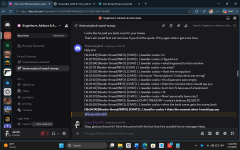
[16:22:44] [Render thread/INFO]: [CHAT] L | Jeweller coslos » hi
[16:22:55] [Render thread/INFO]: [CHAT] L | Jeweller coslos » I figured out
[16:23:04] [Render thread/INFO]: [CHAT] L | Jeweller coslos » what heppened to that machine
[16:23:17] [Render thread/INFO]: [CHAT] L | Jeweller coslos » use what?
[16:23:30] [Render thread/INFO]: [CHAT] L | Jeweller coslos » thats the wrong place
[16:23:42] [Render thread/INFO]: [CHAT] L | Armourer Themoneylord » Coslos what was wrong?
[16:23:52] [Render thread/INFO]: [CHAT] L | Jeweller coslos » the dispensers were empty
[16:24:14] [Render thread/INFO]: [CHAT] L | Jeweller coslos » thats the moment when I would pay you
[16:24:33] [Render thread/INFO]: [CHAT] L | Jeweller coslos » but I lost 7k becouse of a bank heist
[16:24:46] [Render thread/INFO]: [CHAT] L | Jeweller coslos » 7k
[16:24:57] [Render thread/INFO]: [CHAT] L | Jeweller coslos » Now I personally have only 2
[16:25:07] [Render thread/INFO]: [System] [CHAT] TREASURY » coslos's balance: $2,520.79
[16:25:01] [Render thread/INFO]: [CHAT] L | Armourer Themoneylord » Will i ever be paid?
[16:25:20] [Render thread/INFO]: [CHAT] L | Jeweller coslos » when the bank owner gets the money back

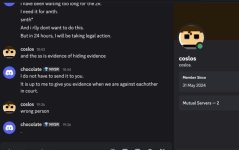
Themoneylord: I have been waiting to long for the 2k
Themoneylord: I need it for amth
Themoneylord: smth*
Themoneylord: And i rlly dont want to do this,
Themoneylord: But in 24 hours, I will be taking legal action.
Coslos: and the ss is evidence of hiding evidence.
Themoneylord: I do not have to send it to you.
Themoneylord: It is up to me to give you evidence when we are against eachother in court.
Coslos: Wrong person.

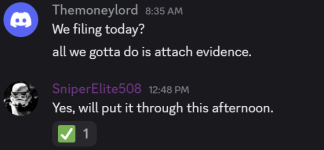
I, Themoneylord, am willing to have SniperElite508 represent my interests in court.

Slot_Machine.png

See attached .zip file.
 

Attachments

  • IMG_1926.jpeg
    IMG_1926.jpeg
    56.8 KB · Views: 41
  • Proof#1.zip
    Proof#1.zip
    33.9 KB · Views: 32
Last edited:

Writ of Summons


@coslos is commanded to appear in the District Court in the case of themoneylord v. coslos [2026] DCR 152

Failure to appear within 72 hours of this summons will result in a default judgement based on the known facts of the case.

Both parties should make themselves aware of the Court Rules and Procedures, including the option of an in-game trial should both parties request one.


Answer to Complaint


Answer to Complaint


IN THE FEDERAL COURT OF THE COMMONWEALTH OF REDMONT
ANSWER TO COMPLAINT

themoneylord
Plaintiff

v.

coslos
Defendant

I. ANSWER TO COMPLAINT
1. The defense AFFIRMS that the plaintiff paid one thousand dollars(1000$)
2. The defense AFFIRMS that the defendant's slot machine was out of winning tickets
3. The defense AFFIRMS that the Plaintiff asked the Defendant “Will {I} ever be paid,” to which the Defendant responded, “when the bank owner gets the money back.”
4. The defense DECLINES that the defendant's statement was a tactic of delay
4. The defense AFFIRMS that the Defendant’s statement of “when the bank owner gets the money back,” additionally implies that the Defendant promised to restore Plaintiff’s lost funds
5. The defense AFFIRMS that Several days later, on the 29th of June, 2026, the Plaintiff gave the Defendant twenty-four (24) hours to reimburse the Plaintiff the lost funds, before the prosecution planned on taking legal action.
6. The defense DECLINES that The Defendant, instead of responding to The Plaintiff’s request of payment, attempted to ghost The Plaintiff by stating “wrong person,” despite earlier discussions showing that the Defendant recognized The Plaintiff’s Discord messages.


II. DEFENCES
1. The defense declines that the defendant's statement was a tactic of delay, the defendant was at that time in a difficult financial situation, in a twenty-five thousand(25k) debt. The defendant wasn't also able to access most of his balance from a suspended bank account. Therefore a delay was reasonable action to take.
2. The defense admits that the defendant's statement implies that the defendant promised to restore plaintiff's lost funds, therefore creating a contract that would replace the good of the reward from the machine to which the plaintiff has agreed to since he is using it as an argument in court.
3. The defense admits that the plaintiff gave the defendant twenty-four (24) hours to reimburse the lost funds, in the message the plaintiff used legal action as a threat in many ways. (example threat is shown in the evidence)
4. The defendant tried reaching out to a lawyer after he found the lawsuit pending, after hiring him he attempted to send the evidence to him but confused the users, in effect sending it to the plaintiff. After the incident the defendant closed the platform, after coming back he saw a (now deleted) message "lol" from the plaintiff. When realising his mistake he deleted the evidence and said "wrong person". The plaintiff was fully aware of this mistake and still decided to use it as a false fact in the case.
5. The plaintiff has messaged the defendant many times trying to persuade him to pay the money faster by using law action as a threat.(as shown in the evidence)
6. On the 29th of June the defendant was asked for money. At that moment he couldn't remember all his debts, in an act of good will and geniue attempt to try and pay he asked for evidence to which the defendant did not agree to share.
7. The defense believes the plaintiff has filed the case out of malice, proven by numerous attempts at trying to persuade the defendant to pay trough threats of law action, lying in court to put the defendant in a bad light in front of a jury and many more.

By making this submission, I agree I understand the penalties of lying in court and the fact that I am subject to perjury should I knowingly make a false statement in court.

DATED: This 25th day of August 2026


Objection


IN THE FEDERAL COURT OF THE COMMONWEALTH OF REDMONT
OBJECTION - ASSUMES FACTS NOT IN EVIDENCE

Point 1 of the Defenses assumes facts not in evidence. Without proper documentation of the alleged bank freeze being submitted to this court, there is no way to tell if such a freeze actually existed.


Objection


IN THE FEDERAL COURT OF THE COMMONWEALTH OF REDMONT
OBJECTION - ASSUMES FACTS NOT IN EVIDENCE

Point 4 of the Defenses assumes facts not in evidence. Without proper documentation of the alleged deleted messages, there is no way to tell if said messages actually existed.


Objection


IN THE FEDERAL COURT OF THE COMMONWEALTH OF REDMONT
OBJECTION - SPECULATION

Point 7 of the Defenses is Speculation. The Defense does not have direct experience with or insight into the thoughts of the Plaintiff. The terminology "believes" additionally demonstrates that this point is not based in fact but is rather speculation.

 
Your Honour,
Due to not having acess to the device with evidence I would like to request a 48 hour extenstion to submit my responses to:

Objection


IN THE FEDERAL COURT OF THE COMMONWEALTH OF REDMONT
OBJECTION - SPECULATION

Point 7 of the Defenses is Speculation. The Defense does not have direct experience with or insight into the thoughts of the Plaintiff. The terminology "believes" additionally demonstrates that this point is not based in fact but is rather speculation.

Objection


IN THE FEDERAL COURT OF THE COMMONWEALTH OF REDMONT
OBJECTION - ASSUMES FACTS NOT IN EVIDENCE

Point 4 of the Defenses assumes facts not in evidence. Without proper documentation of the alleged deleted messages, there is no way to tell if said messages actually existed.

Objection


IN THE FEDERAL COURT OF THE COMMONWEALTH OF REDMONT
OBJECTION - ASSUMES FACTS NOT IN EVIDENCE

Point 1 of the Defenses assumes facts not in evidence. Without proper documentation of the alleged bank freeze being submitted to this court, there is no way to tell if such a freeze actually existed.

Thank you for your consideration.
 

Objection


IN THE DISTRICT COURT OF THE COMMONWEALTH OF REDMONT
OBJECTION - ASSUMES FACTS NOT IN EVIDENCE

Point 1 of the complaint assumes facts not in evidence. There is no way of telling if the failed transaction has been made on 24th of June 2026 without proper evidence.


Objection


IN THE DISTRICT COURT OF THE COMMONWEALTH OF REDMONT
OBJECTION - ASSUMES FACTS NOT IN EVIDENCE

Point 1 of the complaint assumes facts not in evidence. There is no way of telling if the failed transaction has been made on 24th of June 2026 without proper evidence.

Your Honor,

The Defense has already affirmed point 1 in their response to this case.

If the Defense wished to object to this point, they should have done so by denying it's validity in their answer to the complaint.

But since both sides have affirmed the truth of the point in question, the point is not up for objection during the proceedings of this case.

Therefore, the Plaintiff respectfully requests that this objection be overruled.
 

Motion


MOTION TO DISMISS — RULE 5.5
The Defendant respectfully moves this Court to dismiss the Plaintiff's complaint pursuant to Court Rule 5.5 for failure to state a claim upon which relief may be granted.

The Plaintiff's claim is premised upon an alleged failure by the Defendant to fulfill the obligation of delivering a good/service at issue. However, the money was already fully paid, as demonstrated by D-001.

Because the obligation was fulfilled, there is no outstanding breach for which the Plaintiff may obtain relief. Accordingly, the Plaintiff has failed to establish a cognizable claim against the Defendant, and dismissal is appropriate under Rule 5.5.

The Defendant respectfully requests that the Court dismiss the Plaintiff's complaint with prejudice.


D-001 transactions between the Plaintiff and the Defendant
4641875, 2321725, 58082, -1500.00 Payment from coslos to Themoneylord 2026-06-19 20:36:18, Payment from coslos to Themoneylord, 1620aeac-f8c5-41e9-91c5-e8c04b90f678,,
4641677, 2321618, 58082, -400.00, Payment from coslos to Themoneylord, 2026-06-19 20:33:17, Payment from coslos to Themoneylord, 1620aeac-f8c5-41e9-91c5-e8c04b90f678,,
4641661, 2321618, 58082, -100.00, Payment from coslos to Themoneylord, 2026-06-19 20:32:28, Payment from coslos to Themoneylord, 1620aeac-f8c5-41e9-91c5-e8c04b90f678,,


D-002 The defendant's message in the bank account,
PC&B
PORTAL LOCKED DOWN
Maintenance In Progress
The banking portal is undergoing core network upgrades.
Standard player access is temporarily offline.
Auditor Notice: Our accounting complience auditors are currently working on ledger migrations. The system will return to operational status shortly.


[Themoneylord] [You] Just pay me the 2k, my lawyer has agreed to take the case.
 

Attachments

  • D-001.png
    D-001.png
    40.3 KB · Views: 23
  • D-002.png
    D-002.png
    138.9 KB · Views: 25
  • D-003.png
    D-003.png
    24 KB · Views: 22
D-001 transactions between the Plaintiff and the Defendant
4641875, 2321725, 58082, -1500.00 Payment from coslos to Themoneylord 2026-06-19 20:36:18, Payment from coslos to Themoneylord, 1620aeac-f8c5-41e9-91c5-e8c04b90f678,,
4641677, 2321618, 58082, -400.00, Payment from coslos to Themoneylord, 2026-06-19 20:33:17, Payment from coslos to Themoneylord, 1620aeac-f8c5-41e9-91c5-e8c04b90f678,,
4641661, 2321618, 58082, -100.00, Payment from coslos to Themoneylord, 2026-06-19 20:32:28, Payment from coslos to Themoneylord, 1620aeac-f8c5-41e9-91c5-e8c04b90f678,,

Objection


IN THE DISTRICT COURT OF REDMONT
Objection - Relevance

D-001 is irrelevant to this case. Without greater context, there is no way to tell what these payments were for. For all this court knows, the payments listed could have been for a product, a service, or any sort of transaction other than the transaction related to this case. Thus, the evidence cannot be submitted to this court.

 
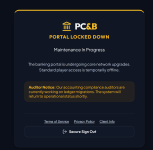
D-002 The defendant's message in the bank account,
PC&B
PORTAL LOCKED DOWN
Maintenance In Progress
The banking portal is undergoing core network upgrades.
Standard player access is temporarily offline.
Auditor Notice: Our accounting complience auditors are currently working on ledger migrations. The system will return to operational status shortly.

Objection


IN THE DISTRICT COURT OF REDMONT
Objection - Relevance

The screenshot of D-002 seems to depict an error message for "PC&B" Bank denying access to the bank's interface. Nevertheless, this evidence fails to show if the Defendant:

1. Had an account with this bank,
2. Had money in an account with this bank, and
3. If this error message was present at the time the defendant claims, assuming on the good faith basis that the defendant plans on stating that this message prevented him from accessing his account if he in fact does hold an account with this bank.

Thus, this evidence should not be submitted to this court.

 
Your honour, while in process of writing more defences and gathering evidence the defence has unfortunately been notified of an power outage that will happen in their place of residence, therefore the defence would like to respectfully request a 24 hour discovery extension as well as a 24 hour extension on all messages that require the defense to answer before the date of 31/08/2026.
Thank you for your consideration.
 
Your honour, while in process of writing more defences and gathering evidence the defence has unfortunately been notified of an power outage that will happen in their place of residence, therefore the defence would like to respectfully request a 24 hour discovery extension as well as a 24 hour extension on all messages that require the defense to answer before the date of 31/08/2026.
Thank you for your consideration.

Granted, an extra 24 hrs is given.
 
The defence would like to use their rights from rule 3.4 of court rules and procedures Information - Court Rules and Procedures [Deprecated]
The previous answer to complaint had a few fact errors therefore
in exchange for the current answer and defences the defence posts a remade and fact checked answer to complaint
and would like to respectfully ask the court to not take the first answer into consideration

Answer to Complaint


I. ANSWER TO COMPLAINT
1. The defence DENIES point one of the complaint.
2. The defence DENIES point two of the complaint.
3. The defence AFFIRMS point three of the complaint.
4. The defence DENIES point four of the complaint.
5. The defence AFFIRMS point five of the complaint.
6. The defence DENIES point six of the complaint.

II. DEFENCES
1. first(1st) fact in the complaint is denied because while the plaintiff has played in the defendant's casino countless times there is no evidence of the plaintiff playing on that specific date.
2. second(2nd) fact in the complaint is denied because no evidence was provided, the defendant has stated a reason why the machine could have malfunctioned, the plaintiff didn't show any evidence of it failing to reder their winnings.
3. The defendant has stated that they wasn't shown any evidence of a malfunction therefore a contract to pay two thousand(2k) dollars for a malfunction caused losses was not legally binding since there wasn't any proven malfunction.
4. The plaintiff can not show why the defendant sent message from fact 6 as an attempt to ghost instead of an answer to a now deleted message.
5. No malfunction was proved to the defendant or court.
6. The plaintiff takes the defendant's words however they desire, no context or clear intent is shown, the casino owner's only motivation in that case would be to provide the best playing expirience since satisfied clients bring money.
7. Point 1 (a) of claims for relief is a speculation, no evidence was provided.
8. Point 1 (b) of claims for relief states that: "This failure to compounded by the Defendant's offer (...)" A valid contract was not obligating the defendant.


Dated thirty-first(31st) of August 2026


Motion


IN THE FEDERAL COURT OF THE COMMONWEALTH OF REDMONT
MOTION TO DISMISS - RULE 5.5

The defence moves that the complaint in this case be dismissed with prejudice, and in support thereof, respectfully alleges:

1. The plaintiff has insufficient evidence to prove any of his claims

DATED: thirty-first(31st) of August 2026

 
The defence would like to use their rights from rule 3.4 of court rules and procedures Information - Court Rules and Procedures [Deprecated]
The previous answer to complaint had a few fact errors therefore
in exchange for the current answer and defences the defence posts a remade and fact checked answer to complaint
and would like to respectfully ask the court to not take the first answer into consideration

Answer to Complaint


I. ANSWER TO COMPLAINT
1. The defence DENIES point one of the complaint.
2. The defence DENIES point two of the complaint.
3. The defence AFFIRMS point three of the complaint.
4. The defence DENIES point four of the complaint.
5. The defence AFFIRMS point five of the complaint.
6. The defence DENIES point six of the complaint.

II. DEFENCES
1. first(1st) fact in the complaint is denied because while the plaintiff has played in the defendant's casino countless times there is no evidence of the plaintiff playing on that specific date.
2. second(2nd) fact in the complaint is denied because no evidence was provided, the defendant has stated a reason why the machine could have malfunctioned, the plaintiff didn't show any evidence of it failing to reder their winnings.
3. The defendant has stated that they wasn't shown any evidence of a malfunction therefore a contract to pay two thousand(2k) dollars for a malfunction caused losses was not legally binding since there wasn't any proven malfunction.
4. The plaintiff can not show why the defendant sent message from fact 6 as an attempt to ghost instead of an answer to a now deleted message.
5. No malfunction was proved to the defendant or court.
6. The plaintiff takes the defendant's words however they desire, no context or clear intent is shown, the casino owner's only motivation in that case would be to provide the best playing expirience since satisfied clients bring money.
7. Point 1 (a) of claims for relief is a speculation, no evidence was provided.
8. Point 1 (b) of claims for relief states that: "This failure to compounded by the Defendant's offer (...)" A valid contract was not obligating the defendant.


Dated thirty-first(31st) of August 2026


Objection


IN THE DISTRICT COURT OF REDMONT
OBJECTION - PERJURY

Your Honor,

It is not with a light hand that the Plaintiff raises this objection, but when such conduct requires it, it is the duty of the just to speak against blatant falsehoods being presented in this court, that the integrity of the court may be preserved.

Perjury is committed when counsel "knowingly provides false testimony in a court of law," according to the CCA Part III § I and the Court Rules page.

Due to the above amendments, The Plaintiff has reason to believe that the Defendant in this case is guilty of perjury before this court on the following grounds:

1. As can be seen in post #9, the Defendant initially responded to this case by stating that the transaction that is in question in this case occurred between the Defendant and the Plaintiff.

2. After admitting that the transaction took place, Defense then proceeded to object in post #15 that the transaction "...assumes facts not in evidence. There is no way of telling if the failed transaction has been made on 24th of June 2026 without proper evidence."

This was done in spite of the fact that the Defense already agreed with the plaintiff, which issue was raised in the Plaintiff's response to the objection in post #16.

3. At this point, the Defense attempted to switch tactics, by again admitting that the transaction took place and attempting to prove that payment was made, thereby completing the requirements of the transaction that the Defense agreed existed. In post #18, the Defendant submitted to this court a Motion for dismissal on the following grounds:

"The Defendant respectfully moves this Court to dismiss the Plaintiff's complaint pursuant to Court Rule 5.5 for failure to state a claim upon which relief may be granted.

The Plaintiff's claim is premised upon an alleged failure by the Defendant to fulfill the obligation of delivering a good/service at issue. However, the money was already fully paid, as demonstrated by D-001.

Because the obligation was fulfilled
, there is no outstanding breach for which the Plaintiff may obtain relief. Accordingly, the Plaintiff has failed to establish a cognizable claim against the Defendant, and dismissal is appropriate under Rule 5.5." (Empasis added)


4. After arguing that the transaction took place, the Defense then proceeded to present evidence in post #20 in support of the argument in post #18 stating particularly that D-001 was evidence of "transactions between the Plaintiff and the Defendant" to which the plaintiff had it on a good faith basis that such evidence would be used to prove that payment for the transaction was made as was argued in post #21. In addition, the said evidence was explicitly claimed to be proof of the payment of the transaction in the motion to dismiss made by the Defendant in post #18.

5. Now, in an attempt to have this case removed from before this court, the Defense has changed their story yet again, by amending the answer to the complaint in post #25 and stating that, in fact, no transaction ever occurred. These changes have been submitted on the grounds that the initial submission had just "a few fact errors." This has been done irrespective of the fact that the Defense tried to support the now supposedly erroneous claims.

Your honor, it is the duty of the Defense to get their story straight before any submission is presented before this court. The Plaintiff would like to bring to mind that both sides in this case have taken a vow that we "understand the penalties of lying in court" and the fact that we are subject to perjury should we knowingly make a false statement before this court. This vow is not something to be taken lightly, for to do so would throw into jeopardy all the principles that allow our society to function.

The transaction, which either did happen or did not, may, in the eyes of the Defense, be a point of contention, but for the Defense to try to repeatedly change their story in way that has been described above goes beyond the basic understanding that both sides are to abide by a principle of honesty. Since the Defense has tried to claim during this discovery that the transaction both did and did not happen, their testimony must be called into question, for basic logic requires that a fact cannot be both true and false at the same time, and in the same sense.

Therefore, based on the above facts, as well as the general context of the preceding discovery, the Plaintiff believes that the Defense is guilty of perjury before this court and asks that the Defense should be remanded for such.

The Plaintiff also requests that the above amended answer and the proceeding motion to dismiss be overruled that the proceedings may continue in a manner honoring to this court.

So submitted,
SniperElite508

 
Last edited:

Objection


IN THE DISTRICT COURT OF REDMONT
OBJECTION - PERJURY

Your Honor,

It is not with a light hand that the Plaintiff raises this objection, but when such conduct requires it, it is the duty of the just to speak against blatant falsehoods being presented in this court, that the integrity of the court may be preserved.

Perjury is committed when counsel "knowingly provides false testimony in a court of law," according to the CCA Part III § I and the Court Rules page.

Due to the above amendments, The Plaintiff has reason to believe that the Defendant in this case is guilty of perjury before this court on the following grounds:

1. As can be seen in post #9, the Defendant initially responded to this case by stating that the transaction that is in question in this case occurred between the Defendant and the Plaintiff.

2. After admitting that the transaction took place, Defense then proceeded to object in post #15 that the transaction "...assumes facts not in evidence. There is no way of telling if the failed transaction has been made on 24th of June 2026 without proper evidence."

This was done in spite of the fact that the Defense already agreed with the plaintiff, which issue was raised in the Plaintiff's response to the objection in post #16.

3. At this point, the Defense attempted to switch tactics, by again admitting that the transaction took place and attempting to prove that payment was made, thereby completing the requirements of the transaction that the Defense agreed existed. In post #18, the Defendant submitted to this court a Motion for dismissal on the following grounds:

"The Defendant respectfully moves this Court to dismiss the Plaintiff's complaint pursuant to Court Rule 5.5 for failure to state a claim upon which relief may be granted.

The Plaintiff's claim is premised upon an alleged failure by the Defendant to fulfill the obligation of delivering a good/service at issue. However, the money was already fully paid, as demonstrated by D-001.

Because the obligation was fulfilled
, there is no outstanding breach for which the Plaintiff may obtain relief. Accordingly, the Plaintiff has failed to establish a cognizable claim against the Defendant, and dismissal is appropriate under Rule 5.5." (Empasis added)


4. After arguing that the transaction took place, the Defense then proceeded to present evidence in post #20 in support of the argument in post #18 stating particularly that D-001 was evidence of "transactions between the Plaintiff and the Defendant" to which the plaintiff had it on a good faith basis that such evidence would be used to prove that payment for the transaction was made as was argued in post #21. In addition, the said evidence was explicitly claimed to be proof of the payment of the transaction in the motion to dismiss made by the Defendant in post #18.

5. Now, in an attempt to have this case removed from before this court, the Defense has changed their story yet again, by amending the answer to the complaint in post #25 and stating that, in fact, no transaction ever occurred. These changes have been submitted on the grounds that the initial submission had just "a few fact errors." This has been done irrespective of the fact that the Defense tried to support the now supposedly erroneous claims.

Your honor, it is the duty of the Defense to get their story straight before any submission is presented before this court. The Plaintiff would like to bring to mind that both sides in this case have taken a vow that we "understand the penalties of lying in court" and the fact that we are subject to perjury should we knowingly make a false statement before this court. This vow is not something to be taken lightly, for to do so would throw into jeopardy all the principles that allow our society to function.

The transaction, which either did happen or did not, may, in the eyes of the Defense, be a point of contention, but for the Defense to try to repeatedly change their story in way that has been described above goes beyond the basic understanding that both sides are to abide by a principle of honesty. Since the Defense has tried to claim during this discovery that the transaction both did and did not happen, their testimony must be called into question, for basic logic requires that a fact cannot be both true and false at the same time, and in the same sense.

Therefore, based on the above facts, as well as the general context of the preceding discovery, the Plaintiff believes that the Defense is guilty of perjury before this court and asks that the Defense should be remanded for such.

The Plaintiff also requests that the above amended answer and the proceeding motion to dismiss be overruled that the proceedings may continue in a manner honoring to this court.

So submitted,
SniperElite508

1. the defence has the right to change their denial or affirm of the fact under the rule 3.4 of courts rules and procedures
2. again, this behaviour is allowed under rule 3.4 of courts rules and procedures
3. the motion was not granted. The evidence was objected and as the defendant said "The previous answer to complaint had a few fact errors" the defence in facts does agree that the payment was not relevant to the case.
4. evidence objected. motion not granted.
the defence is allowed to change their affirmation of facts as well as defences, no bad faith was or is in the defendant's mind. The defence just admits to making a lot of speculations as proved by the plaintiff himself, the defence is sorry to make such mistakes but their re-answer is a way to fix. speculations and factual errors made.
No laws were broken and the plaintiff has no evidence of prejury.
Discovery is the time for the defence to correct their mistakes too.
The defence would like to respectully ask the court for this objection to be overruled.
 
Your honor,

The Plaintiff's counsel respectfully requests a 24-hour extension for discovery.

Plaintiff believes that he may have further evidence that is relevant to the transaction issue but is currently on vacation and needs additional time so that he can return to his home computer to retrieve it.
 
Your honor,

Plaintiff has had an unfortunate scheduling issue and needs to visit his doctor for medical testing.

We respectfully request one final 24-hour extension as he will be unable to send counsel the required documents to find the evidence of the transaction until after the testing.

Screenshot 2026-09-01 103454.png
 
Additional proof of transaction.

Screenshot_2026-09-01_at_17.29.14.webp
 
I see no witnesses and discovery is closed.

@TheREALWINner Please submit a closing brief including all arguments and statements you'd like to make. You have until 9/10/26 at 9pm EDT. @coslos You have 72 Hours after that submission to submit your own.

Objection


IN THE DISTRICT COURT OF REDMONT
OBJECTION - PERJURY

Your Honor,

It is not with a light hand that the Plaintiff raises this objection, but when such conduct requires it, it is the duty of the just to speak against blatant falsehoods being presented in this court, that the integrity of the court may be preserved.

Perjury is committed when counsel "knowingly provides false testimony in a court of law," according to the CCA Part III § I and the Court Rules page.

Due to the above amendments, The Plaintiff has reason to believe that the Defendant in this case is guilty of perjury before this court on the following grounds:

1. As can be seen in post #9, the Defendant initially responded to this case by stating that the transaction that is in question in this case occurred between the Defendant and the Plaintiff.

2. After admitting that the transaction took place, Defense then proceeded to object in post #15 that the transaction "...assumes facts not in evidence. There is no way of telling if the failed transaction has been made on 24th of June 2026 without proper evidence."

This was done in spite of the fact that the Defense already agreed with the plaintiff, which issue was raised in the Plaintiff's response to the objection in post #16.

3. At this point, the Defense attempted to switch tactics, by again admitting that the transaction took place and attempting to prove that payment was made, thereby completing the requirements of the transaction that the Defense agreed existed. In post #18, the Defendant submitted to this court a Motion for dismissal on the following grounds:

"The Defendant respectfully moves this Court to dismiss the Plaintiff's complaint pursuant to Court Rule 5.5 for failure to state a claim upon which relief may be granted.

The Plaintiff's claim is premised upon an alleged failure by the Defendant to fulfill the obligation of delivering a good/service at issue. However, the money was already fully paid, as demonstrated by D-001.

Because the obligation was fulfilled
, there is no outstanding breach for which the Plaintiff may obtain relief. Accordingly, the Plaintiff has failed to establish a cognizable claim against the Defendant, and dismissal is appropriate under Rule 5.5." (Empasis added)


4. After arguing that the transaction took place, the Defense then proceeded to present evidence in post #20 in support of the argument in post #18 stating particularly that D-001 was evidence of "transactions between the Plaintiff and the Defendant" to which the plaintiff had it on a good faith basis that such evidence would be used to prove that payment for the transaction was made as was argued in post #21. In addition, the said evidence was explicitly claimed to be proof of the payment of the transaction in the motion to dismiss made by the Defendant in post #18.

5. Now, in an attempt to have this case removed from before this court, the Defense has changed their story yet again, by amending the answer to the complaint in post #25 and stating that, in fact, no transaction ever occurred. These changes have been submitted on the grounds that the initial submission had just "a few fact errors." This has been done irrespective of the fact that the Defense tried to support the now supposedly erroneous claims.

Your honor, it is the duty of the Defense to get their story straight before any submission is presented before this court. The Plaintiff would like to bring to mind that both sides in this case have taken a vow that we "understand the penalties of lying in court" and the fact that we are subject to perjury should we knowingly make a false statement before this court. This vow is not something to be taken lightly, for to do so would throw into jeopardy all the principles that allow our society to function.

The transaction, which either did happen or did not, may, in the eyes of the Defense, be a point of contention, but for the Defense to try to repeatedly change their story in way that has been described above goes beyond the basic understanding that both sides are to abide by a principle of honesty. Since the Defense has tried to claim during this discovery that the transaction both did and did not happen, their testimony must be called into question, for basic logic requires that a fact cannot be both true and false at the same time, and in the same sense.

Therefore, based on the above facts, as well as the general context of the preceding discovery, the Plaintiff believes that the Defense is guilty of perjury before this court and asks that the Defense should be remanded for such.

The Plaintiff also requests that the above amended answer and the proceeding motion to dismiss be overruled that the proceedings may continue in a manner honoring to this court.

So submitted,
SniperElite508

Understood, your Honor.

Respectfully, before opening arguments are submitted, has your Honor been able to view the several objections raised to the evidence in this case? The ruling on these objections will affect the opening statement of the Plaintiff.
 
Understood, your Honor.

Respectfully, before opening arguments are submitted, has your Honor been able to view the several objections raised to the evidence in this case? The ruling on these objections will affect the opening statement of the Plaintiff.

No I didn't. Give me 24 hours to review the objections. You're deadline is pushed back another day while I review.
 

Objection


IN THE DISTRICT COURT OF REDMONT
OBJECTION - PERJURY

Your Honor,

It is not with a light hand that the Plaintiff raises this objection, but when such conduct requires it, it is the duty of the just to speak against blatant falsehoods being presented in this court, that the integrity of the court may be preserved.

Perjury is committed when counsel "knowingly provides false testimony in a court of law," according to the CCA Part III § I and the Court Rules page.

Due to the above amendments, The Plaintiff has reason to believe that the Defendant in this case is guilty of perjury before this court on the following grounds:

1. As can be seen in post #9, the Defendant initially responded to this case by stating that the transaction that is in question in this case occurred between the Defendant and the Plaintiff.

2. After admitting that the transaction took place, Defense then proceeded to object in post #15 that the transaction "...assumes facts not in evidence. There is no way of telling if the failed transaction has been made on 24th of June 2026 without proper evidence."

This was done in spite of the fact that the Defense already agreed with the plaintiff, which issue was raised in the Plaintiff's response to the objection in post #16.

3. At this point, the Defense attempted to switch tactics, by again admitting that the transaction took place and attempting to prove that payment was made, thereby completing the requirements of the transaction that the Defense agreed existed. In post #18, the Defendant submitted to this court a Motion for dismissal on the following grounds:

"The Defendant respectfully moves this Court to dismiss the Plaintiff's complaint pursuant to Court Rule 5.5 for failure to state a claim upon which relief may be granted.

The Plaintiff's claim is premised upon an alleged failure by the Defendant to fulfill the obligation of delivering a good/service at issue. However, the money was already fully paid, as demonstrated by D-001.

Because the obligation was fulfilled
, there is no outstanding breach for which the Plaintiff may obtain relief. Accordingly, the Plaintiff has failed to establish a cognizable claim against the Defendant, and dismissal is appropriate under Rule 5.5." (Empasis added)


4. After arguing that the transaction took place, the Defense then proceeded to present evidence in post #20 in support of the argument in post #18 stating particularly that D-001 was evidence of "transactions between the Plaintiff and the Defendant" to which the plaintiff had it on a good faith basis that such evidence would be used to prove that payment for the transaction was made as was argued in post #21. In addition, the said evidence was explicitly claimed to be proof of the payment of the transaction in the motion to dismiss made by the Defendant in post #18.

5. Now, in an attempt to have this case removed from before this court, the Defense has changed their story yet again, by amending the answer to the complaint in post #25 and stating that, in fact, no transaction ever occurred. These changes have been submitted on the grounds that the initial submission had just "a few fact errors." This has been done irrespective of the fact that the Defense tried to support the now supposedly erroneous claims.

Your honor, it is the duty of the Defense to get their story straight before any submission is presented before this court. The Plaintiff would like to bring to mind that both sides in this case have taken a vow that we "understand the penalties of lying in court" and the fact that we are subject to perjury should we knowingly make a false statement before this court. This vow is not something to be taken lightly, for to do so would throw into jeopardy all the principles that allow our society to function.

The transaction, which either did happen or did not, may, in the eyes of the Defense, be a point of contention, but for the Defense to try to repeatedly change their story in way that has been described above goes beyond the basic understanding that both sides are to abide by a principle of honesty. Since the Defense has tried to claim during this discovery that the transaction both did and did not happen, their testimony must be called into question, for basic logic requires that a fact cannot be both true and false at the same time, and in the same sense.

Therefore, based on the above facts, as well as the general context of the preceding discovery, the Plaintiff believes that the Defense is guilty of perjury before this court and asks that the Defense should be remanded for such.

The Plaintiff also requests that the above amended answer and the proceeding motion to dismiss be overruled that the proceedings may continue in a manner honoring to this court.

So submitted,
SniperElite508


Objection OVERRULED.

A modification under Rule 3.4 can't be seen as evidence of dishonesty on its own. The Court notes the inconsistent positions on the status of the transaction, but I don't really see much more. This is more a degradation of credibility, rather than an imposition of a perjury charge.
 
Objection OVERRULED.

A modification under Rule 3.4 can't be seen as evidence of dishonesty on its own. The Court notes the inconsistent positions on the status of the transaction, but I don't really see much more. This is more a degradation of credibility, rather than an imposition of a perjury charge.
Understood, your Honor.

In light of this ruling then, the Plaintiff wishes to know how we ought to proceed.

The objection was initially raised not just because the Defense made a modification under rule 3.4, but because the Defense has submitted evidence that attempts to refute their now current position, in addition to submitting two contradictory motions to dismiss, particularly in the order of the first admitting the transaction took place and the second saying it did not.

In short, the Plaintiff wishes to know if the Court is then prepared to accept argumentation that their now current position is untenable by their own admission in the Discovery proceedings, or ought we to build our case irrespective of this fact?

If the court wishes us to perform the latter in our arguments, then the Plaintiff is unsure how to proceed as the Defense's submitted evidence is currently contradictory in nature to their most recent claim, making it unclear how to build a coherent argument.

Therefore, if the court can offer any guidance on what exactly is expected of both parties as we proceed, the Plaintiff would greatly appreciate such.

Respectfully submitted,
SniperElite508
 
Last edited:
Understood, your Honor.

In light of this ruling then, the Plaintiff wishes to know how we ought to proceed.

The objection was initially raised not just because the Defense made a modification under rule 3.4, but because the Defense has submitted evidence that attempts to refute their now current position, in addition to submitting two contradictory motions to dismiss, particularly in the order of the first admitting the transaction took place and the second saying it did not.

In short, the Plaintiff wishes to know if the Court is then prepared to accept argumentation that their now current position is untenable by their own admission in the Discovery proceedings, or ought we to build our case irrespective of this fact?

If the court wishes us to perform the latter in our arguments, then the Plaintiff is unsure how to proceed as the Defense's submitted evidence is currently contradictory in nature to their most recent claim, making it unclear how to build a coherent argument.

Therefore, if the court can offer any guidance on what exactly is expected of both parties as we proceed, the Plaintiff would greatly appreciate such.

Respectfully submitted,
SniperElite508

You're more than welcome to include that argument in closing.
 

Closing Statement


Your Honor and may it please the court.

Today's case is a simple matter of breach of contract, and as it is disputed by the Defense upon the facts in question, we are now gathered before this court to discuss the issues at hand.

In order to do so, the Plaintiff's arguments shall be two-fold. We shall prove that:

1. Did a contract actually form between the Defendant and the Plaintiff?

And;

2. Did the Defendant fail to deliver on the terms of that contract?

I. Did a Contract actually form between the Defendant and the Plaintiff?

Part VI §3 of the RCCA states that "Failure to deliver goods or services is committed when a person “fails without lawful excuse to deliver goods or services that they have agreed to supply under a valid transaction or contract.”

In order to meet this requirement, a five-pronged test applies as was outlaid in Part IV of the Contracts Act and in both SimplifiedMax v. L4ndaakk [2026] DCR 28 and Two Guys Realty v. Mastercaelen [2026] FCR 43.

This test gives a clear and explicit definition of what constitutes a contract, and for such a contract to form, it must have the following five characteristics:

  1. Offer,
  2. Acceptance,
  3. Consideration,
  4. Intent, and
  5. Capacity.
The requirements now outlaid, the Plaintiff will show how the facts meet this standard.

I.A Offer

The test of Offer is defined by the Contracts Act under 4.2.A as "a clear and unequivocal communication expressing a party's willingness to enter into a contract, either explicitly stated or reasonably inferred from the circumstances."

As is seen in P-004, the Defendant has set up a redstone-based chest shop slot machine. By having such a chest shop available, and accessible to the public, it is clear that the Plaintiff would reasonably infer that such a shop was an offer for the Plaintiff to gamble for a chance to win more money. In fact, as can be clearly seen in the photo, a sign below the machine states in clear language that potential patrons can "Buy a Stick to play." After playing on the machine, the machine had a chance to dispense slime balls that could be sold for a profit should the defendant win enough of them.

This clearly shows that the Defendant, by proxy of the chest shop, was setting up a universal offer to any who wished to try their luck at his place of business. Therefore, the requirement of offer has been clearly met.

I.B Acceptance

The test of Acceptance is defined by the Contracts Act under 4.2.B as "the positive and unambiguous response to an offer communicated to the offeror, mirroring the terms of the offer and conveyed through various means."

This test is also clearly met. As is seen in P-006, the Defendant spent $1,000 on the chest shop, in exchange for the ability to "play" the machine. The chest shop then accepting the money on behalf of the Defendant thus fulfills the requirement of acceptance.

I.C Consideration

The test of Consideration is defined by the Contracts Act under 4.2.C as "the positive and unambiguous response to an offer communicated to the offeror, mirroring the terms of the offer and conveyed through various means."

As further clarified by the previously cited SimplifiedMax v. l4ndaakk, consideration is only potential and not an actual exchange of goods. "[T]he Plaintiff was to provide the Defendant $10k, while the Defendant was to provide the Plaintiff a gold drill." (SimplifiedMax v. l4ndaakk, Post #72, I.B.1; emphasis added.)

The price stated on the chest shop, in addition to the sign stating, "Buy a Stick to play," instructed the Defendant that he too was to provide the shop with money, and in exchange the shop would activate the machine to play, offering him a chance to win more than was spent. Thus, the test of Consideration is met.

I.D Intent

The test of Intent is found in the Contracts Act under 4.2.D. "Parties must demonstrate a clear intention to create legal obligations for the contract to be valid."

The facts show that Intent too is met as by setting up the chest shop machine, the Defendant offered a clear intention to sell "plays" on his publicly available chest shop machine. The Plaintiff's interaction with that machine by purchasing a "Stick to play" (P-004) shows that the Plaintiff intended to form a contract in response to the Defendant's clear intention.

I.E Capacity

The test of Capacity is found in the Contracts Act under 4.2.E. "Parties entering into a contract must possess the legal capacity to do so. Players with low playtime may lack the capacity to fairly enter a contract."

This court has ruled in SimplifiedMax v. I4ndaakk that, on the matter of Capacity, if "the Defendant was the initiator of the negotiation," and "instructed the Plaintiff to send payment," then "capacity, as a matter of fact, was present at the time of contract formation," and that "On this record, low playtime alone does not defeat capacity." This remains to be true so long as it is the case that "the record does not show that this transaction threaten[s the] Defendant’s starting balance." (SimplifiedMax v. I4ndaakk, Post #72, II.B.2)

The Chest Shop in this case fulfills this test. The Defendant "was the initiator of the negotiation" by setting up a chest shop. The Defendant "instructed the Plaintiff to send payment," by setting up the chest shop and additionally displaying a sign that stated one could "Buy a Stick to play." (P-004)

Such a transaction could not harm the Defendant's starting balance as the Plaintiff was giving the Defendant funds in exchange for a play on the machine. This was done with the desire that the Plaintiff would win more money than was spent via the re-sale of the slime balls the machine could drop back to the Defendant. But such re-sale is dependent on the fact that the machine would dispense the slime balls, at which point the re-sale would form a separate contract.

The issue at hand and as shall be soon proven is that the machine failed to deliver the slime balls in the first place due to the fact that the machine was out of stock. Since all the parts of this contract were set up and pre-negotiated by the Defendant, and since the nature of the initial playing of the machine is such that money can only flow into and not out of the Defendant's account, it is clear that in the matter of this transaction, the record shows that it could in no way "threaten [the] Defendant's starting balance." (SimplifiedMax v. I4ndaakk, Post #72, II.B.2) Therefore, the Defendant has Capacity to form this contract.

2. Did the Defendant fail to deliver on the terms of that contract?

Now, it being proven that a valid contract does in fact exist between the Defendant and the Plaintiff, it must be proven that the Defendant failed to deliver on the terms of that contract.

2.A Is it the case that the transaction took place?

As is seen in P-001, the Defendant approached the Plaintiff stating that he "figured out...what happened with that machine." (Referring to the machine in the casino.) After this, the Plaintiff responded with the question, "Coslos what was wrong?" The Defendant responded that "the [machine's] dispensers were empty" and that "that[']s the moment when I would pay you." At this point, the Defendant very well could have reimbursed the plaintiff, but offered the defense that he "lost 7k because of a bank heist" and that "Now I personally only have 2." At this point, the record shows that the Defendant's personal balance was indeed "$2,520.79."

After being presented with this evidence, the Defense during discovery initially agreed with the plaintiff that such a transaction happened in the following manner as previously argued in the objection to Perjury:

(While the court may not find the Defendant guilty of Perjury, the order of the events of Discovery nevertheless offer important insight into this case and should not be ignored. Thus, the argument has been restated below for this court.)

1. As can be seen in post #9, the Defendant initially responded to this case by stating that the transaction that is in question in this case occurred between the Defendant and the Plaintiff.

2. After admitting that the transaction took place, Defense then proceeded to object in post #15 that the transaction "...assumes facts not in evidence. There is no way of telling if the failed transaction has been made on 24th of June 2026 without proper evidence."

This was done in spite of the fact that the Defense already agreed with the plaintiff, which issue was raised in the Plaintiff's response to the objection in post #16.

3. At this point, the Defense attempted to switch tactics, by again admitting that the transaction took place and attempting to prove that payment was made, thereby completing the requirements of the transaction that the Defense agreed existed. In post #18, the Defendant submitted to this court a Motion for dismissal on the following grounds:

"The Defendant respectfully moves this Court to dismiss the Plaintiff's complaint pursuant to Court Rule 5.5 for failure to state a claim upon which relief may be granted.

The Plaintiff's claim is premised upon an alleged failure by the Defendant to fulfill the obligation of delivering a good/service at issue. However, the money was already fully paid, as demonstrated by D-001.

Because the obligation was fulfilled
, there is no outstanding breach for which the Plaintiff may obtain relief. Accordingly, the Plaintiff has failed to establish a cognizable claim against the Defendant, and dismissal is appropriate under Rule 5.5." (Empasis added)


4. After arguing that the transaction took place, the Defense then proceeded to present evidence in post #20 in support of the argument in post #18 stating particularly that D-001 was evidence of "transactions between the Plaintiff and the Defendant" to which the plaintiff had it on a good faith basis that such evidence would be used to prove that payment for the transaction was made. The Plaintiff argued this in post #21. In addition, the said evidence was explicitly claimed to be proof of the payment of the transaction in the motion to dismiss made by the Defendant in post #18.

5. Now, in an attempt to have this case removed from before this court, the Defense has changed their story yet again, by amending the answer to the complaint in post #25 and stating that, in fact, no transaction ever occurred. These changes have been submitted on the grounds that the initial submission had just "a few fact errors." This has been done irrespective of the fact that the Defense tried to support the now supposedly erroneous claims.

As the above goes to show, despite the current argument of the Defendant, the defendant has admitted to this court on several evidentiary and in several motions that the now contested transaction has occurred.

As was stated previously, the objection was initially raised not just because the Defense made a modification under Court Rule 3.4, but because the Defense has submitted evidence that attempts to refute their now current position, in addition to submitting two contradictory motions to dismiss, particularly in the order of the first admitting the transaction took place and the second saying it did not.

This admission cannot be overlooked by the court on the sole grounds of rule 3.4, for rule 3.4 references the amendment of an answer to a complaint and does not pertain to the amendment of submitted evidence or motions to dismiss.

In Addition, if the Defense had read one further rule down to Court Rule 3.5, they would have read the following:

"Amendments to an Answer or Complaint cannot change information that was already submitted."

Thus, it should be held that the Defense has violated this procedure and the court ought to take this into account during their ruling.

Yet even irrespective of the amended claims, the Defendant has clearly and unambiguously destroyed their own position through their prior evidence submissions and motions that clearly show that the Defendant agreed the transaction took place.

2.B Did the Plaintiff offer to reimburse the Defendant for the failure to deliver the goods?

This question can be shown to be the case again on the evidence and can additionally be inferred from the Defendant's own admission in prior motions and evidence.

As can be seen in P-001, the Plaintiff asked the Defendant, "will I ever get paid?" To which the Defendant responded, "when the bank owner gets the money back."

This clearly shows that the Defendant promised to pay back the Plaintiff, and the Defendant evidently understood this to be the case. As seen in post #18, the Defendant attempted to prove that he had fulfilled this debt, attempting to have this case dismissed on the grounds that "the money was already fully paid." While the Defense has now abandoned this position, the words of the Defendant again clearly speak against the Defense's currently stated position, and should not be ignored.

2.C Is it a Legitimate Defense to State that the Defendant was Unable to Reimburse the Plaintiff?

The final question that must be answered is if the Defendant was actually unable to reimburse the plaintiff on the grounds that he could not access the funds.

As is seen in P-006, the funds in this issue were transferred to the business account of the Defendant. This account, being in-server, would have clearly held the funds to reimburse the plaintiff and could have had a withdrawal taken from it to reimburse the Plaintiff.

And even if for some reason the money was not in that account, the Defendant still had immediate access to the funds needed to reimburse the Plaintiff as the Defendant admits in P-001 that "Now I personally have only 2" and via the Treasury log stating that "coslos's balance: $2,520.79."

Thus, the claim that the Defendant was unable to reimburse the Plaintiff at the time of the discussion is far-fetched at best. Even if it is the case that the Defendant has outstanding debts, if this ordeal had never occurred, then the Plaintiff would not be affected in his debts in the slightest. It is not the Plaintiff's fault that the Defendant owes money elsewhere. All the Defendant was asking for was the return of what was rightly his in the first place. Since the Defendant had the money, all that needed to be done was a simple slash command.

III. Conclusion

In conclusion, it is clear that the Defendant:

A. Made a contract with the Plaintiff for a play on his casino machine.

B. The Defendant admitted that the contract was breached as the machine could not deliver goods to the Plaintiff on the grounds that the machine was out of stock.

C. The Defendant failed to reimburse the Plaintiff for the contract breach even though such reimbursement was possible at the time of the incident.

For these reasons, we humbly request that this honorable court rule in favor of the Plaintiff.

Thus Submitted,
SniperElite508


Closing Statement


IN THE FEDERAL COURT OF THE COMMONWEALTH OF REDMONT
CLOSING STATEMENT

The plaintiff still didn't provide fully confirmed proof. The defendant was never presented with any proof of the machine malfunctioning, neither in court nor outside of it. The defendant only stated what could be a reason of a malfunction. Statement "thats the moment when I would pay you" was only made because the defendant had a good relationship with the plaintiff, when asked to provide the evidence of a malfunction the plaintiff didn't provide it, therefore leading the defendant to a conclusion it was not real.
The defence states that a malfunction was not proved trough evidence and only trough a testimony of a non-native English speaker.
In conclusion:
The plaintiff can not prove his standing since there is no real evidence of harm happening.

For that reason, the defence humbly requests that this honorable court rule in favor of the Defendant.


Closing Statement


Your Honor and may it please the court.

Today's case is a simple matter of breach of contract, and as it is disputed by the Defense upon the facts in question, we are now gathered before this court to discuss the issues at hand.

In order to do so, the Plaintiff's arguments shall be two-fold. We shall prove that:

1. Did a contract actually form between the Defendant and the Plaintiff?

And;

2. Did the Defendant fail to deliver on the terms of that contract?

I. Did a Contract actually form between the Defendant and the Plaintiff?

Part VI §3 of the RCCA states that "Failure to deliver goods or services is committed when a person “fails without lawful excuse to deliver goods or services that they have agreed to supply under a valid transaction or contract.”

In order to meet this requirement, a five-pronged test applies as was outlaid in Part IV of the Contracts Act and in both SimplifiedMax v. L4ndaakk [2026] DCR 28 and Two Guys Realty v. Mastercaelen [2026] FCR 43.

This test gives a clear and explicit definition of what constitutes a contract, and for such a contract to form, it must have the following five characteristics:

  1. Offer,
  2. Acceptance,
  3. Consideration,
  4. Intent, and
  5. Capacity.
The requirements now outlaid, the Plaintiff will show how the facts meet this standard.

I.A Offer

The test of Offer is defined by the Contracts Act under 4.2.A as "a clear and unequivocal communication expressing a party's willingness to enter into a contract, either explicitly stated or reasonably inferred from the circumstances."

As is seen in P-004, the Defendant has set up a redstone-based chest shop slot machine. By having such a chest shop available, and accessible to the public, it is clear that the Plaintiff would reasonably infer that such a shop was an offer for the Plaintiff to gamble for a chance to win more money. In fact, as can be clearly seen in the photo, a sign below the machine states in clear language that potential patrons can "Buy a Stick to play." After playing on the machine, the machine had a chance to dispense slime balls that could be sold for a profit should the defendant win enough of them.

This clearly shows that the Defendant, by proxy of the chest shop, was setting up a universal offer to any who wished to try their luck at his place of business. Therefore, the requirement of offer has been clearly met.

I.B Acceptance

The test of Acceptance is defined by the Contracts Act under 4.2.B as "the positive and unambiguous response to an offer communicated to the offeror, mirroring the terms of the offer and conveyed through various means."

This test is also clearly met. As is seen in P-006, the Defendant spent $1,000 on the chest shop, in exchange for the ability to "play" the machine. The chest shop then accepting the money on behalf of the Defendant thus fulfills the requirement of acceptance.

I.C Consideration

The test of Consideration is defined by the Contracts Act under 4.2.C as "the positive and unambiguous response to an offer communicated to the offeror, mirroring the terms of the offer and conveyed through various means."

As further clarified by the previously cited SimplifiedMax v. l4ndaakk, consideration is only potential and not an actual exchange of goods. "[T]he Plaintiff was to provide the Defendant $10k, while the Defendant was to provide the Plaintiff a gold drill." (SimplifiedMax v. l4ndaakk, Post #72, I.B.1; emphasis added.)

The price stated on the chest shop, in addition to the sign stating, "Buy a Stick to play," instructed the Defendant that he too was to provide the shop with money, and in exchange the shop would activate the machine to play, offering him a chance to win more than was spent. Thus, the test of Consideration is met.

I.D Intent

The test of Intent is found in the Contracts Act under 4.2.D. "Parties must demonstrate a clear intention to create legal obligations for the contract to be valid."

The facts show that Intent too is met as by setting up the chest shop machine, the Defendant offered a clear intention to sell "plays" on his publicly available chest shop machine. The Plaintiff's interaction with that machine by purchasing a "Stick to play" (P-004) shows that the Plaintiff intended to form a contract in response to the Defendant's clear intention.

I.E Capacity

The test of Capacity is found in the Contracts Act under 4.2.E. "Parties entering into a contract must possess the legal capacity to do so. Players with low playtime may lack the capacity to fairly enter a contract."

This court has ruled in SimplifiedMax v. I4ndaakk that, on the matter of Capacity, if "the Defendant was the initiator of the negotiation," and "instructed the Plaintiff to send payment," then "capacity, as a matter of fact, was present at the time of contract formation," and that "On this record, low playtime alone does not defeat capacity." This remains to be true so long as it is the case that "the record does not show that this transaction threaten[s the] Defendant’s starting balance." (SimplifiedMax v. I4ndaakk, Post #72, II.B.2)

The Chest Shop in this case fulfills this test. The Defendant "was the initiator of the negotiation" by setting up a chest shop. The Defendant "instructed the Plaintiff to send payment," by setting up the chest shop and additionally displaying a sign that stated one could "Buy a Stick to play." (P-004)

Such a transaction could not harm the Defendant's starting balance as the Plaintiff was giving the Defendant funds in exchange for a play on the machine. This was done with the desire that the Plaintiff would win more money than was spent via the re-sale of the slime balls the machine could drop back to the Defendant. But such re-sale is dependent on the fact that the machine would dispense the slime balls, at which point the re-sale would form a separate contract.

The issue at hand and as shall be soon proven is that the machine failed to deliver the slime balls in the first place due to the fact that the machine was out of stock. Since all the parts of this contract were set up and pre-negotiated by the Defendant, and since the nature of the initial playing of the machine is such that money can only flow into and not out of the Defendant's account, it is clear that in the matter of this transaction, the record shows that it could in no way "threaten [the] Defendant's starting balance." (SimplifiedMax v. I4ndaakk, Post #72, II.B.2) Therefore, the Defendant has Capacity to form this contract.

2. Did the Defendant fail to deliver on the terms of that contract?

Now, it being proven that a valid contract does in fact exist between the Defendant and the Plaintiff, it must be proven that the Defendant failed to deliver on the terms of that contract.

2.A Is it the case that the transaction took place?

As is seen in P-001, the Defendant approached the Plaintiff stating that he "figured out...what happened with that machine." (Referring to the machine in the casino.) After this, the Plaintiff responded with the question, "Coslos what was wrong?" The Defendant responded that "the [machine's] dispensers were empty" and that "that[']s the moment when I would pay you." At this point, the Defendant very well could have reimbursed the plaintiff, but offered the defense that he "lost 7k because of a bank heist" and that "Now I personally only have 2." At this point, the record shows that the Defendant's personal balance was indeed "$2,520.79."

After being presented with this evidence, the Defense during discovery initially agreed with the plaintiff that such a transaction happened in the following manner as previously argued in the objection to Perjury:

(While the court may not find the Defendant guilty of Perjury, the order of the events of Discovery nevertheless offer important insight into this case and should not be ignored. Thus, the argument has been restated below for this court.)


As the above goes to show, despite the current argument of the Defendant, the defendant has admitted to this court on several evidentiary and in several motions that the now contested transaction has occurred.

As was stated previously, the objection was initially raised not just because the Defense made a modification under Court Rule 3.4, but because the Defense has submitted evidence that attempts to refute their now current position, in addition to submitting two contradictory motions to dismiss, particularly in the order of the first admitting the transaction took place and the second saying it did not.

This admission cannot be overlooked by the court on the sole grounds of rule 3.4, for rule 3.4 references the amendment of an answer to a complaint and does not pertain to the amendment of submitted evidence or motions to dismiss.

In Addition, if the Defense had read one further rule down to Court Rule 3.5, they would have read the following:


Thus, it should be held that the Defense has violated this procedure and the court ought to take this into account during their ruling.

Yet even irrespective of the amended claims, the Defendant has clearly and unambiguously destroyed their own position through their prior evidence submissions and motions that clearly show that the Defendant agreed the transaction took place.

2.B Did the Plaintiff offer to reimburse the Defendant for the failure to deliver the goods?

This question can be shown to be the case again on the evidence and can additionally be inferred from the Defendant's own admission in prior motions and evidence.

As can be seen in P-001, the Plaintiff asked the Defendant, "will I ever get paid?" To which the Defendant responded, "when the bank owner gets the money back."

This clearly shows that the Defendant promised to pay back the Plaintiff, and the Defendant evidently understood this to be the case. As seen in post #18, the Defendant attempted to prove that he had fulfilled this debt, attempting to have this case dismissed on the grounds that "the money was already fully paid." While the Defense has now abandoned this position, the words of the Defendant again clearly speak against the Defense's currently stated position, and should not be ignored.

2.C Is it a Legitimate Defense to State that the Defendant was Unable to Reimburse the Plaintiff?

The final question that must be answered is if the Defendant was actually unable to reimburse the plaintiff on the grounds that he could not access the funds.

As is seen in P-006, the funds in this issue were transferred to the business account of the Defendant. This account, being in-server, would have clearly held the funds to reimburse the plaintiff and could have had a withdrawal taken from it to reimburse the Plaintiff.

And even if for some reason the money was not in that account, the Defendant still had immediate access to the funds needed to reimburse the Plaintiff as the Defendant admits in P-001 that "Now I personally have only 2" and via the Treasury log stating that "coslos's balance: $2,520.79."

Thus, the claim that the Defendant was unable to reimburse the Plaintiff at the time of the discussion is far-fetched at best. Even if it is the case that the Defendant has outstanding debts, if this ordeal had never occurred, then the Plaintiff would not be affected in his debts in the slightest. It is not the Plaintiff's fault that the Defendant owes money elsewhere. All the Defendant was asking for was the return of what was rightly his in the first place. Since the Defendant had the money, all that needed to be done was a simple slash command.

III. Conclusion

In conclusion, it is clear that the Defendant:

A. Made a contract with the Plaintiff for a play on his casino machine.

B. The Defendant admitted that the contract was breached as the machine could not deliver goods to the Plaintiff on the grounds that the machine was out of stock.

C. The Defendant failed to reimburse the Plaintiff for the contract breach even though such reimbursement was possible at the time of the incident.

For these reasons, we humbly request that this honorable court rule in favor of the Plaintiff.

Thus Submitted,
SniperElite508

Objection


IN THE DISTRICT COURT OF THE COMMONWEALTH OF REDMONT
OBJECTION - SPECULATION
The prejury objection was overruled in message #37 of this thread therefore the plaintiff is not allowed to use post #18 as an argument since it was edited with the use of rule 3.4


Objection


IN THE DISTRICT COURT OF THE COMMONWEALTH OF REDMONT
OBJECTION - SPECULATION
The prejury objection was overruled in message #37 of this thread therefore the plaintiff is not allowed to use post #18 as an argument since it was edited with the use of rule 3.4

Your Honor,

The Defense seems to be confused about the nature of post #18.

Post #18 was not edited or stuck from the record by the overruling of the Perjury objection in post #37. Post #37 only established that the edits in the Amendment to the Answer presented by the defendant were not sufficient to constitute a perjury charge.

As is stated in the above argumentation, Rule 3.4 is to be used for amendment to an Answer, and as is seen in Rule 3.5, Rule 3.4 cannot amend an answer where such an amendment would "change information that was already submitted."

Additionally, Rule 3.3 outlays what exactly can be amended under a rule 3.4 amendment.
At anytime during the course of discovery, the plaintiff (or prosecution) may amend their Complaint to change the following:
  1. Parties
  2. Facts
  3. Claims for Relief
  4. Prayer for Relief
Post #19 does not meet these conditions as it was instead a Motion to Dismiss and not an Answer to Complaint.

The Defense's claim that this court has "edited" post #19 is unfounded, as such edits are nowhere to be found and furthermore post #19 has not been struck from the record by any objection.

Thus, the Plaintiff requests that this objection be overruled.
 
Back
Top