Appeal: Pending INTERLOCUTORY Steelbirch6844 v. Hon. Judge CreeperTD [2026]

coshjlose

Citizen
Reserve Bank Governor
Commerce Department
jJoshuaTheGreat
jJoshuaTheGreat
Reserve Member
Joined
Oct 17, 2025
Messages
58
Username: jJoshuaTheGreat

I am representing a client.

Who is your Client?: Steelbirch6844

File(s) attached

What Case are you Appealing?: amah853 v. SteelBirch6844 [2026] DCR 174

Link to the Original Case: Lawsuit Pending - amah853 v. SteelBirch6844 [2026] DCR 174

Basis for Appeal: INTERLOCUTORY APPEAL - See Brief Below

Supporting Evidence: See Brief Below
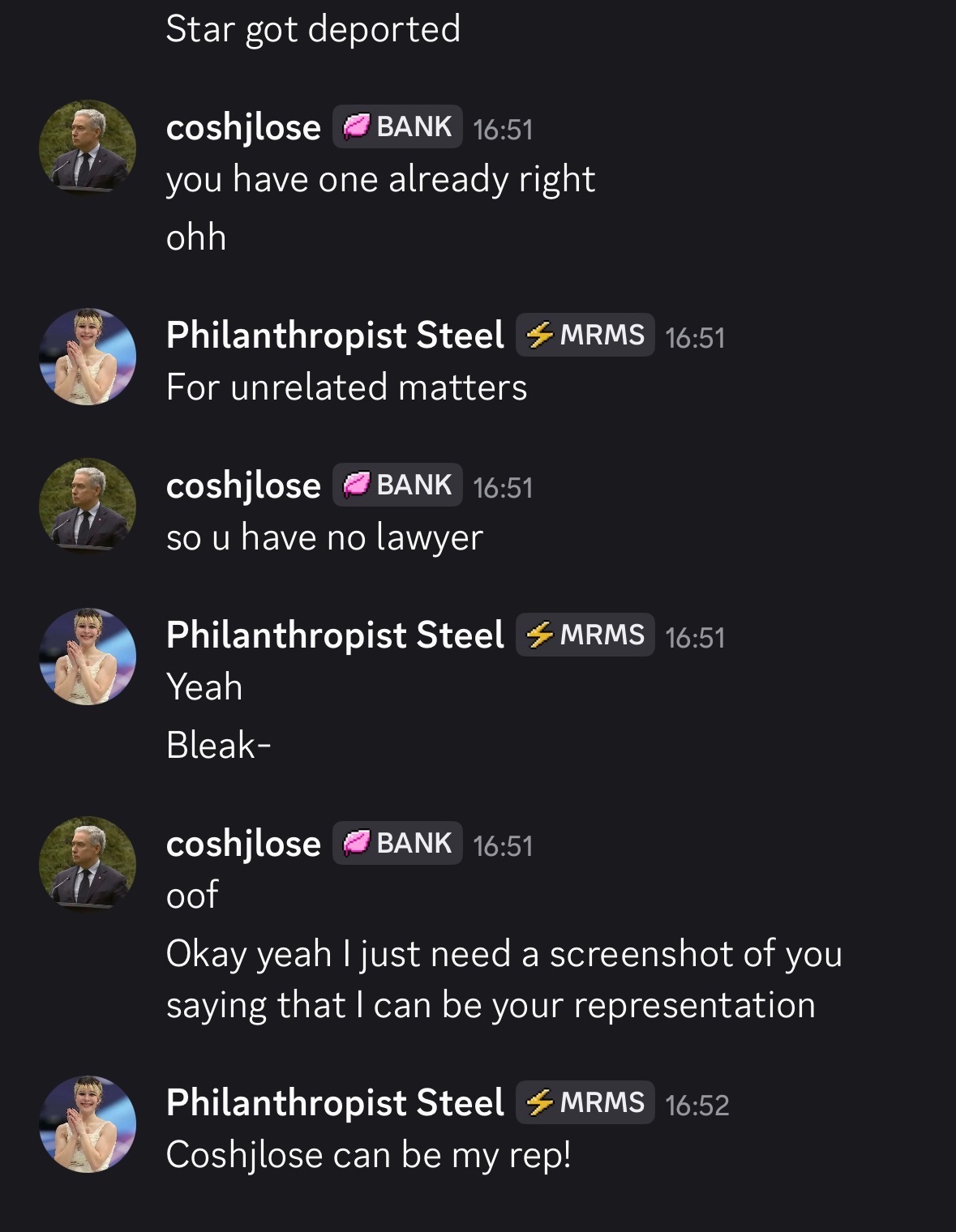
IMG_1351.jpeg
 

Brief


IN THE FEDERAL COURT OF THE COMMONWEALTH OF REDMONT

INTERLOCUTORY APPEAL

SteelBirch6844

Appellant

v.

Hon. Judge CreeperTD
Appellee

Underlying Proceeding: amah853 v. SteelBirch6844 [2026] DCR 174
​
SUMMARY
This interlocutory appeal concerns a narrow but important question of trial procedure:

Where a defence is already properly before the Court, may counsel at Closing Statement develop additional legal arguments, case law authorities, and reasonable inferences from the existing evidentiary record in support of that defence?

The District Court has answered that question largely in the negative. After replacement Defence Counsel entered this case at the Closing Statement stage, the Court struck the Defence Closing Statement in its entirety. The original Order held that Court Rule 4.2 "material" extends to previously uncited precedent and wholly new Defenses.

View attachment 102166

Defence moved for reconsideration, citing superior court rulings in contradiction of the District Court's interpretation, however, the District Court maintained that the entire Closing Statement be struck and adopted a broader restriction, stating that:
"A counselor is bound by their previous filings by, if nothing else, the principles of Court Decorum."
and warning that new arguments at the end of a case would be punished.

Those propositions are the subject of this appeal.

Appellant does not contending that replacement counsel may not reopen discovery, introduce undisclosed factual material, or even argue a new legal theory of defence after the proper pleading stage has ended. The issue is instead whether counsel may develop legal reasoning from an existing record in support of an existing defence.

Here, that defence has already been expressly pleaded. Before successor counsel entered the case, Defence had already asserted that Plaintiff had failed to establish a positive and unambiguous acceptance under section 4(2) of the Contracts Act and relied on the surrounding circumstances of the communication, viewed in its full context, to prove that.

The struck Closing Statement developed that same legal theory of defence by explaining the significance of evidence already in the record, and presenting case law (previously unmentioned in the case), which supported this defence.

No new screenshots, witnesses, communication, or any other factual material was ever introduced. The District Court nevertheless removed the entire Closing and now requires Defence Counsel to submit another Closing constrained by the prior counsel's level of legal analytics.

This ruling conflicts with the text of Court Rule 4.2, the Supreme Court's interpretation of Rule 4.2, and established superior-court practice concerning Closing Statements and replacement counsel.

Interlocutory review is necessary before the District Court forces Appellant to submit a materially restricted replacement Closing Statement under threat of further sanction.


I. FACTUAL AND PROCEDURAL BACKGROUND

I.I The Defence of "No Positive and Unambiguous Acceptance" Predated Successor Counsel


The underlying action alleges breach of contract. In its Answer to Complaint, Defence expressly disputed whether Plaintiff had established the positive and unambiguous acceptance required by section 4(2) of the Contracts Act.

The Answer to Complaint in Post #22 stated:
"II. DEFENCES
1.
...The defence disputes that the communication relied upon by the [P]laintiff constituted such acceptance."

Defence further commented that Defendant's use of quotation marks indicated reproduction of Plaintiff's proposed acceptance wording rather than agreement. But prior Defence Counsel then made clear that the Defence was not confined to quotation marks considered in isolation.

In Opening Statement, predecessor counsel framed the issue as whether Defendant's communication, "viewed in its full context," constituted positive and unambiguous acceptance. The Opening Statement in Post #58 expressly argued:

"The defence acknowledges that the wording itself resembles the prescribed acceptance language. However, the issue before the Court is not whether the words were copied; it is whether the Defendant's communication, viewed in its full context, constituted a positive and unambiguous acceptance."

The Opening further submitted that the "quotation marks and surrounding circumstances" (emphasis mine) created the ambiguity section 4(2) requires acceptance to avoid.

Accordingly, before present counsel entered this proceeding, the following propositions were already squarely before the District Court:
  1. contractual acceptance was disputed;
  2. the statutory question was whether acceptance was positive and unambiguous;
  3. the communication was to be assessed objectively and in its full context; and
  4. its surrounding circumstances, not just quotation marks, were relevant to whether ambiguity remained.
I.II Successor Counsel Developed That Existing Defence From the Completed Record

Present counsel entered only after Plaintiff had submitted its Closing Statement. Defence Counsel did not seek to reopen discovery, amend the Answer, introduce another exhibit, or call another witness. Counsel reviewed the record already created and submitted a Closing addressing the same question of positive and unambiguous acceptance.

The principal submission was that Plaintiff could not isolate the apparent acceptance sentence from its immediately surrounding communication. The Closing therefore considered the quotation marks together with Defendant's immediate statement, "Wait," and questions that followed concerning the proposed Agreement.

Those communications were already in evidence, and contemplated by the Plaintiff. See P-004 in the Complaint in Post #1.

The novelty, if any, was therefore in the legal analysis applied to existing evidence, not in the evidence itself or in the statutory defence being advanced.

I.III District Court Struck the Entire Closing

At Post #116, the District Court entered an Order to Strike, stating that it was "astounded" by the amount of previously unmentioned argument and precedent and expressly held that Rule 4.2 "material" includes cited precedent and thus Defence Counsel's application of case law, previously uncited, was not permitted.

Most significantly, the Court struck the entire Closing Statement and threatened contempt for renewed noncompliance.

This was not simply an evidentiary ruling excluding undisclosed fact, the entire final Defence submission was removed based upon the Court's understanding of what legal argument successor counsel was permitted to make or not to make,

I.IV The Court Maintained the Restriction on Reconsideration

Defence timely moved for reconsideration and identified three independent errors of law underlying the Order to Strike:

"(1), its interpretation of Court Rule 4.2 as extending ‘material’ to legal precedent, (2), the Court Rules expressly contemplate new legal arguments being advanced through closing statements; and (3), in any event, the Defence's principal argument concerning positive and unambiguous acceptance was not a new defence at all, but a developed application of the defence already pleaded in the Answer and Opening Statement.”

Each ground was separately developed and supported by authority.

Most importantly, Defence directed the District Court to ToadKing v Commonwealth of Redmont [2025] SCR 18, where the Supreme Court expressly interpreted Court Rule 4.2 and defined "material" as referring to facts, evidence, and testimony, while distinguishing that statutes, judicial rulings, and law from material that must first be introduced during discovery.

That authority directly addresed the original Order's holding that Rule 4.2 "material" "extends to cited precedent." The District Court nevertheless left its original Order and strike fully operative.

In denying reconsideration, the Court did not address the Supreme Court's express definition of "material" or explain how its original treatment of cited precedent could be reconciled with that definition. Instead the Court relied exclusively upon a later cautionary passage from ToadKing concerning strategic late introduction of a novel law:

"...it is unwise (and perhaps uncouth) to present novel cases and revelations of law at the end of a case or argument"

But the Supreme Court's anti-ambush caution does not erase its preceding definition of Rule 4.2 "material." The reconsideration ruling neglected to explain how cited precedent could remain Rule 4.2 material notwithstanding the Supreme Court's holding that judicial rulings and law generally are not material that must be introduced before Closing.

Secondly, Defence separately argued that the Court Rules expressly permit development of legal argument at Closing. Namely, Defence relied upon Court Rule 9.2, which described Closing Statements as:
"the last time new arguments and evidence may be submitted"

Defence submitted that this language necessarily distinguishes a new legal argument from a new defence and permits counsel to develop legal reasoning from the completed evidentiary record. This was a distinct ground for reconsideration that the Court did not discuss or interpret.

Nor did the ruling engage the superior-court authority Defence submitted concerning that distinction. Most notably, Defence relied upon Vanguard & Co v. Naezaratheus [2025] FCR 32, where the Federal Court confronted legal theories it described as "novel defenses." Rather than exclude those arguments, the Federal Court distinguished them from undisclosed factual material, left the legal arguments before the Court, and afforded the opposing party time to respond.

The District Court's reconsideration ruling does not mention Vanguard. It therefore left unanswered Defence's argument that the District Court was applying the same Court Rules inconsistently, and more restrictively, than the superior court had applied in materially more extreme circumstances.

Thirdly, Defence separately argued that no novel defence had been introduced in the first place. This ground was independent of the first two. Even if the District Court were correct that genuinely new defences may be restricted at Closing, Defence submitted that this case did not involve one.

Prior Defence Counsel had already pleaded absence of positive and unambiguous acceptance. The Answer disputed Plaintiff's interpretation of the communication. The Opening expressly instructed the Court to consider the communication "viewed in its full context" and relied upon the "quotation marks and surrounding circumstances" as creating ambiguity.

Successor counsel's Closing did not replace that defence, it only identified and analyzed particular surrounding circumstances already in evidence, including "Wait" and the immediately following questions to explain why Plaintiff had failed to establish positive and unambiguous acceptance.

The reconsideration ruling failed to determine whether those propositions constituted a genuinely new defence or merely additional reasoning supporting the existing section 4(2) defence.

Defence preserved three discrete questions of law through a timely Motion to Reconsider, and the written ruling did not resolve the second or third questions or engage the superior-court authorities submitted in support of them, and it maintained the original Rule 4.2 ruling without reconciling that ruling with the Supreme Court's express definition of "material."


II. INTERLOCUTORY REVIEW IS WARRANTED

Part VI, section 3 of the Judicial Standards Act permits interlocutory review where a significant error of law materially affects the fairness or accuracy of an ongoing proceeding and waiting until final judgment would cause irreparable harm.

All three requirements are met.

II.I The Appeal Raises Significant Questions of Law

The District Court has not merely made a discretionary determination that one sentence in Closing was unfair, it has adopted legal propositions governing the meaning of Rule 4.2 and the permissible scope of final argument.

First, the original Order expressly held that Rule 4.2 "material" includes cited precedent. Second, the reconsideration Order held that successor counsel is substantively bound by prior filing and may be punished for materially developing argument at Closing. Third, the Court relied upon Court Decorum as an independent basis for that restriction.

These propositions concern the interpretation and interaction of Court Rules 1.3, 1.4.3.1, 4.1, 4.2, and 9.2. They are therefore questions of law.

In In re [2026] FCR 47 | [2026] SCR 11, the Supreme Court rejected the proposition that Rule 1.2 gives trial judges unrestricted interpretative authority over Court Rules and confirmed that rule applications remain subject to superior review.

"The standard of any specific rule is up to the Supreme Court, and the Supreme Court alone, to decide the standard of how a rule should be applied. Rule 1.2 is for expediency and allows judges some leeway in how to work, but does not give them carte blanche discretion such as to interpret in any manner they see fit. We may review any rule application."

This appeal asks the Federal Court to perform that function of review.

II.II The Error Directly Affects the Fairness and Accuracy of the Trial

The challenged rule determines which legal analysis the District Court will permit Defendant to make concerning the dispositive issue of contract formation. The original Defence Closing has already been removed in its entirety.

The District Court now requires successor counsel to prepare another Closing within the analytical limits the Court believes predecessor counsel established. The effect is direct: the merits of contractual formation will be decided after excluding legal submissions concerning evidence already in the record and bearing directly upon whether acceptance was positive and unambiguous. That is not collateral case management, it determines the body of legal argument upon which judgment will be rendered.

II.III The Harm Is Occurring Before Judgment

Waiting until judgment does not prevent the harm presently imposed. The Order forces the Defendant to choose among three options:
  1. abandon arguments counsel believes are lawful;
  2. repeat them and risk the punishment threatened by the District Court; or
  3. submit a materially restricted Closing and proceed to verdict without those arguments.
That compelled choice exists now. Interlocutory review is therefore necessary before the challenged standard dictates the final stage of the trial.


III. THE DISTRICT COURT APPLIED THE GOVERNING LAW INCORRECTLY

The District Court's Order cannot be sustained as an ordinary exercise of the procedural discretion. It rests upon a legal interpretation of Rule 4.2 that conflicts with the Supreme Court's definition of that Rule, and upon a treatment of late-developed legal argument that is inconsistent with the approach repeatedly taken by superior courts.

The authorities establish a straightforward framework. Rule 4.2 regulates undisclosed factual material. Law and judicial precedent are not Rule 4.2 material. But where legal authority or legal reasoning is developed later in a proceeding, courts examine whether it creates actual unfairness. If it does not, the argument may simply be considered. If it does, the original remedy is to permit the opposing party to respond, not to strike the entire party's Closing Statement.

The District Court departed from that framework at each stage.

III.I The District Court Disregarded the Supreme Court's Interpretation of Rule 4.2

The original Order to Strike held that:
""All material used in legal arguments must have either been included in the case prior to the submission." The Court holds that "material" extends to cited precedent and wholly new Defenses, both of which are clearly contained within this Closing Statement."

That proposition is irreconcilable with the Supreme Court's subsequent express interpretation of the same Rule in ToadKing v Commonwealth of Redmont [2025] SCR 18. The issue in ToadKing was specifically whether legal precedent cited for the first time at Closing constituted "material" that must previously have been introduced through the pleadings or discovery.

Chief Justice Smallfries answered that question directly:

"“‘Material’ as written within rule 4.2 refers to facts, evidence, and testimony generally. Statutes, the Constitution, rulings by sitting judicial officers, and the law generally exist in the realm of public knowledge and therefore do not need to be affirmatively presented during discovery before presentation, as they exist already within the context of the courts themselves.”

That is not dicta about a neighbouring issue, it is an express definition of the term upon which the District Court's strike depended. The Supreme Court then provided an obiter dictum, in response to counsel questioning whether it could be employed to strategically gain an advantage:

“New cases and precedent introduced without prior discussion should tend towards supporting an argument already made, not creating a new argument.”

Those are two distinct propositions, because the first defines what Rule 4.2 "material" means, and the second addresses the fairness problems that may arise when legal authority is introduced late.

The District Court's reconsideration ruling relied upon the second proposition while leaving its original interpretation of the first entirely intact, in defiance of the Supreme Court. It never explained how cited precedent could continue to constitute Rule 4.2 "material" after the Supreme Court expressly held that rulings and law generally are not material requiring prior submission. That was an error of law.

Moreover, the Supreme Court's caution does not support the result reached below, because the principal authorities and arguments in the Defence's Closing supported a defence already made: Plaintiff had failed to establish positive and unambiguous acceptance under section 4(2).

III.II The District Court Acted Inconsistently With Established Judicial Practice

The cases applying these principles below do not support the categorical restriction imposed by the District Court in this case. The following cases repeatedly distinguish between changing the factual record and developing legal advocacy from that record.

A. FlyingBlocks v Commonwealth - New Precedent Was Permitted Without Further Response

In FlyingBlocks v Commonwealth of Redmont [2025] FCR 1, Defence relied in its Closing upon precedent that had not previously appeared during discovery or Opening Statements.

Plaintiff made essentially the same procedural objection raised here, and asked either:
  1. to be permitted a further response; or
  2. for the new material to be struck.
The Federal Court rejected both remedies, and held:
"It is no fault of the Defence that the Plaintiff failed to consider case precedent available to the public."

and then ordered:
"Their closing statement will not be struck, and this trial is hereby in recess pending verdict."

Thus previously uncited law appearing at Closing did not itself create a right to further submissions, much less justify striking the Defence Closing.

That case establishes one end of the spectrum: where the late legal authority merely assist the Court in resolving an issue already before it and does not create sufficient prejudice, the Court may simply consider it.

B. Vernicia and Steveshat - Successor Counsel May Further Develop the Case at Closing

The treatment of replacement counsel in the Federal Court likewise contradicts the proposition that successor counsel is analytically bound to predecessor counsel's precise formula.

In Vernicia v RylandW [2025] FCR 5, replacement Defence Counsel entered after the evidentiary stage had substantially concluded. The Federal Court refused to reopen crosss-examination, but the Court nevertheless afforded successor counsel additional time to prepare the Defence Closing.

That Closing did considerably more than reproduce predecessor counsel's Opening Statement. Successor counsel developed alternative interpretations of the disputed communications, expanded the existing lack-of-damages defence into a more detailed causation analysis, identified missing context affecting the meaning of the communications, and developed the argument that even communications directed toward Plaintiff could bear an innocent rather than defamatory meaning.

Further, in Steveshat v Vanguard [2024] FCR 62, successor Defence Counsel entered only after Plaintiff had already filed its Closing Statement, the Federal Court afforded new counsel 72 hours to prepare the Closing. Successor counsel then materially developed the existing defence by arguing both that Vanguard was not a shareholder at the time of the underlying transaction and that, in any event, the Commercial Standards Act insulated non-managing shareholders from liability for corporate obligations. These arguments were not advanced in the Answer to Complaint nor the Opening Statements, yet the Federal Court did not restrict successor counsel to predecessor counsel's earlier formation. It accepted the Closing, entered recess, and ultimately relied upon those developed arguments in ruling for the Defence.

C. Commonwealth v wttn2c - Defence Counsel May Supply Missing Legal Analysis at Closing

The contrast is still more striking in Commonwealth v wttn2c [2026] DCR 80, as that case was presided over by the same District Court judge whose Order is presently under appeal.

In that case, prior Defence Counsel failed to submit a Defence Opening Statement. After the case had already progressed beyond that stage, replacement counsel was appointed. The District Court did not hold that new counsel was analytically confined in its Closing. Replacement counsel was permitted to enter at the final stage and perform the legal-advocacy function predecessor counsel had failed to perform, filling in the missing legal argument.

These precedents demonstrate that there is nothing inherent in the arrival of a successor counsel at Closing that requires counsel to remain confined to predecessor counsel's analytical deficiencies. Indeed, the District Court itself has recognized that replacement counsel may be allowed to use Closing precisely to provide the legal advocacy previously missing.

III.III Where Late Argument Creates Unfairness, Allow Plaintiff to Respond

The strongest authority is Vanguard & Co v Naezaratheus [2025] FCR 32 because it addresses the precise concern relied upon by the District Court: what should a court do when new legal argument appears so late that the opposing party has not had an adequate opportunity to respond?

The circumstances in Vanguard were substantially more serious than those present here. The Federal Court found that the Defence Closing:
"used facts not disclosed in Discovery and cited 12 unique and previously unmentioned cases to develop novel defenses."

However, the Court distinguished explicitly between facts as Rule 4.2 "material" which had to be struck, but allowed the case law and did not strike the legal arguments. Instead, the Federal Court judge ruled:
"As for the legal arguments raised, I'm granting Plaintiff 72 hours to submit a brief responding to them."
The Court expressly recognized why:
"The arguments you present may not necessarily be faulty, but if they are, they can not be challenged if they're presented in a way that disallows the opposing party a response."

Vanguard therefore identifies both the problem and its solution, the problem is not that new legal reasoning is inherently inadmissible, it is that sufficiently novel defences would create unfairness if the opposing party has no opportunity to answer it. The cure is to provide that opportunity.

The District Court in this case repeatedly emphasizes that the Plaintiff would not have an opportunity to respond to successor counsel's developed Closing. Accepting that concern entirely for purposes of argument still does not support striking the Closing, the District Court should be bound by the precedent of the superior courts and simply cure any real unfairness by allowing the Plaintiff to respond.

Indeed, Vanguard involved twelve new cases and what the Federal Court described as "novel defenses." This case involves significantly less, and raises no new theories of defence. Accordingly, even if the District Court was correct that some portion of the Closing created unfairness because Plaintiff had already submitted its final argument, Vanguard demonstrates the appropriate remedy. The Court could permit Plaintiff a limited responsive brief. It did not need to strike the Defence Closing.

III.IV Conclusion

Taken together, the authorities establish a clear framework. First, under ToadKing, law and judicial precedent are not Rule 4.2 "material" merely because they were not previously introduced during discovery.

Second, FlyingBlocks, Vernicia, Steveshat, and wttn2c demonstrate that courts permit counsel, including a new counsel entering late in a proceeding, to further develop and build legal arguments from the existing record in Closing Statements.

Third, Vanguard establishes that even where late legal development does create genuine unfairness, the appropriate remedy is to cure that prejudice by allowing a response, not automatically excluding the legal argument.

The District Court departed from that framework. It treated precedent itself as Rule 4.2 material, restricted successor counsel's ability to develop an existing defence, and then responsed to its concern for Plaintiff's opportunity to respond by striking the Defendant's entire Closing Statement.

Appellant respectfully submits that each step was inconsistent with the governing precedent. The proper course was to allow the Closing to remain before the Court. If the District Court believed Plaintiff required an opportunity to answer any particular argument, Vanguard provided a narrower remedy.

IV. THE DISTRICT COURT IS MATERIALLY IMPAIRING DEFENDANT'S ABILITY TO PRESENT ITS DEFENCE

By striking the entire Closing Statement and restricting what Defence Counsel may advocate creates its own substantial fairness problem. The Defendant has retained qualified counsel, yet that counsel is prevented from fully explaining why the existing evidentiary record supports a defence already before the Court.

The Constitution guarantees a fair trial and, in accordance with its provisions governing representation, the assistance of legally qualified counsel for one's defence. That guarantee does not immunize counsel from procedural rules, but it weighs strongly against interpreting those rules more restrictively than superior precedent requires where narrower measures can fully protect the opposing party.

The Federal Court recognized this same principle in INTERLOCUTORY MasterCaelen v Hon. Magistrate Dr_Eksplosive [2026] FCR 14: procedural rules cannot operate so as to deprive a person affected by judicial proceedings of a meaningful opportunity to contest the legal case against them.

"Every citizen must have the ability to contest legal claims made that would negatively impact them"

The legal errors raised above directly impacted the fairness of the underlying proceeding, as Appellant's final legal submissions have been struck and successor counsel is now constrained from fully presenting an existing defence from the evidentiary record. Delaying resolution until final judgment would only compound that prejudice by allowing the case to proceed to verdict under the very legal standard challenged in this appeal.

Therefore, this interlocutory appeal should be granted, and the Federal Court should provide relief to the Appellant.

V. PRAYER FOR RELIEF

1. Declaratory Relief. The Appellant prays that the Federal Court declare:
  1. That the District Court erred in interpreting Court Rule 4.2 "material" as extending to judicial precedent and legal authority, contrary to ToadKing v Commonwealth of Redmont [2025] SCR 18;
  2. That successor counsel is not prohibited from developing legal reasoning, citing authority, and drawing reasonable inferences from the existing evidentiary record in support of a defence already properly before the Court;
  3. That the Defence's principal argument concerning positive and unambiguous acceptance was a developed application of the defence already raised in the Answer and Opening Statement, rather than a wholly new defence; and
  4. That where late legal argument creates genuine unfairness because opposing party lacks an adequate opportunity to respond, the appropriate remedy may be a limited responsive submission consistent with Vanguard & Co v Naezaratheus [2025] FCR 32, rather than wholesale exclusion of the defending party's Closing Statement.
2. Remedial Relief. The Appellant prays that the Federal Court:
  1. Reverse the District Court's Orders striking and maintaining the strike of Defendant's original Closing Statement;
  2. Restore Defendant's original Closing Statement to the record and direct that it be considered on its merits;
  3. Vacate the requirement that successor counsel submit a replacement Closing constrained by predecessor counsel's earlier analytical formulation; and
  4. In the alternative, if this Court determines that any discrete argument created material unfairness because Plaintiff lacked an opportunity to respond, permit Plaintiff a limited responsive brief addressing that argument rather than striking Defendant's Closing Statement in its entirety.
3. Other Relief. Grant any further equitable relief that this Honourable Court considers just and necessary to remedy the errors identified in this appeal.


VI. EXHIBITS


Motion


IN THE FEDERAL COURT OF THE COMMONWEALTH OF REDMONT

MOTION FOR EMERGENCY INJUNCTION
​


Your Honour,

Appellant respectfully moves for an immediate stay of proceedings in amah853 v. SteelBirch6844 [2026] DCR 174 pending this Court's determination of the present interlocutory appeal.

Emergency relief is necessary because the District Court has ordered Appellant to submit a replacement Defence Closing Statement tonight, October 14, 2026. That replacement must comply with the very legal restrictions challenged in this appeal, and the District Court has threatened contempt for renewed noncompliance.

Without immediate relief, Appellant must either abandon legal arguments Appellant maintains are lawful, submit a Closing constrained by the allegedly erroneous standard now before the Court, or risk sanction by refusing to comply. The harm is therefore imminent and would be irreparable to the Appellant.

This relief is necessary only to preserve the status quo until the Court can consider the appeal.


Respectfully submitted,


jJoshuaTheGreat
Counsel for Appellant

 
Back
Top