Appeal: Denied In re [2026] DCR 24 | [2026] FCR 103

Status
Not open for further replies.

jsrkiwi

Citizen
Supporter
Oakridge Resident
Homeland Security Department
Justice Department
Health Department
jsrkiwi
jsrkiwi
Lieutenant
Joined
Aug 27, 2025
Messages
481

Appeal

- Client & counsel name: @roy405, represented by @jsrkiwi

- Appealed case name & style: emmythegremlin v. roy405 [2026] DCR 24

- Were you originally the plaintiff or the defendant: Defendant

- Reason for appeal:

Summary of the case​

Roy405 attacked and killed emmythegremlin while she was working on an in-game book. The court found that the text also existed in a Google Document and could be copied back into the book. The Court found that the murder caused the loss of five pages, representing approximately fifteen minutes of work.

The Court found roy405 liable for damages resulting from murder and civil trespass, and valued the five lost pages at 23% of the $1,500 commission value of the completed book, awarding $345 in compensatory damages.

The Court further found that the murder warranted punitive damages, and awarded $15,000.

Ground 1. The punitive award relies substantially upon the murder despite the Court finding murder was not independently compensable.​

1.1 The judgment recognised that murder itself does not establish an independent civil claim for damages.
1.2 Nevertheless, the punitive-damages analysis focused entirely upon the murder, and the need to punish similar attacks.
Finally, Plaintiff requests punitive damages in the amount of $15,000. Punitive damages are a type of deterring punishment given when a party’s actions are so outrageous that they disturb the basic fabric of civilized society, and demand harsh action be taken. In assessing these damages, we look to “[T]he character of the defendant’s act, the nature and extent of the harm to the plaintiff that the defendant caused or intended to cause and the wealth of the defendant.” MegaMinerM v. Blazora Corporation [2025] FCR 27 (quoting Ligthiago v. FuriousPaladin [2023] SCR 20).

Defendant went into a private location, killed someone for no apparent reason, and caused her to lose not an insignificant amount of time. The record plainly shows that Defendant, just prior to the murder, was on a murder cooldown. He was unrepentant and at times mocking towards Plaintiff. When told a real genuine loss was at hand, instead of offering sympathy he merely retorted that Plaintiff couldn’t prove it, and then stated her loss meant nothing and he would lose “like 250” for his actions.

You do not have a right to attack others in Redmont. If your actions cause harm, you may certainly be found liable for that harm in court. The purpose of the law is to see justice done; and there is no justice when parties believe they can continuously cause harm without punishment. Defendant’s actions certainly demonstrate a "substantial departure from acceptable standards of behavior,” and are absolutely a depraved display of “oppressive, reckless, or grossly negligent disregard for the rights, interests, or safety of others.” Defendant “intended to cause harm or loss,” “acted knowing their conduct was likely [to harm another] person,” and “acted with reckless indifference as to whether harm or loss would occur.”

I find Defendant’s actions—before and after the incident—so outrageous and reprehensible that serious punitive damages are indeed warranted. Genuine harm was done, and I have little faith that even this lawsuit would do much to dissuade Defendant or others like him without harsher punishment. Therefore, as accorded to and empowered by law, I award the full requested punitive damages of $15,000. As Defendant has not demonstrated (nor even feigned) genuine remorse or taken steps to remedy the harm, no diminution of the award is authorized by the RCCA. RCCA Part III, § 3(3).
1.3 The Court never established whether the loss of the book was intentional or foreseeable.
1.4 The Appellant submits that a $15,000 punitive award for an unforeseeable minor property loss is disproportionate. The award appears to have been awarded to punish the Defendant for the murder.

2. The punitive damages assessment failed to apply all mandatory factors.​

2.1 The Court identified the punitive-damages test as including the character of the act, the nature and extent of the harm, and the Defendant's wealth.
2.2 However, the judgment makes no finding concerning the Defendant's wealth before awarding the Plaintiff's entire requested $15,000.
2.3 Further, the Court's own findings limited the property harm to approximately fifteen minutes of lost work. Nevertheless, the court awarded $15,000 in punitive damages without explaining how that figure followed from the established harm.

3. The compensatory damages calculation is inconsistent with the Court's own findings.​

3.1 The Court awarded $345 by treating five lost pages as 23% of a $1,500 writing commission.
3.2 However, the Court acknowledged that the underlying content existed in a Google Document.
3.3 It held that the compensable harm was the time required to transcribe it back into Minecraft, which it found was approximately fifteen minutes of work.
3.4 If the text itself survived in a Google Document, 23% of the value of the completed literary commission was not destroyed. The damages should have reflected the value of the lost transcription work, not the value of the underlying writing.

4. The Court's factual findings are contradicted by evidence already within the trial record.​

4.1 The Plaintiff's own evidence indicated that the material existed in a Google Document. P-006 records the Plaintiff stating immediately following the incident that she had a save on Google Docs, while P-007/P-013 records her stating that she could “just copy and paste from the doc”.
4.2 This directly undermined the characterisation of the incident by the Plaintiff as permanently destroying five pages of original literary work.
4.3 Early in the case, the Court did acknowledge this discrepancy. However, in the verdict , the Court did not acknowledge the reduced credibility of the Plaintiff from this perjury.
4.4 This assertion by the Plaintiff was material to both liability and damages, yet the contradiction was never resolved by the Court.

Appeal prayer​

The Appellant therefore requests that the compensatory and punitive awards be reversed or remanded for reassessment, with the legal-fee award recalculated accordingly.

- Are you requesting oral argument: No

- Additional Information or evidence (see appellate rules): No new evidence is relied upon. The relevant evidence is already contained within the record of [2026] DCR 24, particularly P-005, P-006, P-007, P-013 and the District Court's verdict. Proof of representation is attached.
 

Attachments

  • Screenshot 2026-09-25 215702.png
    Screenshot 2026-09-25 215702.png
    27.4 KB · Views: 29
Your Honour, since I filed this application for appeal, it has come to my attention that the Plaintiff perjured herself in her case filing. I therefore request your permission to append this additional ground for appeal to the original application, with it’s accompanying evidence:

5. Perjury by the Plaintiff​

5.1 The Plaintiff alleged, and the Court found, that the Plaintiff had been working for 15 minutes prior to the murder, and that 15 minutes of work was lost.
5.2 The Plaintiff logged onto the server at 14:49 UTC+1 (see exhibits D-A01 and D-A02 attached). According to the trial record, the murder took place at 14:56 UTC+1. Therefore, the plaintiff logged onto the server a maximum of 7 minutes before the murder.
5.3 The alleged fact that “fifteen minutes of work” was lost is material to the case, and appears four times in the Court’s verdict.
5.4 This also places doubt on the veracity of the Plaintiff’s claim that 5 pages of work was lost.
5.5 I therefore ask the Court to enter a finding of Perjury against the Plaintiff, or remand the case back to the DCR for this.

- Additional Information or evidence (see appellate rules): D-A01 showing the Plaintiff logging on at 14:49 UTC+1; and D-A02 showing a discord search to prove the date and show wider context.
 

Attachments

  • D-A01.png
    D-A01.png
    376.9 KB · Views: 35
  • D-A02.png
    D-A02.png
    412.2 KB · Views: 32
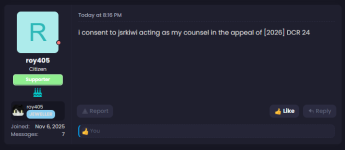
I would also like it to be known that I represent emmythegremlin in this matter.
Screenshot 2026-10-20 135412.png
 

Verdict


IN THE FEDERAL COURT OF THE COMMONWEALTH OF REDMONT
Decision, Memorandum, and Order -
In re [2026] DCR 24 | [2026] FCR 103

SUMMARY ON APPEAL

The Appellant killed the Appellee while she was writing a commissioned work in an in-game book. The District Court found the Appellant liable for the resulting loss of unsaved work and awarded $345 in compensatory damages. It found the Appellant's conduct outrageous, awarded the full $15,000 in punitive damages requested, and awarded legal fees of $4,603.50.

The Appellant raises four grounds on appeal: (1) that the punitive award improperly punishes the murder itself; (2) that the District Court failed to consider the Appellant's wealth in setting punitive damages; (3) that the compensatory award was miscalculated; and (4) that the District Court failed to account for evidence affecting the Appellee's credibility. After filing, the Appellant sought leave to add a fifth ground alleging perjury by the Appellee.

With respect to Appellant's formatted grounds, the Court proceeds in analysis:


GROUND 1: PUNITIVE DAMAGES MAY PUNISH THE MURDER

A. The Appellant's argument

The Appellant advances three related contentions. First, he argues that the District Court, having held that murder is not by itself a compensable civil claim, could not then rely on the murder to justify punitive damages. Second, he argues that the punitive analysis focused entirely on the killing and on the need to deter similar attacks, so that the award was in substance a civil punishment for a crime already punished under the Criminal Code Act. Third, he argues that the District Court never found that the loss of the Appellee's work was intentional or foreseeable, and that a $15,000 award for an unforeseeable and minor property loss is therefore disproportionate.

Each contention rests on a misunderstanding of what the District Court decided and of what punitive damages are. This Court addresses them in turn and, because the questions raised will recur in future cases, states the governing principles expressly.

B. The District Court's findings

The verdict proceeded in two distinct steps, and the Appellant's argument collapses them into one.

At the first step, the District Court asked whether the Appellee had a cause of action at all. Relying on Le9endz_ v. AussieBloke25 [2026] DCR 59 and MMiqa v. ZachOfPotatoes10 [2026] DCR 67, it accepted that murder is not an independent civil claim: a plaintiff cannot recover merely because she was killed. But it held that the Redmont Civil Code Act is not an exhaustive list of civil wrongs (RCCA Part II §3(1)), and that where a murder causes a real and cognizable harm, the murder and the harm together support a claim. As the District Court put it, Congress cannot have meant to insulate murderers from every consequence except a criminal fine. The District Court then found, on the balance of probabilities, that the Appellant's killing of the Appellee caused the loss of her unsaved work, and held him liable for it.

At the second step, having established liability, the District Court asked whether the Appellant's conduct warranted punitive damages. That is a different question. It does not ask what the plaintiff lost. It asks what kind of conduct the defendant engaged in.

The Appellant reads the first step as a holding that murder is legally irrelevant to civil liability, and then argues that the second step was inconsistent with it. The first step held no such thing. It held that murder alone is not enough to state a claim, and that murder causing harm is. Once the claim was established, nothing in the District Court's reasoning prevented it from examining the murder when assessing punitive damages. On the contrary, as explained below, the law required it to.

C. Civil Liability may attach to a criminal act.

This Court affirms the District Court's holding at the first step. There is a difference between a cause of action and the wrongful act that grounds it. A cause of action is the legal basis on which a plaintiff may recover. A wrongful act is the conduct that gives rise to the liability. Murder is not, by itself, a cause of action; that is the rule of Le9endz and MMiqa, and this Court does not disturb it. But murder is plainly a wrongful act. It is prohibited by the Criminal Code Act (CCA Part IV §3), and the Redmont Civil Code Act operates concurrently with that Code and expressly contemplates civil recovery for conduct that is also criminal (RCCA Part II §4).

It follows that where a murder causes a cognizable harm, the plaintiff's claim is a claim for harm caused by the murder. The murder is not incidental to that claim; It is the conduct for which the defendant is being held responsible.

D. Punitive damages punish the defendant's conduct

The Redmont Civil Code Act defines punitive damages as damages awarded against a person to punish them for their outrageous conduct and to deter them and others like them from similar conduct in the future (RCCA Part III §3). The object of punitive damages, as the statute itself states, is the defendant's conduct. Compensatory damages answer the question "what did the plaintiff lose?" Punitive damages answer a different question: "what did the defendant do, and how should the law respond to it?"

The Supreme Court's test reflects this. In Lightiago v. FuriousPaladin [2023] SCR 20, the Supreme Court held that conduct is outrageous when it is "completely indecent, totally atrocious, and fully intolerable in a civilized community," and directed courts assessing punitive damages to consider the character of the defendant's act, the nature and extent of the harm caused or intended, and the wealth of the defendant. The first factor is the character of the act. The act in this case was the murder. The Appellant's position, taken to its conclusion, would require a court assessing the character of the defendant's act to disregard the act. A defendant could then escape punitive scrutiny for the most serious part of his conduct by observing that it was not separately compensable. That cannot be correct. Whether a given wrong is independently compensable is a question about the plaintiff's cause of action. It has nothing to say about how reprehensible the defendant's conduct was. The Supreme Court's own practice confirms that punitive damages track the gravity of the conduct, not the size of the compensable loss. In AnimeInc & KattoC324 v. The Commonwealth of Redmont [2025] SCR 5, the Supreme Court awarded substantial punitive damages for the mishandling of an election, conduct whose seriousness lay in its character and its consequences for the plaintiffs' rights rather than in any narrow financial measure. Likewise, in Krisztie v. zko0 [2025] FCR 13, the Federal Court sized a punitive award by comparing the outrageousness of the defendant's conduct with the conduct in earlier cases. In each case the court looked at what the defendant did.

The District Court did not punish the Appellant merely for the fact of a killing. It examined his entire course of conduct, before and after the murder, and the record amply supports its findings. The District Court found that:

  • Shortly before the killing, the Appellant announced that he was waiting for his murder cooldown to expire, indicating that the killing was planned rather than impulsive.
  • The Appellant entered private property, a members-only floor, and killed the Appellee there while she was working.
  • When the Appellee told him she had lost her work, the Appellant answered that he could argue she should have saved, or that he had no way of knowing.
  • When she explained that she had been writing a commissioned work, he replied that this "means nothing."
  • He then told her he would "lose like 250" for the murder.
The last of these statements is significant. It shows that the Appellant regarded the criminal fine as a price he was willing to pay. Where a defendant treats the penalty for his conduct as an acceptable cost, the criminal penalty has failed to deter him. Supplying that deterrence is exactly the function of punitive damages. The District Court was entitled to conclude, as it did, that it had little confidence the Appellant or others like him would be dissuaded without a meaningful punitive award.These are findings of fact. They are well grounded in the record, including the Appellant's own words, and this Court will not disturb them. [2025] FCR 128 - Contempt of Court Charge - Appeal.

E. A criminal penalty does not bar punitive damages
The Appellant argued, and implies again here, that the fine he paid to the Department of Homeland Security already punished the murder, so that punitive damages punish him twice. This Court rejects that argument.The Redmont Civil Code Act operates concurrently with the Criminal Code Act and does not limit or displace it (RCCA Part II §4). It expressly permits a party to pursue civil remedies for conduct that is also an offence. A criminal fine and a punitive award serve different interests. The fine vindicates the Commonwealth's interest in enforcing the criminal law and is paid to the Commonwealth. A punitive award responds to the wrong done to the plaintiff, is paid to the plaintiff, and serves to deter conduct that the criminal penalty has failed to deter. This case illustrates the point precisely: the Appellant openly treated the criminal fine as an acceptable price. If the existence of a criminal penalty barred punitive damages, the law would offer no further deterrent to a defendant who had already decided that the penalty was worth paying.

The Appellant's real complaint in reality, expressed in his contention that $15,000 is disproportionate to a minor loss, goes to the third requirement. It is a complaint about quantum, not about whether punitive damages could be awarded at all.

GROUND 2: THE WEALTH FACTOR AND THE AMOUNT OF THE AWARD

Whether punitive damages are warranted, and if so in what amount, is a determination entrusted to the trier of fact. The trier of fact hears the evidence, assesses the parties, and is best placed to judge what award will punish and deter the particular defendant before it. The Ligthiago factors guide that judgment. They are considerations which inform the exercise of discretion, not a checklist on which a court must record a separate finding before any award can stand. How much weight each factor carries in a given case is itself a matter for the trier of fact.

The Supreme Court has made clear that discretionary determinations of this kind are not to be second-guessed on appeal. In [2025] FCR 128 - Contempt of Court Charge - Appeal, the Supreme Court held that reviewing courts must not substitute their judgment for the reasonable judgment of the trial court, and that a penalty imposed within the court's discretion will not be disturbed unless it is "monstrously unequal, unfair, or burdensome beyond what justice requires." The Supreme Court further observed that judicial officers are not required to follow a rigid and objective scheme in assigning penalties. That reasoning applies with equal force to punitive damages, which are by definition a punishment.

This Court therefore asks not whether it would have awarded the same amount, but whether the District Court's award fell outside the bounds of reasonable discretion. It did not.

The Appellant did not raise his wealth before the District Court. He offered no evidence of it, made no argument that the amount sought would be disproportionate to his means, and contested punitive damages only on the ground that his criminal fine already punished the murder. The Appellee's prayer for $15,000 in punitive damages was on the record from the outset, and the Appellant had every opportunity to argue that the figure was beyond his means. He did not.

Further, the Appellant contends that the District Court did not explain how $15,000 followed from a harm of fifteen minutes of lost work. This contention misunderstands the purpose of punitive damages. As this Court has explained under Ground 1, punitive damages punish the defendant's conduct. They are not a multiple of the compensable loss, and Redmont law prescribes no ratio between punitive and compensatory damages. The relative size of the two awards does not, by itself, show that the punitive award is unreasonable.

The District Court explained its award at length. It found that the Appellant planned the killing, carried it out on private property, dismissed the resulting loss as meaningless, and treated the criminal fine as an acceptable price for his conduct. It expressly stated that it had little confidence the Appellant or others like him would be deterred without a serious punitive award. It considered whether any reduction was warranted for remorse or remediation and found none (RCCA Part III §3(3)). It then awarded the amount the Appellee had requested. That reasoning ties the award to the purposes of punishment and deterrence that the statute identifies. A trier of fact is not required to reduce that reasoning to arithmetic.


All other grounds were considered and found unpersuasive. Ground 5 is specifically unpersuasive as it includes an accusation of a criminal nature that would be inappropriate to adjudicate at an appellate proceeding.

THEREFORE, in consideration of the appellant's brief before this Court, the appeal is DENIED without costs.


So ordered,
Justice Mug in the Federal Court

 
Status
Not open for further replies.
Back
Top