[2026] FCR 7 - Appeal

TheSnowGuardian

Citizen
Public Defender
TheSnowGuardian
TheSnowGuardian
Public Defender
Joined
Jan 16, 2026
Messages
52


Username: TheSnowGuardian

I am representing a client

Who is your Client?: Bank of Reveille, LLC

File(s) attached

What Case are you Appealing?: [2026] FCR 7

Link to the Original Case: Appeal: Accepted - [2025] DCR 108 - Appeal | [2026] FCR 7

Basis for Appeal: (see Brief below)

Supporting Evidence: https://www.democracycraft.net/threads/bank-of-reveille.32570/


(Further evidence attached below)
 

Attachments

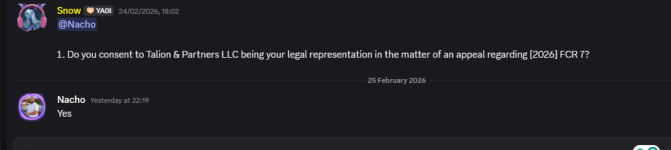
  • PROOF OF REPRESENTATION.PNG
    PROOF OF REPRESENTATION.PNG
    30.1 KB · Views: 4
Under Rule 1.7 of Court Rules and Procedures, the Appellant hereby submits the following evidence that were either (a) had no chance of being admitted in the previous trial, AND/OR (b) were non-existent at the time of the FCR appeal:

1772129861181.png

1772129893814.png

1772129951884.png

1772129963343.png

See Attachment 'BOR - Certificate of Formation(1).pdf'
 

Attachments

Brief


IN THE SUPREME COURT OF THE COMMONWEALTH OF REDMONT
BASIS FOR APPEAL

I. INTRODUCTION

Bank of Reveille, LLC ("BOR") respectfully appeals the Federal Court's judgment in [2026] FCR 7, dated 16 February 2026. That judgment vacated the District Court verdict in BOR's favour, declared BOR's Legal Entity Act ("LEA") registration void ab initio, ordered BOR's dissolution under the Business Structuring Act Sunset Act ("BSASA"), and directed repayment of $28,850 plus $6,000 in legal fees to the Appellee.

BOR submits that the Federal Court committed three reversible errors of law. First, the court misread the LEA by treating the DOC Secretary's signature as a mere procedural formality, despite LEA Section 9(5)(c) providing that existence unambiguously "shall begin" at that moment. Second, the court applied the BSASA to a company that had already completed its LEA transition before that Act was even enacted - a retroactive application the BSASA's own text does not authorise. Third, even if the court's registration analysis were correct, it erred in finding BOR failed to make continuing reasonable efforts to transition, because the DOC never notified BOR of any deficiency during the transition period, making correction impossible.

For these reasons, BOR asks the Supreme Court to reverse [2026] FCR 7, restore the District Court judgment, and alternatively grant BOR the statutory eight-week transition period it never had the opportunity to use.


II. JURISDICTION

The Supreme Court has appellate jurisdiction over Federal Court judgments pursuant to the Constitution of the Commonwealth of Redmont. This appeal raises questions of statutory interpretation of the LEA and BSASA, and the constitutional validity of BSASA provisions, all squarely within this Court's jurisdiction. BOR appeals as of right from a final judgment that declared its legal existence void and ordered its dissolution.


III. STATEMENT OF THE CASE

A. Background


BOR was incorporated as an LLC under the Business Structuring Act ("BSA") in 2024. On 10 August 2025, the LEA was enacted, repealing the BSA. On 20 October 2025, BOR filed formation documents with the Department of Commerce ("DOC") to transition to the LEA. Acting DOC Secretary ElysiaCrynn signed those documents on or about 21 October 2025. Under LEA Section 9(5)(c), BOR's existence as an LEA entity commenced at that moment.

The BSASA was not enacted until 6 November 2025 - sixteen days after BOR had already completed its LEA registration. BOR therefore entered the BSASA era as an LEA entity, not a BSA entity.

On 20 December 2025, BOR filed the underlying action [2025] DCR 108 to recover a loan. Default judgment was entered for BOR on 10 January 2026.

On 25 January 2026 - 24 days after the BSASA transition deadline had already expired - the DOC conducted a re-review and notified BOR of deficiencies in its formation documents. BOR's manager, Nacholebraa, had no actual notice of these issues until 4 February 2026, when the DOC made direct Discord contact. On that same day, the Appellee filed the present appeal. BOR retained counsel on 7 February 2026, submitted corrected formation documents on 14 February 2026, and provided further amendments on 16 February 2026. All identified deficiencies were cured before any dissolution order could take effect.

B. The Federal Court's Decision

The Federal Court held: (1) the Secretary's signature did not cure the absence of mandatory statutory elements; (2) BOR's LEA registration was void ab initio; (3) BOR remained a BSA entity subject to BSASA; (4) BSASA Section 4(1)(b) prohibited BOR from filing the lawsuit; and (5) BOR failed to make reasonable efforts to transition. The court ordered dissolution and vacated the DCR judgment.

Notably, the Federal Court included Order 4(a), which permits the DOC, at its independent discretion, to allow BOR's filings to be rectified and the status quo before litigation to be restored. BOR submits that this discretionary avenue does not cure the legal errors in the judgment and does not provide the certainty of legal standing that only a reversal on the merits can supply.


IV. QUESTIONS PRESENTED

1. Whether the Federal Court erred in holding that the DOC Secretary's signature did not commence BOR's existence under the LEA, where LEA Section 9(5)(c) expressly provides that the entity "shall begin its existence" from that moment, and LEA Section 6(2)(f) separately provides that Company Docket records - including that signature - are immutable and permanent.

2. Whether the Federal Court erred in applying the BSASA to BOR, where BOR had already completed its LEA transition sixteen days before the BSASA was enacted, meaning BOR was not a "firm under the Business Structuring Act" within the meaning of BSASA Section 5(1) at the time of that Act's enactment.

3. Whether the Federal Court erred in finding that BOR failed to make continuing reasonable efforts to transition, where the DOC never notified BOR of any deficiency during the transition period, correcting during that period was factually impossible.

4. Whether, even if BOR's registration were void, dissolution is the appropriate remedy given that all identified deficiencies have since been fully cured and the DOC confirmed BOR's dissolution would cause substantial harm to the Commonwealth's economy.


V. ARGUMENT

Ground One: The Federal Court Misread the LEA - The Secretary's Signature Commences Existence by Operation of Law, and the Resulting Docket Record Is Immutable

A. The Statutory Sequence Is Unambiguous: "Shall Begin Its Existence"


LEA Section 9(5) sets out a clear, sequential formation process for LLCs. First, the incorporator files a Certificate of Formation. Second, if it fails verification, the DOC provides reasons, and the process stops. Third - and only if verification is passed - a Company Docket is opened, the Secretary signs, and the entity's existence begins. The critical language is in Section 9(5)(c)(iii):

The Corporation shall begin its existence from the point the signature of the Certificate of Formation has been posted in the Company Docket.

The word "shall" is mandatory in statutory construction. The provision does not say the entity "may" begin existence, or that it begins existence "provided the documents are fully compliant." It says the entity shall begin its existence at that point, full stop. This is not ambiguous. This is not open to interpretation. The Federal Court acknowledged this language and then characterised the signature as evidencing "that verification occurred, not that statutory prerequisites were satisfied." With respect, this reading rewrites the statute. The LEA does not say the signature is evidence of verification. It says the signature triggers existence.

B. A Wholly New and Dispositive Argument: LEA Section 6(2)(f) Makes the Company Docket Record Immutable by Law

This argument was not raised or addressed at the FCR stage. It goes directly to the heart of the Federal Court's error.

LEA Section 6(2)(f) provides, in full:
Information recorded in the Company Docket shall be immutable and permanent, even if the Incorporated Entity does not exist anymore. (i) Small mistakes such as spelling mistakes may be corrected shortly after posting, but may not alter the meaning or the spirit of the record.

The Secretary's signature on BOR's Certificate of Formation is a record in the Company Docket. It was posted there on 21 October 2025. Under LEA Section 6(2)(f), that record is immutable and permanent. It cannot be deleted, reversed, or treated as if it never happened.

The Federal Court's ruling that BOR was void ab initio requires precisely that: it requires this Court to treat the Secretary's signature - a permanent, immutable docket record under the LEA's own terms - as legally meaningless. The LEA itself forbids this. Section 6(2)(f) is not a minor procedural provision. It is a substantive rule of evidentiary permanence that the legislature deliberately enacted to give legal certainty to Company Docket records. To hold that a court may declare an immutable record void is to strike down a clear statutory mandate.

The only carve-out in Section 6(2)(f)(i) is for "small mistakes such as spelling mistakes" - and even those "may not alter the meaning or the spirit of the record." The Secretary's signature is not a spelling mistake. It is the foundational act of formation. It cannot be corrected away, it cannot be voided, and it cannot be treated as legally inoperative. This Court should find that the Federal Court's void ab initio declaration is incompatible with LEA Section 6(2)(f).

C. The DOC's Power to Reject Is Exhausted Upon Signing - There Is No Post-Signature Revocation Power

LEA Section 9(5)(b) grants the DOC one specific and limited power: to reject a deficient Certificate before signing, and to "provide a clear reason" for that rejection. This is the DOC's only statutory opportunity to act on deficient formation documents. The DOC did not exercise this power at the point of review on 21 October 2025. It verified, signed, and opened the docket.

The LEA contains no provision allowing the DOC to revoke, nullify, or retroactively reject a formation after the docket has been opened. Separately, LEA Section 6(3) states:
DOC shall have the power to reject any formation of an Incorporated Entity for a clear and justifiable reason.

"Reject" applies to "formation" - the process. Once formation is complete and existence has begun under Section 9(5)(c)(iii), there is no longer a formation to reject. The DOC can only reject before the act is complete. This is confirmed by the immutability rule in Section 6(2)(f): once posted in the docket, the record stands.

The legislature chose to vest the gatekeeping function in the DOC's verification process. If the DOC negligently passes a deficient document, the remedy is to hold the DOC accountable - not to void the entity's existence at the expense of an innocent incorporating party who relied in good faith on the official docket.

D. The Void Ab Initio Finding Creates Unworkable Consequences Inconsistent with Legislative Intent

Under the Federal Court's ruling, any LEA entity whose formation documents contain a deficiency the DOC failed to catch is retroactively void from the date of filing - potentially months after trading, contracting, and litigating. This produces absurd results: all contracts would be of doubtful validity, all judgments obtained would be vulnerable to collateral attack, and any party that relied on the official Company Docket as confirmation of valid formation would have no legal protection. Courts in this Commonwealth should not adopt interpretations that produce such manifestly unreasonable results.

E. All Deficiencies Have Been Cured

Even accepting the Federal Court's view that deficiencies must be corrected, BOR corrected all of them before dissolution proceedings commenced. The corrected Certificate of Formation (revised 14 February 2026, further amended 16 February 2026) explicitly states the LLC is member-based, correctly names the entity as "Bank of Reveille," uses the correct instrument title, and adds all required sections. The DOC Secretary confirmed receipt and ongoing review. Where a deficiency is cured, the rationale for voiding the registration evaporates.

Ground Two: The BSASA Does Not Apply to BOR - Applying It Would Require Retroactive Reclassification That the Statute Does Not Authorise

A. The BSASA's Plain Text Applies Only to Firms "Under the Business Structuring Act" - BOR Was Not


BSASA Section 5(1) states:

All firms under the Business Structuring Act shall be given 8 weeks from the enactment of this act to transition to the Legal Entities Act, failure to do this will result in dissolution.

The operative phrase is "firms under the Business Structuring Act." This is a status question, assessed at the moment of the BSASA's enactment: 6 November 2025. On that date, was BOR under the BSA? No. BOR had filed its LEA formation documents on 20 October 2025 and received the Secretary's signature on 21 October 2025 - sixteen days earlier. Under LEA Section 9(5)(c)(iii), BOR's existence as an LEA entity commenced at that signature. BOR was therefore an LEA entity, not a BSA firm, when the BSASA was enacted.

The Federal Court did not dispute this timeline. It reached BOR via the back door: by first declaring the LEA registration void, it reclassified BOR as a BSA firm, then applied the BSASA to that reclassified entity. But this sequencing is circular. It requires the court to use the BSASA's consequences (dissolution) to justify a reclassification that is the necessary predicate for applying the BSASA in the first place. If the LEA registration is valid - as Ground One establishes it is - then BOR was never a BSA firm on 6 November 2025, and the BSASA simply does not reach it.

B. This Is a Genuinely New Argument Not Addressed at FCR Stage: The BSASA Cannot Operate Retroactively

The FCR proceedings debated whether BOR's registration was valid - but did not squarely confront the retroactivity problem that arises from the Federal Court's approach.

The Federal Court's reasoning works like this: (1) the formation documents were deficient; (2) therefore, the LEA registration was always void; (3) therefore, BOR was always a BSA firm; (4) therefor,e the BSASA applied to BOR from 6 November 2025 onwards. Steps (2) and (3) involve a retroactive reclassification - looking back to 21 October 2025 and recharacterising BOR's status on that date.

But statutes do not operate retroactively unless they expressly say so. The BSASA contains no retroactivity clause. It applies to "firms under the Business Structuring Act" - a present-tense status at the time of enactment, not a status that courts may later assign retrospectively based on post-enactment findings. The Federal Court essentially enacted its own retroactivity provision by judicial decision. That is not statutory interpretation. It is judicial legislation, and this Court should not endorse it.

Retroactive application of the BSASA to BOR is also unconstitutional. R. Const. Section 32(14) protects against deprivation except "in accordance with the principles of fundamental justice." Retroactively reclassifying an entity as a BSA firm - based on a DOC error that BOR had no knowledge of - and then applying dissolution provisions that were never in force at the time of BOR's transition, is not fundamentally just by any standard.

C. The Appellee’s Internal Contradiction

If the Court accepts that BOR was a BSA firm subject to the BSASA, then BSASA Section 4(1)(a) prohibited BOR from entering into the loan contract during the transition period. The loan contract would be void. If the contract is void, the entire judgment - the very thing the Appellee is trying to protect by bringing this appeal - is vacated anyway. There is no path available to the Appellee that preserves both the dissolution argument and the underlying debt. BOR's registration was either valid (BSASA does not apply, judgment stands) or it was not (contract void, judgment falls). The Appellee cannot have it both ways.

Ground Three: The Federal Court Erred in Finding BOR Failed to Make Reasonable Efforts to Transition

A. BOR Could Not Correct Deficiencies It Was Never Notified Of - This Is a New Factual Argument


BSASA Section 5(2)(a) postpones dissolution as long as a firm "continues to make reasonable efforts to transit." The Federal Court held that BOR made no corrective efforts during the transition period, and this constituted a failure of the "continuing" requirement.

What makes this finding legally untenable is a simple factual sequence that the Federal Court did not adequately address: the DOC did not notify BOR of any deficiency during the transition period. The transition period ran from 6 November 2025 to 1 January 2026. The DOC posted its notification in the Company Docket on 25 January 2026 - twenty-four days after the deadline had already expired. The DOC then made direct Discord contact on 1 February 2026. BOR's manager had actual awareness of the issue on 4 February 2026.

The question this Court must ask is: what "reasonable effort to transit" was available to BOR during the window it was given, when the DOC itself had not identified any problem with the registration? The answer is none - because from BOR's perspective, the transition was already complete. The DOC's own signature said so. The Company Docket said so. BOR had no obligation to second-guess the regulator's official verification.

"Reasonable" is an objective standard assessed against the circumstances known to the party. BOR's circumstances included an official DOC signature confirming formation. No reasonable incorporator in that position would have taken further corrective steps during the transition period. To find that BOR "failed" to make efforts is to impose a standard of clairvoyance, not reasonableness.

B. Once BOR Had Actual Notice, It Acted Promptly

BOR's manager had no actual notice of any issue until 4 February 2026. Within three days, counsel was retained. Within ten days of actual notice, a corrected Certificate of Formation was submitted. All identified issues were resolved by 16 February 2026. This is a demonstrably prompt and continuing good-faith effort. The statute requires reasonable effort, not instantaneous perfection, and BOR met that standard the moment it became aware there was a problem.

C. The DOC's Own Conduct Caused the Prejudice

The Federal Court itself noted that the DOC Secretary who signed BOR's documents was newly appointed and had been in post barely one month. The DOC had over two months during the transition period to identify and flag the deficiencies. It did not. It then waited a further 24 days after the deadline to notify BOR. This is an institutional failure by the regulator. The consequences of that failure should not be borne by BOR, the innocent party. To dissolve BOR for failing to correct deficiencies that the DOC sat on for three months is to use dissolution as a punishment for the regulator's own negligence.

Ground Four: Dissolution Is Disproportionate When All Deficiencies Have Been Cured and the DOC Has Confirmed Economic Risk

Even if this Court concludes that BOR's original registration was deficient, dissolution is not the only or necessary remedy. The Federal Court itself recognised this through Order 4(a), which gives the DOC discretion to permit rectification and restoration of the status quo. BOR submits that rectification should be the primary outcome, not a fallback.

The DOC's own assessment, filed pursuant to the Federal Court's Writ of Mandamus, stated unequivocally that BOR's dissolution "may pose substantial harm to the Commonwealth's economy." BOR holds over $12 million in its database balance - approximately 11% of all cash in Redmont's economy not held by the Federal Reserve Bank. The DOC specifically identified risks of capital lock-up, disruption to depositor confidence, and systemic consequences for Redmont's financial industry.

The purpose of dissolution under the BSASA is to ensure all firms are properly constituted under the LEA framework. That purpose is fully served if BOR is permitted to regularise its position. As of 16 February 2026, BOR has submitted fully compliant formation documents. Dissolving an entity that is now in compliance, whose dissolution the government's own department says will harm the economy, serves no legitimate regulatory purpose, and causes disproportionate harm.

Ground Five: Congress Itself Has Declared That BOR Continues to Exist - This Argument Was Impossible to Raise at FCR Stage

A. The New LEA Part VIII Section 2 Is a Direct Legislative Declaration of BOR's Continued Existence


This argument was not available at the FCR stage because the new Legal Entity Act was signed into law on 7 February 2026 - after the FCR briefing process had already begun. It is therefore squarely new evidence and a new legal argument for this Court.

The new Legal Entity Act, enacted on 7 February 2026, contains the following provision at Part VIII, Section 2:

All entities existing under the repealed Act shall be regarded as continuing to exist under this Act.

BOR existed under the repealed LEA from 21 October 2025, the date the DOC Secretary signed its Certificate of Formation and opened the Company Docket. Under the old LEA Section 9(5)(c)(iii), BOR's existence commenced at that moment. BOR was therefore an entity "existing under the repealed Act" when the new LEA came into force.

Congress has therefore expressly declared, by statute, that BOR continues to exist under the new Act. This is not a court's inference or a lawyer's argument - it is a direct legislative declaration. The Federal Court's void ab initio ruling, issued on 16 February 2026, directly contradicts an express act of Congress signed nine days earlier. A court judgment cannot override a congressional declaration of corporate existence. The Constitution of the Commonwealth of Redmont establishes that Congress is the supreme law-making body. Where Congress has spoken plainly - "all entities existing under the repealed Act shall be regarded as continuing to exist" - no court may declare the contrary.

B. The New LEA's Immutability Provision Confirms and Strengthens the Section 6(2)(f) Argument

The new LEA restates the immutability rule at Part III Section 1(5), with one important addition not present in the old LEA: subsection (c) provides that "The Incorporated Entity Summary shall be exempt" from the immutability rule. This carve-out is significant. The legislature specifically identified the one category of Company Docket record that can be updated - the Incorporated Entity Summary - and declared everything else immutable.

The Secretary's signature on the BOR's Certificate of Formation is not part of the Incorporated Entity Summary. It is a separate filing in the Company Docket. It therefore falls squarely within the immutability rule and outside the only exception Congress created. The new LEA makes this clearer than the old one did. Congress has now twice - in the immutability provision and in Part VIII Section 2 - enacted provisions that are inconsistent with the Federal Court's void ab initio declaration.

C. The New LEA Removes Interest-Based LLCs and Requires Conversion - BOR Is Unaffected Because It Is Member-Based

The Federal Court's Appellant Reply Brief argued that BOR "cannot comply" with the new LEA's requirement to convert interest-based LLCs to corporations within 30 days, because BOR had never specified its structure. This argument is now moot. BOR's corrected Certificate of Formation, submitted 14 February 2026, explicitly states the LLC is member-based. Member-based LLCs are preserved under the new LEA. The new LEA Part VIII Section 1(1) applies only to interest-based LLCs. BOR is not affected by it. The Appellee’s argument that BOR's failure to specify its structure compounds its non-compliance, therefore, has no further force.

Ground Six: StateStreet Is Factually Distinguishable and Should Not Be Extended to This Case

The Federal Court relied on ToadKing v. StateStreet [2025] FCR 134. That case is distinguishable on its central fact: StateStreet never received the Secretary's signature confirming LEA formation. The entity had genuinely never completed the transition. BOR, by contrast, received the Secretary's signature on 21 October 2025, which under LEA Section 9(5)(c)(iii) commenced its existence as an LEA entity. The precise factual element that drove the StateStreet outcome - absence of the Secretary's signature - is not present here.

Furthermore, the immutability argument under LEA Section 6(2)(f) was not before the court in StateStreet. That provision provides an independent and dispositive basis for distinguishing this case: BOR has a permanent, immutable docket record of its formation that StateStreet lacked. This Court should not extend StateStreet to cover a factual situation that is materially different in the most legally significant respect.


VI. ALTERNATIVE ARGUMENT: IF THE COURT FINDS BOR WAS SUBJECT TO BSASA, IT MUST BE GRANTED THE STATUTORY EIGHT-WEEK TRANSITION PERIOD

Should this Court accept the Federal Court's finding that BOR remained a BSA firm, BOR submits it is nonetheless entitled to the eight-week transition period prescribed by BSASA Section 5(1).

BOR genuinely and reasonably believed it had already transitioned to the LEA. When the BSASA was enacted, BOR did not participate in the transition process because it understood itself to already be an LEA entity - a belief the DOC's own signature and the Company Docket record supported. To now classify BOR as a BSA firm and simultaneously deny it the eight-week period the statute grants to every BSA firm produces a result the legislature could not have intended: a firm is penalised more harshly for having attempted a transition in good faith than one that had never tried at all.

If BOR is to be treated as a BSA firm, equity and constitutional fairness require it be given eight weeks from the date of this ruling to complete the LEA transition. BOR has already submitted corrected documents that the DOC is reviewing. The transition could be completed within days. There is no legitimate interest in denying this.

Should the Court raise the question of what statutory provision allows such a request, we ask that the Court go back to BSASA Section 5(2)(a). This clause allows the Court to order the postponement of dissolution for 8 weeks. Should the DOC accept the amended CoF, then the Court is requested to postpone dissolution for an undefined/indefinite period of time for this matter.


VII. RELIEF REQUESTED

For the foregoing reasons, BOR respectfully requests that this Court:

1. REVERSE the Federal Court's judgment in [2026] FCR 7 in its entirety;

2. DECLARE that BOR was validly registered under the LEA from 21 October 2025, the date of the DOC Secretary's signature, and that the Company Docket record of that registration is immutable and permanent under LEA Section 6(2)(f);

3. REINSTATE the judgment of the District Court in [2025] DCR 108 awarding BOR $28,850 in compensatory damages and 30% legal fees;

4. ORDER that all sums directed to be repaid pursuant to the Federal Court judgment be returned to BOR;

5. AWARD BOR its legal fees in these proceedings;

6. In the ALTERNATIVE, if the Court declines to reverse: DECLARE that BOR is entitled to a full eight-week transition period from the date of this ruling to rectify its formation documents and complete its LEA transition, and DIRECT the DOC to accept BOR's corrected Certificate of Formation as the basis for its LEA registration;

7. Such further or other relief as this Honourable Court deems just and appropriate.


Motion


IN THE SUPREME COURT OF THE COMMONWEALTH OF REDMONT
MOTION FOR EMERGENCY INJUNCTION

The Appellant requests that the Court grant an emergency injunction prohibiting the Department of Commerce from placing the Appellant into receivership pending appellate review.

Receivership proceedings are imminent and would cause immediate and irreparable harm to the Appellant, effectively rendering any appeal moot before the Court has an opportunity to consider it. The requested injunction is necessary to preserve the status quo and ensure that appellate review remains meaningful.

Furthermore, receivership may cause:
- Loss of operational control,
- Damage to contractual and financial relationships,
- Possible liquidation or forced restructuring,
- Rendering appellate relief ineffective.

Maintaining the present state of affairs pending appeal serves the interests of justice and prevents irreversible consequences arising before the legality of the underlying actions can be reviewed.


Motion


IN THE SUPREME COURT OF THE COMMONWEALTH OF REDMONT
MOTION FOR EMERGENCY INJUNCTION


The Appellant requests that the Court grant an emergency injunction prohibiting the Department of Commerce from dissolving the Bank of Reveille.

Dissolution would cause irreparable harm to the Bank of Reveille and, therefore, makes any matter before this court moot.

We request that the Court grant this emergency injunction until the Court considers the Appeal.

 
Last edited:
Back
Top