Appeal: Pending In re [2026] FCR 47 | [2026] SCR 11

MJL

Citizen
Representative
Supporter
Oakridge Resident
Education Department
MJL_
MJL_
Representative
Joined
Mar 3, 2026
Messages
90

Attachments

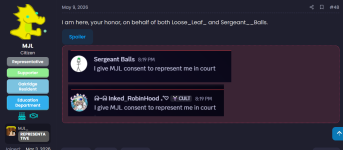
  • Screenshot 2026-05-26 122536.png
    Screenshot 2026-05-26 122536.png
    157 KB · Views: 37

Brief


IN THE SUPREME COURT OF THE COMMONWEALTH OF REDMONT
Brief - INTERLOCUTORY APPEAL

Sergeant__Balls and Loose_Leaf_,
Appellants

v.

Hon. Magistrate Muggy21,
Appellee

On 29 April, ko531 v. Incarnation__ & Jakkuwu_ et. al [2026] FCR 32a was filed by ko531 against Incarnation__ and Jakkuwu_ ("initial parties"). The initial parties did not include the Appellants, but they were added in a Motion to Amend on 9 May (Post #45).

Since then, various procedural errors have denied the Appellants their constitutional rights. As the cases for each of my clients (the Appellants) diverge somewhat in their facts, I will introduce them separately. Needless to say, the case of one is more extreme than the other. Both, however, seek the same relief.

Appellant One. Sergeant__Balls.
The case against Sergeant__Balls ("Appellant 1") is easily one of the grossest misuses of the legal process of our time. I do not say that lightly. Let us start by examining how Appellant 1 was brought into this case.

I. STAFF-2
During the case with the initial parties, ko531 ("Plaintiff") filed a motion to compel which resulted in the submission of evidence since labeled Staff-2. Both appellants were found to be within Staff-2, and this gave cause for the Plaintiff to amend his complaint to enjoin appellants to the case.

Here is the entirety of Appellant 1's appearance in Staff-2:
> 9.91/d ago + Sergeant__Balls picked up x1 kelp. (x1390/y70/z1991/Reveille)
> 9.91/d ago + Sergeant__Balls picked up x1 paper. (x1390/y70/z1989/Reveille)

As can be seen are two very critical facts.

(1) Appellant 1 only picked up 2 items. These items were, according to Plaintiff's own estimations, were of a value of less than $100. Appellant 1 should never have been enjoined to a federal court case with compensatory damages this low. Plaintiff never made any attempt to retrieve the items from Appellant 1, and he refused any settlement negotiations made in good faith by myself.

(2) The coordinates shown in the logs demonstrate Appellant 1 only had access to Plaintiff's property where it was open to the public. Fact 3 of the amended complaint states, "The block located at 1381, -30, 1969 was broken by Incarnation__ given Jakkuwu, Loose_Leaf_ and Sergeant Balls access to my buffs (P-007, P-002, Staff-1 and Staff-2)" However, Plaintiff's own evidence demonstrates this is factually untrue. It is further shown with Exhibit D-L01 submitted by Appellants in their answer to the amended complaint.

The facts for Appellant 1 show no care was taken as to whether to enjoin him to this case by not examining the evidence thoroughly enough.

It should also be noted, in the next section, it will be shown he made to have (jointly with the other appellant) $536,000 in assets frozen. This is for a product with a value less than $100 according to the plaintiff; though it is disputed how much less.

II. Emergency Injunction (Appellant 1)
To only make the situation worse, Plaintiff filed to have $536,000 in Appellant 1's (jointly with Appellant 2) assets frozen less than a minute after I made my first post to the case. This was initially granted in less than 3 minutes by Appellee before he was even issued a summons (Post #49) but later stayed after he realized his mistake.

During sidebar, I was instructed to make a response to the motion for emergency injunction and did so promptly in Post #62. The emergency injunction was then pending for five additional days.

However, Appellee granted the motion for an emergency injunction once again. This was not after a motion for reconsideration, but because the previous grant was stayed. I am not aware of any judicial decision done like this but did my best to follow judicial instructions.

Regardless, this EI was not necessary to prevent harm per the standard set by Commonwealth v. Bardiya_King [2023] SCR 23. $536,880 in assets were already frozen by the court. That represents the full amount of that could be awarded in compensatory damages (Post #7). Why did the appellee feel the need to freeze an additional $536,880 in assets from the appellants? It is unreasonable and only has prevented them from engaging in lawful business dealings.

Neither of the appellants have anywhere close to $536,800 in assets. They each one a single residential plot for housing. Neither had plans to sell their houses, so a court order preventing them from doing so was not an issue. However, each engages in a variety of business dealings which they can no longer engage in due to the freeze in their assets. This has been detrimental to their motivation as entrepreneurs and likely resulted in them having less assets for the Plaintiff to recover than if their assets were left unfrozen due to their inability to invest in their companies with personal funds.

As stated by Justice Matthew100x in his grant of an emergency injunction, "Accordingly, the applicable balancing standard is clear. This Court must craft a narrow remedy that does not broadly dictate what the non-moving party may or may not do." (RiggoSoft V. Dimitre977 [2026] DCR 25; further reading: INTERLOCUTORY MasterCaelen v. Hon. Magistrate Dr_Eksplosive [2026] FCR 14.) It is simply argued that Appellee's ruling failed that standard.

III. Failure to State Claim (Appellant 1)
Please see "II. Failure to State Claim (Appellant 2)" which is incorporated here by reference.

Appellant Two. Loose_Leaf_.
While the case for Loose_Leaf_ ("Appellant 2") is not as extreme as Appellant 1, he still has been deprived of his constitutional rights all the same.

I. Emergency Injunction (Appellant 2)
Please see "II. Emergency Injunction (Appellant 1)" which is incorporated here by reference.

II. Failure to State Claim (Appellant 2)
Both Appellant 2 and Appellant 1 were deprived of their due process rights following an erroneous grant by Appellee to allow him to amend his complaint after discovery.

Both Rule 3.3 (Amendment to Complaint) and Rule 3.7 (Mandatory Time for Amending an Answer) make it clear amendments are meant to be entertained during the course of discovery. This follows the established legal principles of ensuring that the defence can fully answer any complaint made by a plaintiff (See Gnomewhisperer and GnomeCorp v Commonwealth of Redmont [2025] FCR 47 which denied a motion to amend meant to overcome a motion to dismiss for lack of standing; DocTheory v. Commonwealth of Redmont [2025] FCR 42 where an objection on procedure was sustained preventing plaintiff from amending complaint to add a witness after discovery).

In the common law country of the United States, the standard used for these types of matters can be found in Foman v. Davis (371 U.S. 178). Among other things, US federal courts do not grant post-deadline amendments to complaints where it would be prejudice to the opposing party. I see no compelling reason (or conflicting precedent in our own common law system) why this standard would not applied in my case. Granting the motion to amend prejudices my pending motion to dismiss (Post #106). If allowed, there would be no appropriate time for a party to motion to dismiss for lack of claim. That this particular amendment was granted after discover closed also means that I cannot amend my own answer to the complaint per Rule 3.7.

Concluding Matters
(1) Grounds for Interlocutory Appeal. As demonstrated this meets the criteria for interlocutory appeals under the Judicial Standards Act. There is a clear legal mistake present in these decisions by the appellee. This error substantially impacts the the fairness or accuracy of the ongoing proceedings. If the matter is left delayed to final resolution, it would cause irreparable harm.

(2) Prayer for Relief.
(a) Declaratory Relief. The Appellants request that the Supreme Court declare:
(i) That the Federal Court's Emergency Injunction to be overbroad and cause more harm to the Appellants than (a) is necessary for preventing harm to the Plaintiff, and (b) than would be prevented by issuing the Emergency Injunction in the first place;
(ii) That the Federal Court granting of a Motion to Amend Complaint following the end of discovery to be unlawful.
(b) Other Relief. Any further equitable, monetary, or injunctive relief as the Supreme Court may see fit to enter, including legal fees if applicable.


Motion


IN THE SUPREME COURT OF THE COMMONWEALTH OF REDMONT
MOTION FOR EMERGENCY INJUNCTION

As stated in my brief above, the emergency injunction above is causing my clients immediate and unnecessary harm. They cannot rent or purchase properties, invest in their commercial enterprises, or conduct regular business dealings. They need to be able to rent properties to sell their goods, but they have not been able to do despite the largest market of customers recently coming to the server.

Please, just free them from this burdensome emergency injunction. There is not justified reason to maintain it, and it only prevents them from building wealth (which helps no one).

 
Last edited by a moderator:

Motion


IN THE SUPREME COURT OF THE COMMONWEALTH OF REDMONT
MOTION FOR EMERGENCY INJUNCTION

As stated in my brief above, the emergency injunction above is causing my clients immediate and unnecessary harm. They cannot rent or purchase properties, invest in their commercial enterprises, or conduct regular business dealings. They need to be able to rent properties to sell their goods, but they have not been able to do despite the largest market of customers recently coming to the server.

Please, just free them from this burdensome emergency injunction. There is not justified reason to maintain it, and it only prevents them from building wealth (which helps no one).

I withdraw this motion. A motion to reconsider was granted (Post #140) significantly modifying the emergency injunction where it is no longer a detrimental issue for my clients.
 
I withdraw this motion. A motion to reconsider was granted (Post #140) significantly modifying the emergency injunction where it is no longer a detrimental issue for my clients.
Thank you for your timely update. I am hoping we will come to an answer to this by this weekend.
 
  • Aye
Reactions: MJL
The Supreme Court grants this interlocutory appeal as to the issue of the alleged improperly amended complaint alone. All other requests for review are denied. All proceedings in the instant case are frozen at this time, and all deadlines tolled. Appellee @ko531 shall have seventy-two hours to make a response brief.

I will preside.
 
  • Heart
Reactions: MJL

Brief


IN THE SUPREME COURT OF THE COMMONWEALTH OF REDMONT
Brief - Appellee Brief

Your Honors,

The issue brought before you by the appellant that has to do particularly with the motion to amend complaint is filled with argumentation that should flat out not be addressed or deemed as waived. The few cognizable arguments made hold out hopes for an outcome that would entice a dismissal in a case where the defendants are entrenched and strain the judiciary. The appellant also fails to address any reasoning for this decision by Judge Mug.

1. Unconsiderable Arguments
First of all, I will explain which arguments dealing specifically with the amended complaint should be thrown out or waived. To address the elephant in the room, all argumentation that calls U.S. common law into consideration should be tossed off a cliff. Such arguments have no bearing inside a Redmont courtroom.

Next, the appellant makes an argument at the very end of section III of their brief that states: "That this particular amendment was granted after discover closed also means that I cannot amend my own answer to the complaint per Rule 3.7." This argument against the amended complaint should be seen as waived and not considered. The issue of these defendants having the inability to amend their answer was never brought up in the trial court. They were never denied this ability. Judge Mug would most likely, in the interest of equality and fairness allowed any amendment to answer in response to my amendment to the complaint if requested. They should not be able to never raise an issue in trial and be allowed to raise it in the appeal.

2. Binary Arguments
Now, for most of the appellant's arguments, they preach on the breaching of the court rules when it comes to the amended complaint. They treat this breach as a binary act, one that should never be allowed, as it goes against the rules and precedent. But because of rule 1.2, which puts the application of these rules at the discretion of the presiding officer, it should make any argument about such a breach more than just binary. It should explore the reasoning of such a violation. All reasoning given by Judge Mug is unaddressed by the appellant.

3. Judge Mug's Reasons
Judge Mug gave reasons involving the unchanging nature of the trial. The appellant wants the case dismissed against their clients in response to an unamended complaint. A dismissal is a hard thing to achieve at this point in the trial when they have multiple counterclaims against different parties.

The fairness of the trial has not been breached either. Judge Mug explains that the appellant has treated everything in the case up to this point as if their clients are included in all claims of relief. All this can be seen with this Judge Mug quote "You've already answered this case as if your clients were already on the Complaint, you've filed a counterclaim. What exactly does this change Counselor?"

Judge Mug then expressed concerns about what the outcome should mean for the judiciary. A dismissal would give me the ability to refile the claims in a separate lawsuit, which would waste Judicial resources. There would now be two fact-finding processes for the same group of facts. To quote Judge Mug, "If I grant this, the Plaintiff could just refile the entire action against your clients, wasting limited judicial bandwidth."

The reasoning that the precedent does not agree with this decision is due to the nature of the case. This is a multi-party case, something that is very new to Redmont. Precedent for these types of cases has not been set yet. It is a new idea for Redmont that a case against a person be dismissed, and yet the same trial continues against a different person. Any decision by Judge Mug for the appellant in this matter had the chance to turn one trial into two, something that none of the judicial officers listed in the precedent had to consider.

Conclusion
As your honors can very much see, the decision to allow the amended complaint by Judge Mug was made in an effort to save on judicial resources, in an attempt to protect a speedy trial. The fairness of the trial is not one that has been breached to this point.

Any consideration of the breaching of the court rules should never be done as the appellant argues. Such a breach is never binary; the court rules evolve and change slightly with every trial. The consideration should lie in the reasoning for such a breach, something the appellant gives no arguments against. It is therefore the appellee's opinion that this court should rule against the appellant in this matter.


Brief


IN THE SUPREME COURT OF THE COMMONWEALTH OF REDMONT
BRIEF - RESPONSE TO APPELLEE BRIEF

I. ON DISMISSAL
Despite not being what this appeal is about, the major point of contention between myself and the appellee is the point of desire for a dismissal. Under Rule 5.16 (Prejudice Rule), dismissal can be granted with or without prejudice.

I fail to see how a dismissal granted with prejudice would do anything besides avoid wasting judicial resources. It would have reduced the amount of parties who needed to be involved in the case.

If prejudice was not granted, then I am sure the court would see why moving my clients away from the possibility of a verdict where they could be found jointly liable for $1,703,832 would be beneficial to them. Please recall that one of my clients, Sergeant__Balls, was alleged to be responsible for less than 200$ in damages by appellee's own estimations.

Dismissal in any form would obviously be right for my clients. Our counterclaims were meant to survive any dismissal. Still, that is not what is at issue here.

II. On Fairness
This case is about fairness. Plain and simple.

Appellee states:

The issue of these defendants having the inability to amend their answer was never brought up in the trial court. They were never denied this ability. Judge Mug would most likely, in the interest of equality and fairness allowed any amendment to answer in response to my amendment to the complaint if requested. They should not be able to never raise an issue in trial and be allowed to raise it in the appeal.

I ask this court: when would I have been able to do anything like that?

Appellee was granted the motion to amend on 21 May 2026 at 9:24PM EST (Post #112). In that same post, deadlines for opening statements were set to be less than 72 hours later.

At 9:49PM EST on the same night, I posted a motion to reconsider (Post #113). Almost a full hour before the deadline, I re-iterated I could not post an opening statement as I did not receive a response (Post #115).

At 9:22PM EST (22 minutes after the deadline for opening statements), I finally received a response to my motion only for it to be denied. I was also told "[my] Opening Statement deadline has not changed." (Post #117)

There was no parity here. Appellee was granted the ability to amend his complaint past the deadline for doing so. Meanwhile, I was rejected from being able to make opening statements because the deadline was rigidly enforced.

III. On Common Law
The appellee has decidedly ignored how I came to reference United States common law.

I exhausted almost every case which explicitly referenced a controversy with either Rule 3.3 (Amendment to Complaint) or Rule 3.7 (Mandatory Time for Amending an Answer). I guess I also did find MrEntomology v. byleth_irl [2025] FCR 20 which held that Rule 3.7 should not apply in situations where the public defender was absent in their duties. You also have Plura72 v. The Commonwealth of Redmont [2025] FCR 69, but that was before discovery, not after. However, you can see why I left those two cases out of my initial brief.

I, therefore, turned to a standard I felt slots effortlessly into our own legal system. Judicial Officers should deny amendments to complaints following the deadline to do so when it would prejudice the other party. Nothing in our case law would conflict with that principle.

As I am sure the Justices of this court are aware, every case I have cited was at the federal level. While I am certainly happy that the appellee acknowledges "...precedent does not agree with [Judge Mug's decision]...", that is just conflict in a lower court. The Supreme Court can very well make its own standard if it so desires. However, I assume it will want to remain most in line with established (though nonbinding) precedent. If that precedent agrees with established case law elsewhere, then is that not an even greater reason for maintaining it?

IV. On Timing
The consideration should lie in the reasoning for [breaching the court rules], something the appellant gives no arguments against.
I believe appellee simply fails to see my reasoning. My clients were enjoined to the case after discovery started. Normally, a Motion to Dismiss is filed before discovery begins (at a moment when opposing counsel is not able to easily amend the complaint). I, therefore, could not move to dismiss in that critical window where the other party is unable to amend the complaint to forestall the concerns in the motion to dismiss.

Therefore, if I was not able to move to dismiss at the start of the case, then the only time for an enjoyed party like my clients to safely submit a motion to dismiss would be after discovery ended. If, instead, Judicial Officers were to allow opposing parties to infinitely respond to the concerns of the movant, then the motion to dismiss as a tool would become absolutely toothless. Every decent lawyer would drag trials out to verdict because a motion to dismiss, no matter its timing, would only then strengthen the opposing party's complaint.

V. On Concluding
Fairness would dictate neither party can ignore deadlines without a compelling reason. (1) Judicial resources would not be wasted; (2) It would provide parity for both parties; (3) Pre-existing case law is in line with my arguments; (4) It only makes sense to maintain a decent judicial procedure; and (5) That is all I have for this court.

 
Back
Top