Bill: Rejected Congressional Support Reform Act

End

Owner
Owner
Justice Department
xEndeavour
xEndeavour
Warrant Officer
Joined
Apr 7, 2020
Messages
3,275
A
BILL
To

Amend the Legislative Standards Act

The people of the Commonwealth of Redmont, through their elected Representatives in the Congress and the force of law ordained to that Congress by the people through the constitution, do hereby enact the following provisions into law:

1 - Short Title and Enactment

(1) This Act may be cited as the 'Congressional Support Reform Act.'

(2) This Act shall be enacted immediately upon its signing.

(3) This Act has been authored by End.

(4) This Act has been co-sponsored by Vernicia

2 - Reasons

(1) The LSC and OCA duties are duplicated.

(2) It has become apparent that there is a desire for the role of draftsman to be re-raised.

(3) The LSC’s functions should be integrated into the Legislative Standards Act with the OCA.

(4) Impartiality requirements for congressional administrative staff must be strengthened.

3 - Repeal

(1) Legislative Service Commission Act

(2) All references to the LSC are removed from the Standing Orders and the LSA becomes the primary source of truth.

4 - Amendments to the Legislative Standards Act

6 - The Office of Congressional Affairs


(1) The Office of Congressional Affairs is a statutory body which provides both chambers of congress with impartial administrative support.

(2) The Office of Congressional Affairs is responsible to congress, but reports to and is tasked by the Presiding Officers through the Director of Legislative Affairs.

(3) The Office of Congressional Affairs is charged with:

(a) Making the following changes to documents of law:


(i) correcting administrative errors in sequential numbering

(ii) implementing congressional amendments.

(b) Assisting the Speaker with the administration of the House

(c) Assisting the President of the Senate with the administration of the Senate

(d) Communicating with the Press

(e) Assisting in the formatting and drafting of Bills

(f) Managing and publishing congressional transparency reports.

(g) Regularly informing the public of motions of significant public interest via government-announcements. Motions of significant public interest include but are not limited to:

(i) Nominations/Confirmations

(ii) Impeachments/Removals

(iii) Censures

(iv) New committees or changes to committees

(v) Veto overrides


(h) Legislative research and drafting support for bills and resolutions.

(i) Impartial research on law and policy to aid legislators.

.
(4) The OCA shall maintain neutrality and may not engage in political campaigning or advocacy.

(5) The members of the Office will be referred to as 'Congressional Staff':


(a) Director of Legislative Affairs - Presiding Officer's delegate in the management and coordination of the Office. This position is limited to one qualified attorney.

(b) Clerks - Responsible for OCA administrative functions and the facilitation of the Congressional Process under the guidance of the Presiding Officers.

(c) Draftsman - Responsible for legislative procedure, research, providing impartial advice to Members of Congress upon request, and drafting legislation upon request.


(5) The Office of Congressional Affairs will comprise at least two clerks.

(6) Hiring

(a) The Presiding Officers must obtain approval of Congress to appoint the Director of Legislative Affairs.

(b) The Director of Legislative Affairs may hire or contract Congressional Staff.

(c) Congressional Staff may receive salaries as determined by law.


(b) A Congressional Staff position will carry over each term until a Presiding Officer actions §6(7)(a).

(7) Tenure and Dismissal Process

(a) Congressional Staff are not tied to congressional terms and remain in office until dismissed.

(b) Congressional Staff serve at the pleasure of the Director of Legislative Affairs and the Presiding Officers.

(c) Congressional Staff are prohibited from holding any leadership role in a political party or elected congressional office during their tenure.

(d) Congressional Staff must serve in a strictly neutral capacity in support of all Members of Congress.


(8) In the Presiding Officer’s absence, or if otherwise delegated, the Deputy Presiding Officer will assume the Presiding Officer's authority over Congressional Staff.

(8) The OCA is authorised to correct section and subsection numbering within Acts, provided such corrections do not alter the substantive meaning of any provision and are limited solely to administrative numbering errors.

(9) The Presiding Officers fund the OCA's activities through provisions in the Legislative budget.

4 - Amendments to the Congressional Discord

(a) All existing channels and categories previously used by the Legislative Service Commission (LSC) shall be merged, restructured, and renamed to represent the Office of Congressional Affairs (OCA).

(b) The OCA will establish a channel within the OCA's category for:

(i) Congressional staff liaison and conversation with congress members.

(iI) Congressional staff liaison and conversation with presiding officers.

(c) The OCA will be otherwise limited in it's access to speak and view outside of these channels, with a view to ensure that questions are streamlined to one area and that they don't receive an unfair advantage over influencing the presiding officers.

5 - Transition

(a) Existing Clerks, Draftsman, and Directors will be transitioned to equivalent roles within the OCA.

(b) Existing channels will be renamed and integrated into the OCA to prevent the loss of work.
 
Last edited:
Nay. Two reasons:

  1. Section 3(2) is unconstitutional in light of ToadKing v. Commonwealth of Redmont [2025] SCR 18. The Senate alone may modify the Senate standing orders, and the House alone may modify the House standing orders. Standing orders are directly incorporated in the Constitution; they are mentioned directly in Const. 5(3) (House) and Const. 6(3) (Senate).

    In [2025] SCR 18, the Supreme Court found that "[a] regular statute cannot limit the Senate in exercising a power the Constitution gives exclusively to it" (emphasis mine). The same goes for the House as to its own orders.

    We cannot repeal standing orders by ordinary statute. I will not vote for a facially unconstitutional law.
  2. I believe that the presiding officers having direct oversight over congressional staff - and having most congressional staff (like clerks) subject to confirmation votes by congress - is a better system than designating a proxy.
 
Nay. Two reasons:

  1. Section 3(2) is unconstitutional in light of ToadKing v. Commonwealth of Redmont [2025] SCR 18. The Senate alone may modify the Senate standing orders, and the House alone may modify the House standing orders. Standing orders are directly incorporated in the Constitution; they are mentioned directly in Const. 5(3) (House) and Const. 6(3) (Senate).

    In [2025] SCR 18, the Supreme Court found that "[a] regular statute cannot limit the Senate in exercising a power the Constitution gives exclusively to it" (emphasis mine). The same goes for the House as to its own orders.

    We cannot repeal standing orders by ordinary statute. I will not vote for a facially unconstitutional law.
  2. I believe that the presiding officers having direct oversight over congressional staff - and having most congressional staff (like clerks) subject to confirmation votes by congress - is a better system than designating a proxy.
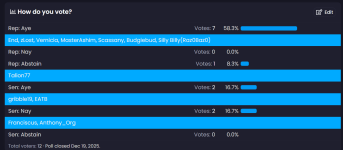
1. The senate is agreeing to the legislation, thereby fulfilling the requirements of SCR 18.

If you argue it doesn’t then the whole LSA (which regulates the Senate) is unconstitutional.

2. Congress was consulted and they chose to delegate rather than have everyone vote on every single congressional staff matter — congress does not need to be down in the weeds for that. Its a rubber stamp anyway.
 
Requesting VP tiebreak.
 

Attachments

  • Screenshot 2025-12-31 133719.png
    Screenshot 2025-12-31 133719.png
    81 KB · Views: 45
Last edited:
Requesting VP Tiebreak.
Nay.

Brief


In my capacity as Vice President, I act here as the tie-breaker consistent with Const. 8(4). In that capacity, I break the tie in the negative ("NAY"), and this bill is thus rejected. My reasons are as follows:

  1. The bill contains a plainly unconstitutional provision.
    As previously noted, section 3(2) is unconstitutional in light of ToadKing v. Commonwealth of Redmont [2025] SCR 18. The Senate alone may modify the Senate standing orders, and the House alone may modify the House standing orders. Standing orders are directly incorporated in the Constitution; they are mentioned directly in Const. 5(3) (House) and Const. 6(3) (Senate).

    In [2025] SCR 18, the Supreme Court found that "[a] regular statute cannot limit the Senate in exercising a power the Constitution gives exclusively to it" (emphasis mine). The same goes for the House as to its own orders.

    We cannot repeal standing orders by ordinary statute. I will not vote for a facially unconstitutional law.

    The bill's author has responded by stating that "The senate is agreeing to the legislation, thereby fulfilling the requirements of SCR 18. \ If you argue it doesn’t then the whole LSA (which regulates the Senate) is unconstitutional."

    The bill that [2025] SCR 18 ruled unconstitutional in application was passed by both the House and the Senate. That the bill author disagrees with the decision is not unreasonable, but it doesn't change the constitutional law here.

    Notwithstanding this, the bill author's reading brings up another issue entirely - under his reading, the LSA binds each chamber and the Congress as a whole. As such, this bill would need to comply with the LSA for it to be a valid law. Does it?

    The answer, as shown below in (2), is a simple "no".

  2. If the issue in (1) were held constitutional, then we'd have a legal problem that arises from the Legislative Standards Act's then-binding language.

    Under the Legislative Standards Act 10(3)(c), "When a bill intends to amend an Act of Congress, a link to the Act of Congress must be present within the bill" (emphasis mine). If we understand that the LSA actually does bind the congress, then this provision too must be binding. The problem for this bill is that, while it links to the Legislative Service Commission Act, it does not link to the Legislative Standards Act in the text of the bill.

    This sloppy procedural defect could have been caught at numerous times, since the bill had already failed in the House once before and one would think that a bit of effort would be put in to finding these defects before re-proposing the bill. Alas, rather than catching this at any point, the Congress was given the same bill that had the same procedural problems as when it was first posted. The bill is now going to get the same result - the bill cannot be passed.

    Now that procedural grounds are covered, let's turn to substantial grounds for opposing this bill.

  3. The bill establishes bad policy as it pertains to restrictions on congressional clerks.
    1. The Conflict of Interest provision is overbroad and harmful.

      The bill would require that all congressional staff "are prohibited from holding any leadership role in a political party or elected congressional office during their tenure". This would apply to Clerks as well.

      This is bad for a number of reasons - it would remove some of the most experienced individuals from having the capacity to do clerking work (such as congresspeople who have done this for multiple terms), while also restricting the number of people who would want to become clerks (most people who have an interest in the congress would like to run for office at some point). The policy is also vague; we do not define "leadership role in a political party" within this bill, which will certainly lead to an increase in partisan sparring relating to the clerk position for anyone who is a member of a political party.

      Indeed, the Congress has, in very recent days, supported appointment of a clerk who would be removed from their congressional staff roles by this very same bill. This includes the appointment of Talion77 (the Speaker of the House). I am not going to move a bill forward when the congress seems (by its appointment of Talion77) to be rejecting the notion that this sort of prohibition is necessary.

    2. Removing confirmation of clerks from the whole congress reduces accountability of congressional staff.

      The bill would remove the hiring of congressional staff, which currently requires a presiding officer to motion it and both chambers to approve it, to one sole person: The Director of Legislative Affairs. The congress has no direct way to remove that individual; doing so requires consent of both the Speaker and the President of the Senate, and thus no mechanism to hold the congressional staff accountable other than withholding pay or VONCing their presiding officer to force them to fire the Director of Legislative Affairs (which, to be clear, is almost certainly never going to happen).

      So what happens here? It's quite clear: if this bill passes, individual congresspeople lose their ability to say "no, we do not want this person to join our staff". The congress has correctly exercised the ability to reject an appointment during this term, and I have no intent to deprive them of this going forward; I do not believe that removing such a privilege should occur without the consent of the substantial portions of political minorities in each chamber. A tiebreaking vote in favor would ram this through the Senate without the support of both the political majority and a substantial portion of the political minority.
To provide some concluding thoughts: there is some good in this bill. Merging the LSC and the OCA, in principle, is a good ideas. But when legislating, details are important and bad or sloppy details can sink bills. Laws we seek to pass must be well-written and avoid unnecessary implementation pitfalls; alas this one does not.

 
  • Nay
Reactions: End
Back
Top