
Lawsuit: Pending .Suixgen v. 12700k [2026] DCR 26

nick

Citizen
xdbh
xdbh
Barrister
Joined
Feb 15, 2026
Messages
18

Motion


IN THE DISTRICT COURT OF THE COMMONWEALTH OF REDMONT
MOTION FOR EMERGENCY INJUNCTION

Evidence and proof of representation shall be attached onto this post for the honorable Judge to review, and will also be presented with the complaint when it is filed.

Your Honor,

1. The Plaintiff Holds a Pre-Existing Contractual Right to the Subject Properties.

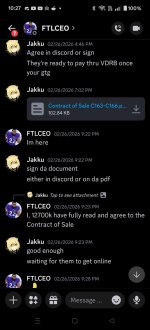
On 2/26/2026, the Plaintiff .Suixgen entered into a valid and fully executed Contract of Sale with 12700k for properties C163 and C166 in Reveille at a purchase price of $100,000. The Sale Contract was signed by all parties — the Opposing Party at 4:39 PM EST, the Plaintiff's agent at 4:39 PM EST, and Two Guys Realty's agent at 4:34 PM EST. The Plaintiff was ready, willing, and able to tender full payment at Closing. The Opposing Party's subsequent deportation from the Commonwealth rendered it unable to perform its obligation to transfer the properties, constituting a material breach of the Sale Contract pursuant to the Contracts Act § 7. The Plaintiff's contractual right to these specific properties is therefore vested and enforceable.

2. The Properties Face Imminent and Irreparable Harm by Government Action.

Pursuant to the Economic Standards Act § 5(2)(a), the Department of Construction and Transportation holds the authority to evict, vault, and auction properties belonging to deported players. As 12700k has been deported, properties C163 and C166 are presently subject to that authority and face imminent disposition. The DCT maintains a well-established practice of moving swiftly to vault and auction deported players' properties. Once C163 and C166 are transferred to a third-party buyer at public auction, the Plaintiff's remedy of specific performance is permanently and irreversibly extinguished — no court order can compel the transfer of property already conveyed to an innocent purchaser for value. Monetary damages are an inadequate substitute for the loss of unique, specific real property to which the Plaintiff holds a vested contractual right. This harm is both imminent and irreparable. This Court granted identical injunctive relief on identical grounds in Plura72 v. Department of Construction and Transportation [2025] DCR 80.

3. The Plaintiff Is Likely to Succeed on the Merits.

The underlying claim is straightforward. A valid Sale Contract was executed, all formalities were observed, and the Plaintiff performed or stood ready to perform all of its obligations. The Opposing Party failed entirely to transfer the properties at Closing. The Opposing Party's deportation does not constitute a force majeure event, as the Contracts Act § 13(4) expressly excludes events arising from a party's own negligence, mismanagement, or acceptance of unnecessary risk. The merits of this claim are strong, and this Court's threshold for likelihood of success is readily satisfied.

4. The Balance of Hardships Overwhelmingly Favors the Plaintiff.

A temporary freeze imposes no meaningful burden on the Commonwealth or the DCT. The properties will remain held by the government regardless of whether they are vaulted pending auction or vaulted pending this Court's resolution of the matter — the DCT's administrative burden is identical in either case. By contrast, denying this injunction permanently and irrevocably destroys the Plaintiff's contractual rights with no possibility of restoration. There is no competing hardship that can be weighed against the permanent extinguishment of a vested property right.

5. Relief Requested.

The Plaintiff respectfully requests that this Court:

(a) Immediately enjoin the Department of Construction and Transportation from auctioning, vaulting, pruning, transferring, or otherwise disposing of properties C163 and C166 for the duration of this litigation; and

(b) Should any such disposition occur after the filing of this motion, order it fully rescinded and the properties placed in escrow pending final resolution of the complaint.
 

Motion


IN THE DISTRICT COURT OF THE COMMONWEALTH OF REDMONT
MOTION FOR EMERGENCY INJUNCTION

Evidence and proof of representation shall be attached onto this post for the honorable Judge to review, and will also be presented with the complaint when it is filed.

Your Honor,

1. The Plaintiff Holds a Pre-Existing Contractual Right to the Subject Properties.

On 2/26/2026, the Plaintiff .Suixgen entered into a valid and fully executed Contract of Sale with 12700k for properties C163 and C166 in Reveille at a purchase price of $100,000. The Sale Contract was signed by all parties — the Opposing Party at 4:39 PM EST, the Plaintiff's agent at 4:39 PM EST, and Two Guys Realty's agent at 4:34 PM EST. The Plaintiff was ready, willing, and able to tender full payment at Closing. The Opposing Party's subsequent deportation from the Commonwealth rendered it unable to perform its obligation to transfer the properties, constituting a material breach of the Sale Contract pursuant to the Contracts Act § 7. The Plaintiff's contractual right to these specific properties is therefore vested and enforceable.

2. The Properties Face Imminent and Irreparable Harm by Government Action.

Pursuant to the Economic Standards Act § 5(2)(a), the Department of Construction and Transportation holds the authority to evict, vault, and auction properties belonging to deported players. As 12700k has been deported, properties C163 and C166 are presently subject to that authority and face imminent disposition. The DCT maintains a well-established practice of moving swiftly to vault and auction deported players' properties. Once C163 and C166 are transferred to a third-party buyer at public auction, the Plaintiff's remedy of specific performance is permanently and irreversibly extinguished — no court order can compel the transfer of property already conveyed to an innocent purchaser for value. Monetary damages are an inadequate substitute for the loss of unique, specific real property to which the Plaintiff holds a vested contractual right. This harm is both imminent and irreparable. This Court granted identical injunctive relief on identical grounds in Plura72 v. Department of Construction and Transportation [2025] DCR 80.

3. The Plaintiff Is Likely to Succeed on the Merits.

The underlying claim is straightforward. A valid Sale Contract was executed, all formalities were observed, and the Plaintiff performed or stood ready to perform all of its obligations. The Opposing Party failed entirely to transfer the properties at Closing. The Opposing Party's deportation does not constitute a force majeure event, as the Contracts Act § 13(4) expressly excludes events arising from a party's own negligence, mismanagement, or acceptance of unnecessary risk. The merits of this claim are strong, and this Court's threshold for likelihood of success is readily satisfied.

4. The Balance of Hardships Overwhelmingly Favors the Plaintiff.

A temporary freeze imposes no meaningful burden on the Commonwealth or the DCT. The properties will remain held by the government regardless of whether they are vaulted pending auction or vaulted pending this Court's resolution of the matter — the DCT's administrative burden is identical in either case. By contrast, denying this injunction permanently and irrevocably destroys the Plaintiff's contractual rights with no possibility of restoration. There is no competing hardship that can be weighed against the permanent extinguishment of a vested property right.

5. Relief Requested.

The Plaintiff respectfully requests that this Court:

(a) Immediately enjoin the Department of Construction and Transportation from auctioning, vaulting, pruning, transferring, or otherwise disposing of properties C163 and C166 for the duration of this litigation; and

(b) Should any such disposition occur after the filing of this motion, order it fully rescinded and the properties placed in escrow pending final resolution of the complaint.


Was payment actually made?
 
Files for the court to review to rule on the motion are attached here.

The actual transfer of property and payment did not yet occur between the signing of the Contract of Sale and the deportation of the Defendant. The Plaintiff was ready and willing to tender full payment at Closing — the failure to close resulted entirely from the Defendant's deportation, not from any default by the Plaintiff. Under the Contracts Act, concurrent obligations had not yet been triggered, meaning the Plaintiff remains in good standing under the Sale Contract. The Plaintiff proposes that arrangements be made through the Commonwealth as administrator of the Defendant's estate to complete the transfer, with full payment tendered directly to the estate at closing. Accordingly, the absence of completed payment reflects only that closing had not yet occurred — not any failure by the Plaintiff — and does not diminish the grounds for the requested injunction.
 

Attachments

  • P - 1.pdf
    P - 1.pdf
    107.7 KB · Views: 0
  • P - 2.jpg
    P - 2.jpg
    143.5 KB · Views: 0
  • Engagement_Letter_Suixgen_Signed.pdf
    Engagement_Letter_Suixgen_Signed.pdf
    265.4 KB · Views: 0

Case Filing


IN THE DISTRICT COURT OF THE COMMONWEALTH OF REDMONT
CIVIL ACTION

.Suixgen, represented by BeloittePlaintiff

v.

12700k, Defendant

COMPLAINT
The Plaintiff complains against the Defendant as follows:

I, .Suixgen, entered into a legally binding contract with 12700k for the purchase of properties C163 and C166 prior to 12700k's permanent deportation from the Commonwealth of Redmont. That contract was signed by 12700k before their deportation, and I have been ready and willing to complete the transaction. I now seek specific performance, damages, and all other available relief against the estate in order to enforce the contractual rights that vested prior to the Defendant's deportation.

I. PARTIES
  1. .Suixgen — Plaintiff; the buyer and intended recipient of properties C163 and C166 under a contract signed prior to 12700k's deportation.
  2. 12700k — Defendant; the seller who entered into a binding contract with the Plaintiff prior to their permanent deportation from the Commonwealth of Redmont.
II. FACTS
  1. 12700k retained Jakkuwu as a broker to identify a buyer for properties C163 and C166.
  2. Jakkuwu identified .Suixgen as a willing buyer and facilitated negotiations between the parties.
  3. 12700k signed a contract agreeing to sell properties C163 and C166 to .Suixgen. This contract was executed prior to 12700k's permanent deportation from the Commonwealth of Redmont.
  4. All elements required for a valid contract under the Contracts Act § 4 were satisfied at the time of signing: offer, acceptance, consideration, intent, and capacity.
  5. Before the transaction could be completed and the plots formally transferred, 12700k was permanently deported from the Commonwealth of Redmont.
  6. As a result of the deportation, 12700k has been unable — and has made no effort — to fulfill their contractual obligation to transfer properties C163 and C166 to the Plaintiff.
  7. The Plaintiff sought administrative recourse with the Department of Construction and Transportation to have the pre-existing contract honored. This recourse was denied.
  8. The Plaintiff stands ready and willing to complete the purchase on the agreed terms. No action or inaction on the part of the Plaintiff has contributed to the failure of performance.
III. CLAIMS FOR RELIEF
  1. Breach of Contract — 12700k entered into a binding contract with the Plaintiff under the Contracts Act § 4 and has failed to fulfill their obligation to transfer properties C163 and C166. The deportation of 12700k does not extinguish contractual obligations that vested prior to that deportation, as affirmed in StressedGV v. SalStar [2022] FCR 52, wherein the court upheld and enforced a pre-deportation contract notwithstanding the defendant's subsequent deportation. Furthermore, the Defendant's deportation does not constitute a force majeure event under Contracts Act § 13(4), which expressly excludes events arising from a party's own negligence, mismanagement, or acceptance of unnecessary risk. This constitutes a breach of contract under the Contracts Act § 7 and the Civil Code Part VI § 1.
  2. Breach of the Duty of Good Faith and Fair Dealing — Under Contracts Act § 12, every contract carries an implied covenant of good faith and fair dealing. The Plaintiff has performed all obligations expected of them and remains willing to complete the purchase. The Defendant has taken no steps whatsoever to ensure the Plaintiff receives the benefit of their bargain, in violation of that implied covenant.
IV. PRAYER FOR RELIEF
The Plaintiff respectfully seeks the following relief:
  1. Specific Performance — That this Court order the fulfillment of the contract between 12700k and .Suixgen, and direct the Department of Construction and Transportation, as the party currently in custody of properties C163 and C166, to transfer said properties to the Plaintiff at the agreed contract price of $100,000 in lieu of proceeding to public auction, pursuant to the Contracts Act § 14(5) and the Civil Code Part II § 5.
  2. Compensatory Damages — In the alternative, should specific performance not be available or not be ordered in full, the Plaintiff seeks compensatory damages equal to the full market value of properties C163 and C166, reflecting the loss of the bargain the Plaintiff was contractually entitled to, pursuant to the Civil Code Part III § 2.
  3. Consequential Damages — The Plaintiff further seeks consequential damages for the loss of enjoyment and economic opportunity resulting from the Defendant's breach, including but not limited to the Plaintiff's inability to make use of, develop, or derive benefit from the subject properties during the pendency of this matter, pursuant to the Civil Code Part III § 5.
  4. Legal Fees — Pursuant to the Civil Code Part III § 7, the Plaintiff seeks reimbursement of legal fees at the applicable statutory rate of 30% of the total case value, with a minimum of $3,000 as prescribed for matters heard by the District Court.
V. Exhibits attached previously
P - 1:
Contract of sale
P -2: Signing of contract of sale by the Defendant

By making this submission, I agree I understand the penalties of lying in court and the fact that I am subject to perjury should I knowingly make a false statement in court.

DATED: This 3rd day of March 2026


Motion


IN THE DISTRICT COURT OF THE COMMONWEALTH OF REDMONT
MOTION FOR DEFAULT JUDGEMENT

Your Honor,

It is well established across this Court's jurisprudence that permanently deported players retain no right to appear or defend themselves before this Court. One such example cited is Ligthiago v. FuriousPaladin [2023] FCR 79 in the verdict of FTL consulting v. Naezaratheus [2025] DCR 41.

The Defendant, 12700k, has been permanently deported from the Commonwealth of Redmont. As such, the Defendant is unable to enter a defence to the Plaintiff's complaint. No response has been filed, and none can be expected given the Defendant's status.

The facts of this matter are uncontested and straightforward. A valid contract was executed between the parties prior to the Defendant's deportation, satisfying all elements under the Contracts Act § 4. The Defendant has failed entirely to perform their obligation to transfer properties C163 and C166. The Plaintiff has at all times been ready and willing to tender full payment at closing, and no default on the Plaintiff's part has contributed to the failure of performance. This is materially identical to the circumstances in 12700k v. Aesyr_ [2025] DCR 87, wherein this Court enforced a pre-deportation contract and awarded full compensatory damages notwithstanding the defendant's deportation.

Accordingly, the Plaintiff respectfully requests that this Court enter default judgment in favour of the Plaintiff and grant the relief sought in the complaint, including specific performance directing the Department of Construction and Transportation to transfer properties C163 and C166 to the Plaintiff at the agreed contract price, or in the alternative, the maximum compensatory and consequential damages, together with legal fees pursuant to the Civil Code Part III § 7.

 
Back
Top