jsrkiwi
Citizen
Supporter
Oakridge Resident
Homeland Security Department
Justice Department
Health Department
jsrkiwi
Lieutenant
- Joined
- Aug 27, 2025
- Messages
- 466
- Thread Author
- #1
Appeal
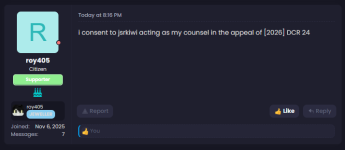
- Client & counsel name: @roy405, represented by @jsrkiwi
- Appealed case name & style: emmythegremlin v. roy405 [2026] DCR 24
- Were you originally the plaintiff or the defendant: Defendant
- Reason for appeal:
Summary of the case
Roy405 attacked and killed emmythegremlin while she was working on an in-game book. The court found that the text also existed in a Google Document and could be copied back into the book. The Court found that the murder caused the loss of five pages, representing approximately fifteen minutes of work.The Court found roy405 liable for damages resulting from murder and civil trespass, and valued the five lost pages at 23% of the $1,500 commission value of the completed book, awarding $345 in compensatory damages.
The Court further found that the murder warranted punitive damages, and awarded $15,000.
Ground 1. The punitive award relies substantially upon the murder despite the Court finding murder was not independently compensable.
1.1 The judgment recognised that murder itself does not establish an independent civil claim for damages.1.2 Nevertheless, the punitive-damages analysis focused entirely upon the murder, and the need to punish similar attacks.
1.3 The Court never established whether the loss of the book was intentional or foreseeable.Finally, Plaintiff requests punitive damages in the amount of $15,000. Punitive damages are a type of deterring punishment given when a party’s actions are so outrageous that they disturb the basic fabric of civilized society, and demand harsh action be taken. In assessing these damages, we look to “[T]he character of the defendant’s act, the nature and extent of the harm to the plaintiff that the defendant caused or intended to cause and the wealth of the defendant.” MegaMinerM v. Blazora Corporation [2025] FCR 27 (quoting Ligthiago v. FuriousPaladin [2023] SCR 20).
Defendant went into a private location, killed someone for no apparent reason, and caused her to lose not an insignificant amount of time. The record plainly shows that Defendant, just prior to the murder, was on a murder cooldown. He was unrepentant and at times mocking towards Plaintiff. When told a real genuine loss was at hand, instead of offering sympathy he merely retorted that Plaintiff couldn’t prove it, and then stated her loss meant nothing and he would lose “like 250” for his actions.
You do not have a right to attack others in Redmont. If your actions cause harm, you may certainly be found liable for that harm in court. The purpose of the law is to see justice done; and there is no justice when parties believe they can continuously cause harm without punishment. Defendant’s actions certainly demonstrate a "substantial departure from acceptable standards of behavior,” and are absolutely a depraved display of “oppressive, reckless, or grossly negligent disregard for the rights, interests, or safety of others.” Defendant “intended to cause harm or loss,” “acted knowing their conduct was likely [to harm another] person,” and “acted with reckless indifference as to whether harm or loss would occur.”
I find Defendant’s actions—before and after the incident—so outrageous and reprehensible that serious punitive damages are indeed warranted. Genuine harm was done, and I have little faith that even this lawsuit would do much to dissuade Defendant or others like him without harsher punishment. Therefore, as accorded to and empowered by law, I award the full requested punitive damages of $15,000. As Defendant has not demonstrated (nor even feigned) genuine remorse or taken steps to remedy the harm, no diminution of the award is authorized by the RCCA. RCCA Part III, § 3(3).
1.4 The Appellant submits that a $15,000 punitive award for an unforeseeable minor property loss is disproportionate. The award appears to have been awarded to punish the Defendant for the murder.
2. The punitive damages assessment failed to apply all mandatory factors.
2.1 The Court identified the punitive-damages test as including the character of the act, the nature and extent of the harm, and the Defendant's wealth.2.2 However, the judgment makes no finding concerning the Defendant's wealth before awarding the Plaintiff's entire requested $15,000.
2.3 Further, the Court's own findings limited the property harm to approximately fifteen minutes of lost work. Nevertheless, the court awarded $15,000 in punitive damages without explaining how that figure followed from the established harm.
3. The compensatory damages calculation is inconsistent with the Court's own findings.
3.1 The Court awarded $345 by treating five lost pages as 23% of a $1,500 writing commission.3.2 However, the Court acknowledged that the underlying content existed in a Google Document.
3.3 It held that the compensable harm was the time required to transcribe it back into Minecraft, which it found was approximately fifteen minutes of work.
3.4 If the text itself survived in a Google Document, 23% of the value of the completed literary commission was not destroyed. The damages should have reflected the value of the lost transcription work, not the value of the underlying writing.
4. The Court's factual findings are contradicted by evidence already within the trial record.
4.1 The Plaintiff's own evidence indicated that the material existed in a Google Document. P-006 records the Plaintiff stating immediately following the incident that she had a save on Google Docs, while P-007/P-013 records her stating that she could “just copy and paste from the doc”.4.2 This directly undermined the characterisation of the incident by the Plaintiff as permanently destroying five pages of original literary work.
4.3 Early in the case, the Court did acknowledge this discrepancy. However, in the verdict , the Court did not acknowledge the reduced credibility of the Plaintiff from this perjury.
4.4 This assertion by the Plaintiff was material to both liability and damages, yet the contradiction was never resolved by the Court.
Appeal prayer
The Appellant therefore requests that the compensatory and punitive awards be reversed or remanded for reassessment, with the legal-fee award recalculated accordingly.- Are you requesting oral argument: No
- Additional Information or evidence (see appellate rules): No new evidence is relied upon. The relevant evidence is already contained within the record of [2026] DCR 24, particularly P-005, P-006, P-007, P-013 and the District Court's verdict. Proof of representation is attached.