

- Joined
- May 24, 2026
- Messages
- 1,003
- Thread Author
- #1
Case Filing
IN THE DISTRICT COURT OF THE COMMONWEALTH OF REDMONT
CIVIL ACTION
CreeperTD
Plaintiff
v.
zPokebr_
Defendant
COMPLAINT
The Plaintiff complains against the Defendant as follows:
WRITTEN STATEMENT FROM THE PLAINTIFF
On October 7, 2026 at 11 AM CST, Defendant posted an Objection which accused Plaintiff of breaching Court Rule 1.4.1.1 and Rule 1.4.2 in Defendant's capacity as a self-represented Litigant in the case of zPokebr_ v. ZapperyDoo [2026] DCR 113. In their objection, the Defendant added an evidence exhibit labeled P-005, displaying a message that staff later identified could only be contained in a channel classified as SECRET or JUD-SECRET. The Plaintiff, in fact, posted the message in a channel classified as SECRET. After being given an opportunity to respond to this objection, Plaintiff was held in Contempt of Court by the Presiding Officer, and fined $6000.
I. PARTIES
1. CreeperTD (Plaintiff)
2. zPokebr_ (Defendant)
II. FACTS
1. Defendant zPokebr_ was a Junior Magistrate from August 29 until their promotion to full Magistrate on September 26, and a Magistrate from then until their resignation on October 23, 2026.
2. Plaintiff CreeperTD has been a Judge in the Commonwealth of Redmont since his confirmation on September 23, 2026.
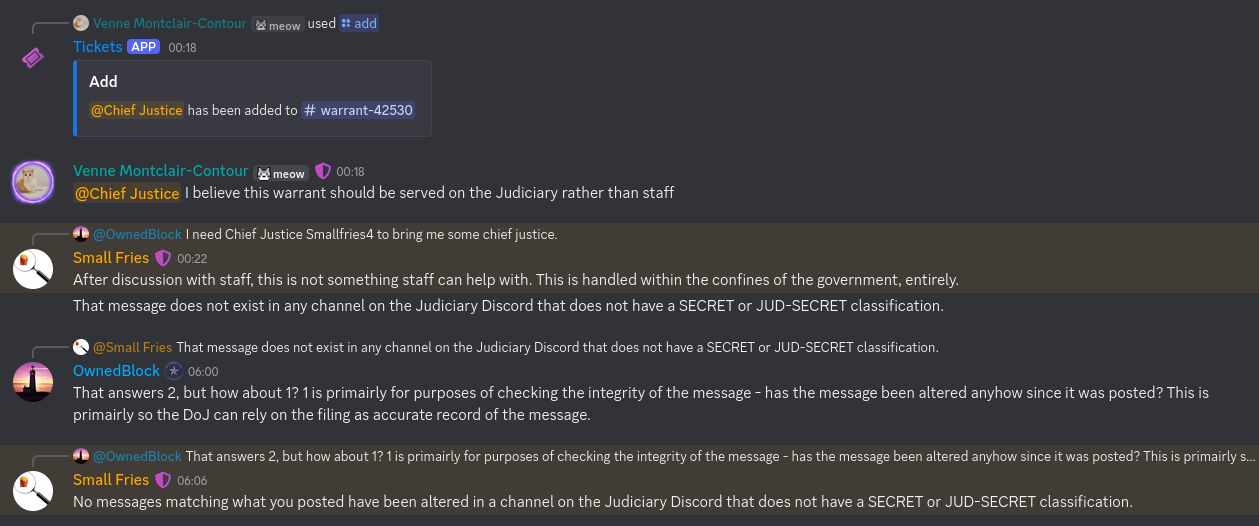
3. In their position as Junior Magistrate and then Magistrate, Defendant had access to channels in the Judiciary server not otherwise accessible to them, many of which are designated as SECRET or JUD-SECRET. (P-001)
4. On October 7, 2026 at 11 AM CST, Defendant posted an Objection which accused Plaintiff of breaching Court Rule 1.4.1.1 and Rule 1.4.2 in Defendant's capacity as a self-represented Litigant in the case of zPokebr_ v. ZapperyDoo [2026] DCR 113.
5. At the time of the Objection, Plaintiff was not a party or counsel to the case, and as such relied on permission from the Court to respond to the Objection, and was not able to make any objections to Defendant’s filings.
6. In their objection, the Defendant added an evidence exhibit labeled P-005, displaying a message that staff later identified could only be contained in a channel classified as SECRET or JUD-SECRET. The Plaintiff, in fact, posted the message in a channel classified as SECRET. (P-001, see Section II of Appeal: Pending - Contempt of Court Appeal | In re [2026] DCR 113)
7. The Defendant falsely claimed in an objection used as a response to Plaintiff’s response that “JO Chat is public under Classified Material Act, as no classification have been attributed to the chat room,” when, in fact, the channel had been classified as SECRET upon its creation.
8. The Plaintiff was held in Contempt by order of Magistrate AsexualDinosaur as a result of Defendant’s objection, and for the Plaintiff’s response to that objection on October 8, 2026. (Lawsuit: Pending - zPokebr_ v. ZapperyDoo [2026] DCR 113)
9. By the Plaintiff being held in Contempt, the Defendant stood to discredit the Plaintiff, who had formerly been the assigned Public Defender in the civil suit, in the eyes of the Court, arguably gaining personal advantage from the outcome. (Lawsuit: Pending - zPokebr_ v. ZapperyDoo [2026] DCR 113)
10. As a result of Defendant’s actions, the Plaintiff was fined a total of 50 Penalty Units, equivalent to 6,000 DC$ by the Presiding Officer (Lawsuit: Pending - zPokebr_ v. ZapperyDoo [2026] DCR 113)
11. On November 3, 2026, the Commonwealth filed criminal charges against Defendant for Breach of Integrity for the evidence presented in the previously mentioned objection. (The Commonwealth of Redmont v. zPokeBr_)
12. At time of filing, the Plaintiff has the Contempt of Court charges on his criminal record, and has not been refunded the fines.
13. The Plaintiff currently has a pending appeal of the Contempt of Court charges, costing him $6000 to pay his attorney. (Appeal: Pending - Contempt of Court Appeal | In re [2026] DCR 113)
III. CLAIMS FOR RELIEF
1. Misfeasance in Public Office (RCCA Part XI § 3)
The Redmont Civil Code Act gives a straightforward definition of Misfeasance in Public Office:
In this case, the Defendant used their ability to see internal judicial channels, which is a “power” given by holding the public office of Magistrate, to bring an accusation of criminal conduct against one of their judicial colleagues. In doing so, the Defendant abused the privileges given to them as a Judicial Officer for personal gain, that being to have an individual who had formally served as opposing counsel held in Contempt of Court. The Defendant had no other way to access the channel other than with their powers as a public official, and using this ability to share information from a classified channel is not in line with their duties, and breaches the Classified Materials Act. Although § 8(8) of that act provides for Whistleblower protections for the release of such materials, Defendant’s actions are not protected under the subsection, as they did not act “in good faith and not for personal or political gain,” as explained above. Therefore, the requirement under subsection (a) has been fulfilled.3. Misfeasance in Public Office
Violation Type: Intentional
Remedy: No Fixed Remedy
A person commits a violation if the person:
(a) being a public official, intentionally misuses their power; and
(b) the misuse causes harm to the plaintiff; and
(c) the official knew or ought to have known that the conduct was unlawful.
The Plaintiff further notes that while it believes that the filing of Criminal charges against the Defendant can serve as evidence of their unlawful conduct, it does not contend that it is compelling evidence, only supporting evidence. Should the Defendant be found guilty of Breach of Integrity by the Federal Court, however, the Plaintiff will henceforth refer to it as evidence of the Defendant’s criminal wrongdoing which led to a Civil Violation in accordance with RCCA Part II § 6(1)(b).
The use of this evidence in Court led to the Plaintiff being held in Contempt of Court, a criminal offense, and being fined $6000. This caused both a financial loss of that $6000, while also damaging the Plaintiff’s reputation as a trustworthy Judicial Officer and exposing him to public ridicule, despite no substantial misconduct having taken place. This harm fulfills requirement (b).
The Judiciary server is known to be highly restricted and secretive; even if the Defendant somehow did not know that the channel containing the communication was classified as SECRET, it stands to reason that they should have taken the time to check, as a majority of the Judiciary discord server is considered classified to some degree, with very few individuals being invited to the server, let alone being given access to it. As a Judicial Officer, it is reasonable to expect the Defendant to have an extensive knowledge of Redmont’s laws, and that they would take particular care to not breach them. The Defendant “ought to have known” that their conduct was unlawful, thereby fulfilling requirement (c).
2. Punitive Damages (RCCA Part III § 3)
The Plaintiff holds that Defendant’s conduct should be considered outrageous by the Court. RCCA Part III § 3(2)(b) provides a list of what constitutes outrageous conduct:
The Plaintiff believes that (i), (ii), (iv), and (vi) likely apply to the Defendant’s conduct.(b) Outrageous conduct means conduct that demonstrates a substantial departure from acceptable standards of behaviour and reflects a wilful, dishonest, oppressive, reckless, or grossly negligent disregard for the rights, interests, or safety of others. Without limiting the generality of the foregoing, conduct is outrageous where any of the following are met:
(i) The defendant intended to cause harm or loss;
(ii) The defendant acted knowing that their conduct was likely to disadvantage, harm, or seriously inconvenience another person;
(iii) The defendant acted with reckless indifference as to whether harm or loss would occur;
(iv) The conduct involved dishonesty, deception, bad faith, or abuse of trust or power;
(v) The defendant engaged in persistent or repeated misconduct, or failed to change their conduct after becoming aware of its consequences; or
(vi) The conduct demonstrates gross negligence, being such a significant departure from the standard of care that it warrants punishment rather than compensation alone.
By making the objection, the Defendant clearly intended to cause harm or loss to the Plaintiff; a Contempt of Court charge creates a criminal record for an individual and results in a fine and/or jail time, all of which constitute a harm or loss. Such a charge in the Court case towards the previous opposing counsel also serves to potentially disadvantage their opponent’s legal defenses, including discrediting their legal arguments. This was certainly known to the Defendant, and their conduct demonstrates clear intent to do the Plaintiff and the absent Defendant in [2026] DCR 113 harm. This fulfills requirements (i) and (ii).
The Defendant abused both the trust and power placed in them in their position as a Magistrate in leaking a message from a classified channel. They had no lawful justification for doing so inside a public courtroom, and they certainly breached the Classified Materials Act in doing so. This fulfills requirement (iv).
Even if the Defendant somehow did not know that the channel in which the message was sent was classified, their failure to ensure that they were not leaking classified information constitutes gross negligence. It is to be expected of a Judicial Officer that they be knowledgeable of the law, and it is certainly expected that a JO should do their utmost to avoid criminal conduct. The standard of care expected for a JO with regards to integrity and leaking are high, as they are expected to interpret the law and deliver unbiased verdicts without outside influence, and also to often handle information that would be harmful if leaked. While a Magistrate, the Defendant abused the public’s trust, if not intentionally, then through their gross negligence. This fulfills requirement (vi).
3. Consequential Damages; Humiliation (RCCA Part III § 5(1)(a)(i))
As it should be well known, the Plaintiff is a Federal Judge in the Commonwealth. Judges are generally expected to be a shining example of legal prowess and integrity, and it is this integrity that allows Redmont’s legal system to operate properly. The Judiciary of Redmont must be integral for it to be respected. That is why the Plaintiff being held in contempt by a Magistrate is so striking. The RCCA defines Humiliation as “Situations in which a person has been disgraced, belittled or made to look foolish”(Part III § 5(1)(a)(i)). A reasonable person holding a Judicial office would feel disgraced by being held in contempt, and in this case, being held in contempt was entirely caused by the Defendant’s unlawful conduct. This has happened before when the Plaintiff was held in contempt in the District Court (see this article by the Fox Gazette). Due to the news channel being broken at the time of the Contempt Charge (the utilities bot had ceased to be operational), no explicit news stories such as this one were made publicly available, and yet it is still certain that the Plaintiff was humiliated by the Contempt of Court charge, which had previously been used to criticize and belittle the Plaintiff. The Plaintiff intends to submit evidence relating to this specific incident during the course of discovery.
IV. PRAYER FOR RELIEF
The Plaintiff seeks the following relief from the Defendant:
1. $12,000 in Compensatory damages; $6,000 for the fines incurred as a result of the Contempt of Court charges, and $6,000 for the legal costs of the appeal of those charges. (RCCA Part III § 2)
2. $20,000 in Punitive Damages. (RCCA Part III § 3)
3. $20,000 in Consequential Damages for Humiliation. (RCCA Part III § 5(1)(a)(i)
4. Legal fees amounting to 30% of the total damages awarded.
Total claims: $52,000 + $15,600 Legal Fees = $68,600
V. EVIDENCE
P-001: Evidence submitted by the Commonwealth of a return on warrant in The Commonwealth of Redmont v. zPokeBr_
By making this submission, I agree I understand the penalties of lying in court and the fact that I am subject to perjury should I knowingly make a false statement in court.
DATED: This 4th day of November 2026.
