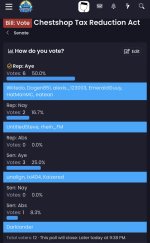
Vetoed Chestshop Tax Reduction Act

How do you vote?


  • Total voters
    12
  • Poll closed .

eatean

Citizen
Representative
Oakridge Resident
eatean
eatean
Representative
Joined
Jul 17, 2026
Messages
40

CONGRESS OF THE
COMMONWEALTH OF REDMONT

​


A BILL TO

SLIGHTLY REDUCE THE CHESTSHOP TAX


​


The people of the Commonwealth of Redmont, through their elected Representatives in the Congress and the force of law ordained to that Congress by the people through the constitution, do hereby enact the following provisions into law:


​
PART I — PRELIMINARIES

1. Short Title and Enactment


(1) This Act may be cited as the ‘Chestshop Tax Reduction Act’

(2) This Act shall be enacted immediately upon its signage.

(3) This Act has been authored by Representative eatean.

(4) This Act has been co-sponsored by Representative Wiitedo.

(5) This Act amends the following acts:

(a) Taxation Act


2. Reasons and Intent

(1) The FRB has determined the deficit is not inherently detrimental, and can be beneficial to the overall health to the economy.

(2) Regardless, having a deficit is not inherently good.

(3) As such, in an attempt to strike a compromise, this bill lowers the Chestshop tax to 1.5%.

PART II — AMENDMENTS

3. Amendments to the
Taxation Act

(1) Part 4, Section 13 of the Taxation Act shall be amended as follows:

(1) A chestshop sales tax of 2.5% 1.5% is imposed on every chestshop transaction.​
​
(2) The tax is calculated on the sale price of the transaction and is withheld from the proceeds paid to the shop owner.​
​
(3) The rate may be changed only by an Act of Congress.​
​
(4) All chestshop sales tax revenue is directed to the DCGovernment account.​
 
Votes before my ascension to Senate and subsequent voting on this bill. I will be going from:
:aye: - House
to
:aye: - Senate
 

Attachments

  • IMG_3848.jpeg
    IMG_3848.jpeg
    210.6 KB · Views: 24
​

Veto


Seal_President_Small.png

​


The Chestshop Tax Reduction Act amends Part IV, Section 13 of the Taxation Act to lower the chestshop sales tax from 2.5% to 1.5%. The tax would still be worked out on the sale price, taken from what the shop owner receives, and paid into the DCGovernment account.

I want to be clear that I support keeping taxes on ordinary trade low, and I am not against looking at the chestshop rate again. Chestshops are where most everyday buying and selling happens, and nobody wants a tax that puts people off opening a shop. But this bill gives no reason why 2.5% is too high. It does not say that shops are closing, that prices have gone up, or that trade has slowed. Its only argument is that the FRB has found the deficit is not harmful, and in the next line it admits that a deficit is not a good thing. A tax cut cannot be a compromise on the deficit when it only makes the deficit bigger.

My main concern is who this cut helps. The chestshop tax is taken from the seller, and on our server the sellers are mostly business accounts. Over the last 30 days chestshops moved about $3 million out of personal accounts and about $2.4 million into business accounts. Business accounts hold around $102.6 million, an average of about $19,600 each, while personal accounts hold around $54.6 million, an average of under $400. Wealth in Redmont is already very unequal: the Gini coefficient is about 0.87, the top 10% hold about 86% of all money, and the top 1% hold about 59%. A cut aimed at sellers puts most of the benefit in the hands of those who already hold the most, while the government gives up about $105,000 a month of the steady tax income that Executive Order 55/26 asks us to protect. The government's accounts are already millions in the red, and more than 70% of our revenue comes from fines, which cannot be relied on. The chestshop tax is one of the few taxes that brings in money every day.

The bill also has drafting problems. The FRB finding it relies on is not linked or quoted anywhere, and I have not been able to find it, so Congress has voted on a claim it could not check. Section 2 argues against itself, saying a deficit is not a problem and then that it is. The bill also gives no estimate of what the cut will cost, which any tax change should include.

Overall, I believe this bill tackles a real problem, but in its current form it gives most of its benefit to the wealthiest accounts, takes away steady revenue while the government is deep in debt, and rests on a finding nobody can see. If the authors can show that the current rate is hurting trade, link the FRB's view, and set out the cost, or pair the cut with help for smaller shops or buyers, I would look at it again. I warmly welcome Congress to bring it forward.

Thank you to Representative eatean for authoring this bill, to Representative Wiitedo for cosponsoring it, and to Congress for its work on it.

 
Back
Top