Lawsuit: Adjourned Escudos v. landshaking [2026] DCR 135

Status
Not open for further replies.

Envony4076

Citizen
Oakridge Resident
Envony4076
Envony4076
Barrister
Joined
Jun 29, 2026
Messages
5

Case Filing

IN THE DISTRICT COURT OF THE COMMONWEALTH OF REDMONT
CIVIL ACTION


Escudos (Plaintiff)
v.
landshaking (Defendant)

COMPLAINT
The Plaintiff complains against the Defendant as follows:
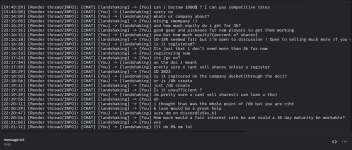
On July 8, 2026, the Defendant and the Plaintiff negotiated a $3,000 loan and finalized the agreement via Discord direct messages. The Plaintiff agreed to provide the $3,000 at a 0% interest rate, with the Defendant explicitly agreeing to repay the full amount in less than a month. The Plaintiff fulfilled this agreement by transferring $3,000 to the Defendant's account at 22:25(adjusted per GMT+3 timezone) that same day. However, the following day on July 9th, the Defendant sent a direct message confessing that they had spent all the loaned funds on random shops and donations. The Defendant maliciously voided the agreement, explicitly refused to repay the money, and taunted the Plaintiff by stating "Have fun filing a lawsuit to recover nothing, bye!". Due to this intentional breach of contract and clear bad faith, the Plaintiff has suffered a direct, unrecovered financial loss of $3,000.

WRITTEN STATEMENT FROM THE PLAINTIFF

On 8th of july, I was contacted by pandlord regarding a loan. We agreed via Discord that I would loan them 3,000, to be paid back in full within a month at 0% interest.I transferred the 3,000 to their account.However, on July 9th, pandlord messaged me stating that they had spent all the money, had an empty balance, and explicitly refused to pay me back, telling me to "have fun filing a lawsuit to recover nothing."

I. PARTIES
1. Escudos
2. landshaking
II. FACTS
1. On the 8th of july at 19:43 GMT+3 Escudos and landshaking(pandlord) started taliking about a 3k loan for a mining company(P-005)
2. On the same night at 22:25 GMT+3 Escudos sent the 3k after finalizing the deal via discord(P-001 to P-004 and P-006)
3. The day after the defendant stated that he acted in bad faith and personally said to "sue me"(P-004)

III. CLAIMS FOR RELIEF
1. Breach of contract as landshaking personally admitted to refusing to return the funds he spent not on the mining company
2. Bad faith as my client was open to giving a loan to a growing company but in reality it was a fictitious company
3. My client suffered a loss of enjoyment and had great emotional distress
IV. PRAYER FOR RELIEF
The Plaintiff seeks the following from the Defendant:
1. 3k in compensatory damages
2. 5k in punitive damages
By making this submission, I agree I understand the penalties of lying in court and the fact that I am subject to perjury should I knowingly make a false statement in court.
DATED: This 13th day of july 2026


 

Attachments

  • P-001.png
    P-001.png
    291.1 KB · Views: 51
  • P-002.png
    P-002.png
    273.4 KB · Views: 48
  • P-003.png
    P-003.png
    276.1 KB · Views: 44
  • P-004.png
    P-004.png
    282.1 KB · Views: 50
  • P-005.png
    P-005.png
    219.1 KB · Views: 47
  • P-006.png
    P-006.png
    304.5 KB · Views: 50
  • Proof_of_rep.png
    Proof_of_rep.png
    18.3 KB · Views: 54
Last edited:
this has been filed almost a month ago and we have gotten no response by a judge, this outrageous conduct is dening my client of his right to a speedy trial
 
Last edited:

Writ of Summons

@landshaking is required to appear before the District Court in the case of Escudos v. landshaking [2026] DCR 132.

Failure to appear within 72 hours of this summons will result in a default judgement based on the known facts of the case.

Both parties should make themselves aware of the Court Rules and Procedures, including the option of an in-game trial should both parties request one.

 
Last edited:
as by court procedure, the 72h from the writ has passed, that mean that we petion the court for a default judgment
 

Court Order


IN THE DISTRICT COURT OF THE COMMONWEALTH OF REDMONT
COURT ORDER - INQUEST PROCEEDING

Pursuant to Rule 3.6.1 of the Court Rules and Procedures, as the defendant has failed to respond to the summons within 72 hours, the case shall proceed into an inquest proceeding under Rule 3.6.2.

Discovery shall be open for 5 days from now on. The Plaintiff may apply by motion for the issuance of subpoenas, writs, or summonses as the Court deems judicially prudent. After the closure of discovery, the Plaintiff shall submit a written brief containing a factual narrative of the controversy and all relevant legal arguments.

So ordered.

Signed,
Magistrate Talion Montclair-Contour

 
Last edited:
I'm making an early submission of the brief because from tomorrow i won't be able to use my PC. Everything talked about in the brief is proofed by the evidence submitted at the filing of the lawsuit
 

Attachments

can we have an ETA of the verdict?
 
Last edited by a moderator:

Verdict


IN THE DISTRICT COURT OF THE COMMONWEALTH OF REDMONT
Verdict

On review of submissions by Plaintiff on Inquest, the Court makes the following determinations of fact and law.

I. BREACH OF CONTRACT​

The civil violation of Breach of Contract is, in the Redmont Civil Code Act, defined as:

"A person commits a violation if the person:
(a) fails to perform obligations under a valid and enforceable contract without lawful excuse."

The clause consists of three elements which need to be proven for Breach of Contract to occur: (1) a valid and enforceable contract is present, (2) the person failed to perform obligations under such contract, and (3) the person did not have a lawful excuse, as defined by subsections (b) through (e) of the same section.

I.I WAS A VALID CONTRACT PRESENT​

To answer this question, we have to take a look at the definition of a contract. Contracts Act §4(1) defines a contract as "a legally binding agreement between two or more parties that creates an obligation to do or not do a particular thing".

In accordance with Id. §4(2), a valid contract is formed when all of the following elements are met:

(a) Offer. An offer is a clear and unequivocal communication expressing a party's willingness to enter into a contract, either explicitly stated or reasonably inferred from the circumstances.
(b) Acceptance. Acceptance is the positive and unambiguous response to an offer communicated to the offeror, mirroring the terms of the offer and conveyed through various means.
(c) Consideration. Consideration, an essential element, involves the exchange of something of value between parties, with sufficiency though not necessarily adequacy. Consideration can be tangible or intanglbie.
(d) Intent. Parties must demonstrate a clear intention to create legal obligations for the contract to be valid.
(e) Capacity. Parties entering into a contract must possess the legal capacity to do so. Players with low playtime may lack the capacity to fairly enter a contract.

I.I.I OFFER​

There is not much to dispute, Plaintiff explicitly made an offer in stating "Do you agree that once i pay you you must pay the 3k back in less than a month?".

I.I.II ACCEPTANCE​

Again, a pretty clear-cut requirement, Defendant explicitly stated "Yes!" in response to the Plaintiff's offer. The response could not get more unambiguous.

I.I.III CONSIDERATION​

For the element of consideration to be met, "the exchange of something of value between parties" has to be facilitated. Plaintiff provided the principal sum of money to the defendant, while the latter provided the binding promise to repay the principal at expiry. Something of value has been exchanged, consideration is met.

I.I.IV INTENT​

For the element of intent to be proven, parties must demonstrate a clear intention to create legal obligations. The Court believes such intent is present here: No sane individual would give out $3,000 in the context of such negotiations without intenting to create legal obligations.

I.I.IV CAPACITY​

Both parties to the contract possess at least 6 hours of total playtime. As such, capacity is met.

With that, we have come to the determination that a valid contract is present.

I.II DID DEFENDANT FAIL TO PERFORM OBLIGATIONS UNDER SUCH CONTRACT​

To answer this question, we have to look at the terms. The terms of the agreement were fairly simple: "once i pay you you must pay the 3k back in less than a month". The Court is convinced of the fact that Defendant did not pay the agreed upon sum back within the prescribed timeframe, as such, a material breach has occurred, and the Defendant failed to perform his obligations under the contract.

I.III DID DEFENDANT HAVE A LAWFUL EXCUSE​

RCCA Part VI §1(b) through (e) define "lawful excuses" in relation to breaches of contract:

(b) the contract is void or voidable; or
(c) performance was rendered impossible by circumstances beyond the party’s control; or
(d) the other party materially breached the contract first; or
(e) the party was induced to enter the contract through misrepresentation or duress.

I.III.I VOID CONTRACT UNDER (b)​

The Court cannot find any appropriate reason for why the Contract should be void, nor has Defendant provided one. The fact that the Contract is valid was already proven earlier, so there is no lawful excuse under this subsection.

I.III.II FORCE MAJEURE UNDER (c)​

The performance of obligations being rendered impossible by circumstances beyond the party's control, also known as "Force Majeure", is a valid defence against a breach of contract violation. However, the apparent reason for the impossibility of the performance of obligations in this case, as inferred by the Defendant's statements in P-004, was that the Defendant spent the money on "random shops and donations". Such circumstances are most definitly not out of the Defendants control, as such, there is no defence under this subsection either.

I.III.III PRIOR BREACH UNDER (d)​

Plaintiff fulfilled his obligations under the contract, as proven by P-006. Again, no excuse under this subsection.

I.III.IV MISREPRESENTATION OR DURESS UNDER (e)​

The Court cannot find any material misrepresentation of fact that occured from the side of the Plaintiff. Further, the Court believes that Defendant did not enter the contract under duress, in fact, Plaintiff in good faith offered more favourable terms to the Defendant by himself. The Court cannot find any reason for a valid lawful excuse to be present here.

With this determination, the Court determines that the civil violation of Breach of Contract has occured. The Court awards $3,000 in compensatory damages, as in line with RCCA Part III §2(1)(a): "Compensatory damages are the restoration of what the party has lost."

II. BAD FAITH AND OUTRAGEOUS CONDUCT​

The Court wholly rejects the claim of "bad faith". Bad faith is a requirement for some violations, not a violation by itself. There are no damages the Court can award simply for acting in bad faith.

However, pursuant to RCCA Part III §3(2)(a): "Punitive damages will not be awarded unless they are either authorised by statute or unless the conduct of the other party in causing the party’s harm is outrageous."

Essential is not the determination whether a party acted in bad faith, but the determination whether the party engaged in outrageous conduct. Pursuant to Id. §3(2)(b), outrageous conduct is defined as:

(b) Outrageous conduct means conduct that demonstrates a substantial departure from acceptable standards of behaviour and reflects a wilful, dishonest, oppressive, reckless, or grossly negligent disregard for the rights, interests, or safety of others. Without limiting the generality of the foregoing, conduct is outrageous where any of the following are met:
(i) The defendant intended to cause harm or loss;
(ii) The defendant acted knowing that their conduct was likely to disadvantage, harm, or seriously inconvenience another person;
(iii) The defendant acted with reckless indifference as to whether harm or loss would occur;
(iv) The conduct involved dishonesty, deception, bad faith, or abuse of trust or power;
(v) The defendant engaged in persistent or repeated misconduct, or failed to change their conduct after becoming aware of its consequences; or
(vi) The conduct demonstrates gross negligence, being such a significant departure from the standard of care that it warrants punishment rather than compensation alone.

Before making a general determination whether the conduct was outrageous in line with (b), the Court will assess each statutory definition of outrageous conduct.

II.I INTENT TO CAUSE HARM OR LOSS UNDER (i)​

The Court believes that the Defendant clearly intended to cause financial loss to the Plaintiff. By wilfully giving away the principal of the loan, and informing the Plaintiff of such conduct in a taunting manner, Defendant proved he clearly intended to cause such loss, and was fully aware of the consequences for the Plaintiff.

II.II KNOWLEDGE ABOUT HARMFUL CONDUCT UNDER (ii)​

By proving subsection (i), subsection (ii) is automatically proven as well. A person can only intend to cause harm if they knew that their conduct was likely to harm someone.

II.III RECKLESS INDIFFERENCE FOR HARM OR LOSS UNDER (iii)​

By proving subsection (i), subsection (iii) is automatically disproven. A person cannot act with reckless indifference if they acted with intent.

II.IV CONDUCT IN BAD FAITH UNDER (iv)​

The Court believes that Defendant's conduct involved bad faith. Plaintiff, as any reasonable person would have been, was under the impression that the principal would be repaid, as required by the contract. Defendant, by wilfully ridding themselves of the funds with the intent to cause financial loss to the Plaintiff, clearly acted in bad faith.

II.V REPEATED MISCONDUCT UNDER (v)​

Defendant did not engage in repeated or persistent misconduct. To the knowledge of the Court, Defendant only committed one instance of misconduct. The second clause of this subsection, failing to change conduct after becoming aware of its consequences, does not apply either: as Defendant acted with intent, they were aware of the consequences from the beginning.

II.VI GROSS NEGLIGENCE UNDER (vi)​

The Court believes that the Defendant, by intentionally causing harm, acted without any care for the situation. In the Court's opinion, such a severe departure from the standard of care warrants punishment.

With these determinations, the Court has determined that the Defendant acted in an outrageous manner. The Court awards $5,000 in punitive damages.

III. EMOTIONAL DISTRESS​

The Court rejects the claim of emotional distress, as no evidence or other statements have been alleged to support it.

IV. VERDICT​


The Court rules in favour of the Plaintiff and orders the following damages, payable to the Plaintiff:

1. $3,000 in compensatory damages
2. $5,000 in punitive damages
3. $3,000 in legal fees, representing the minimum value for DCR proceedings determined by RCCA Part III §7(2)(d)

for a total of $11,000.

So ordered.

Signed,
Magistrate Talion Montclair-Contour

 
Last edited:
Status
Not open for further replies.
Back
Top